

Artificial Intelligence has become one of the most valuable tools behind my DM screen.

Whenever I mention that, people tend to assume one of two things. Either they think AI is somehow running my games for me, or they think it’s a gimmick that produces generic fantasy content.
In reality, it’s neither.
AI doesn’t replace my creativity. It amplifies it.
It doesn’t run my campaigns. It helps me spend less time on administrative work and more time creating memorable experiences for my players.
As both a professional in the cybersecurity industry and a lifelong Dungeons & Dragons enthusiast, I’ve spent a lot of time experimenting with AI tools. Some have been useful. Some have been disappointing. But over the past year, I’ve developed a workflow that has become a permanent part of how I prepare and run games.
These are the five areas where AI has had the biggest impact on my Dungeon Mastering.
1. Session Recaps and Campaign Memory
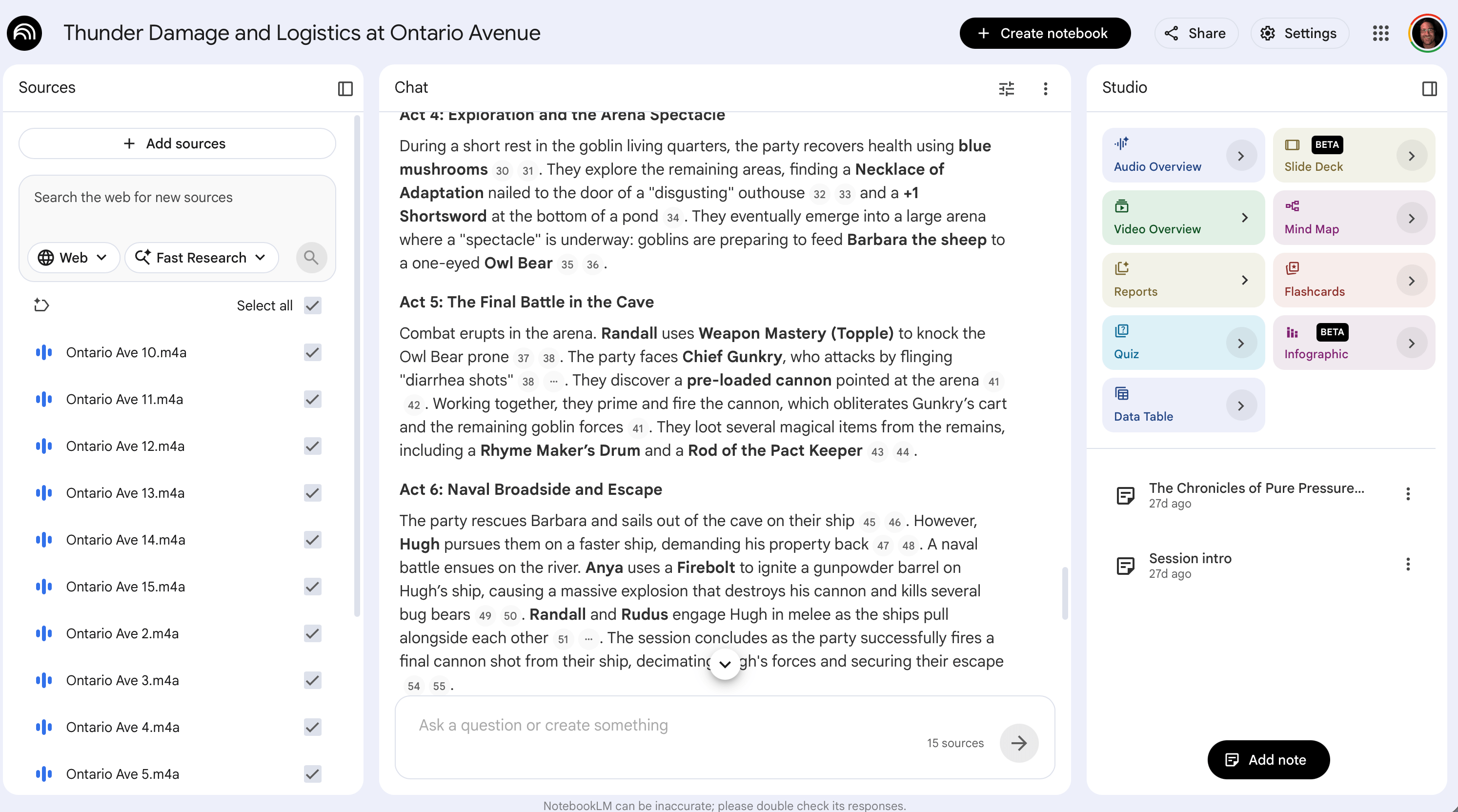
If you’ve ever run a long campaign, you know that one of the biggest challenges isn’t creating content—it’s remembering everything that has already happened.
Players forget details.
Dungeon Masters forget details.
That mysterious NPC from six months ago suddenly becomes important again, and everyone is frantically searching through old notes trying to remember who they were.
This is where AI has become an absolute game changer.
For my games, I record sessions and upload the recordings to NotebookLM. It automatically transcribes the audio and produces surprisingly accurate summaries of what happened during the session.
What impresses me most isn’t the transcription. It’s the understanding.
Anyone who has played D&D knows that a four-hour session isn’t four hours of story. There are side conversations, jokes, pizza discussions, technical issues, and random tangents.
NotebookLM does an excellent job separating the signal from the noise.
It identifies the important story beats, character decisions, combat outcomes, discoveries, clues, and roleplaying moments while largely ignoring the table chatter that isn’t relevant to the campaign.
The result is a clean summary that I can reference later.
I’ve also experimented with Claude and ChatGPT for campaign summaries, and both work very well once I have a transcript. However, NotebookLM is currently the only tool in my workflow that allows me to start with the raw session recording itself.
The practical result is simple:
My campaign notes are dramatically better than they used to be.
I can quickly review previous sessions, refresh my memory before game night, and maintain continuity across long-running campaigns without spending hours writing notes after every session.
2. Campaign Planning, NPC Development, and Encounter Design

This is probably where AI saves me the most preparation time.
One of the biggest misconceptions about AI is that it generates creativity.
I don’t think that’s true.
What it does exceptionally well is stimulate creativity.
Every Dungeon Master has experienced creative roadblocks.
You know where the story is going, but you’re not sure how to connect the dots.
You have a villain, but their motivation feels weak.
You have a dungeon, but the encounters feel repetitive.
AI is an outstanding brainstorming partner.
I regularly use it to explore:
- Villain motivations
- Political intrigue
- Faction relationships
- Campaign twists
- Adventure hooks
- Character backgrounds
- Quest complications
- Alternative story paths
The same applies to NPCs.
When players inevitably become fascinated by the one random merchant or tavern owner you never expected them to care about, AI can help generate personality traits, goals, fears, secrets, and relationships within minutes.
Encounter design benefits as well.
Rather than simply asking, “How many monsters should be in this room?” I can explore questions like:
- What tactics would these creatures realistically use?
- How would an intelligent villain prepare for this battle?
- What environmental hazards would make this encounter more memorable?
- What objectives exist besides defeating every enemy?
The final decisions are always mine.
But AI helps me explore possibilities much faster than I could on my own.
3. Handouts, Letters, and Props

One of the easiest ways to increase immersion in a campaign is to give players something tangible.
A letter.
A journal.
A proclamation.
A wanted poster.
A cryptic note discovered in an abandoned ruin.
The problem is that creating convincing props takes time.
AI dramatically accelerates this process.
Need a centuries-old journal entry from a doomed explorer?
A noble’s formal letter to a rival family?
A cultist’s encoded message?
A desperate plea for help written during a siege?
AI can produce a strong first draft in seconds.
I still edit the final result to ensure it fits my campaign, but starting from a solid draft is much faster than staring at a blank page.
For horror campaigns like Curse of Strahd or other Ravenloft adventures, this has been especially useful.
Handouts make the world feel real.
Players engage differently when they’re holding a physical document instead of simply listening to a description.
AI allows me to create more of those immersive moments with significantly less preparation time.
4. Generating Artwork

I love visual aids.
The challenge is that I am a writer, not an artist.
Historically, Dungeon Masters had limited options for custom artwork.
You could draw it yourself.
Commission an artist.
Search endlessly online hoping someone had already created something similar.
Or simply go without.
AI-generated art has changed that.
Today I can create custom artwork for:
- NPC portraits
- Villains
- Magic items
- Cities
- Taverns
- Dungeons
- Campaign scenes
- Adventure handouts
The most valuable aspect isn’t necessarily the quality of the art.
It’s the specificity.
When I create a completely original NPC, there usually isn’t existing artwork available that perfectly matches my vision.
AI allows me to create visuals tailored specifically to my campaign.
That means players are seeing my villain, not a random image pulled from a Google search.
The same applies to locations, artifacts, and story moments.
The world becomes more visually cohesive and immersive because the artwork is built specifically for that campaign.
5. Answering Questions During the Game

This might be the most underrated use of AI.
Players ask questions.
A lot of questions.
Some are rules questions.
Some are lore questions.
Some are questions about events that happened twenty sessions ago.
Others are questions that come completely out of nowhere.
No Dungeon Master can remember everything.
AI has become an incredibly useful assistant for helping answer questions quickly.
Need clarification on a rules interaction?
Need to remember the name of an NPC from months ago?
Need to verify a piece of Forgotten Realms lore?
Need a quick summary of a faction’s history?
AI can often provide the answer faster than digging through books, notes, websites, and PDFs.
That doesn’t mean I blindly trust every response.
Like any tool, AI occasionally makes mistakes.
But as a first-pass research assistant, it has become remarkably useful.
In many cases it helps keep the game moving rather than bringing the session to a halt while everyone searches for information.
The Real Value of AI for Dungeon Masters

The biggest lesson I’ve learned from using AI is that it doesn’t replace the role of the Dungeon Master.
It removes friction.
The creativity still comes from me.
The storytelling still comes from me.
The worldbuilding still comes from me.
The emotional moments, dramatic reveals, and memorable victories still happen between real people sitting around a table.
What AI does is eliminate some of the busywork that gets in the way.
It helps me remember more.
Create more.
Prepare more efficiently.
And ultimately deliver a better experience for my players.
That’s why AI has earned a permanent seat at my gaming table—not as the Dungeon Master, but as the Dungeon Master’s assistant.


