Category: Technology

  • So you want to start blogging…

    So you want to start blogging? You’re in luck. There’s never been a better time to blog than right now. The costs are low. The tools are easy to use. And the rewards can be great. Sit back and relax as I walk you through the basics of blogging.

    But first, what is a blog? According to Google, a blog is “A web site on which an individual or group of users record opinions, information, etc. on a regular basis.” Blogs were originally created as a mechanism for people to publish their thoughts. Blogs were seen as a fringe tool used by average Joe’s to share their opinions online. But over time, blogs have become dominant websites on the internet.

    Alexa provides a great list of the top sites on the internet. You’ll see that many of them are sites you use every day: Google, Facebook, YouTube, etc. No blogs here. These are transactional sites that serve multiple purposes.

    But, when you look at some of the top media sites in the world, you’ll notice an interesting trend. Pingdom, an internet monitoring company, has provided an interesting snapshot: WordPress completely dominates top 100 blogs. This report mentions a bunch of sites that most of us instantly recognize: The Huffington Post, mashable, various Wired Magazine, New York Times & CNN blogs, etc. The key thing to understand here is that these are HUGE sites with TONS of traffic. And what do they all have in common? The publishers communicate with readers via stories (called blog posts). Readers interact with the content by reading, commenting and sharing that content with their friends.

    All of this reading and writing and sharing generates tremendous website traffic, which translates into premium content sales (ebooks, subscriber only access) and ad revenue (sponsorships, display and text ads wrapped around the stories).

    What does this have to do with you and blogging?

    A lot – actually. These tools that are used by large multi-national, multi-million dollar organizations are available to each of us. And most of the same features are available for free. And the remaining features are available at a nominal cost. So, with a little bit of talent and a whole bunch of effort (don’t fool yourself, writing well is tough), each one of us can build an audience and reach our blogging goals.

    Stick around… over the next few posts:

    1. I’ll give you a tour of the “tools of the trade“;
    2. I’ll teach you how to “build your Tribe”;
    3. I’ll show you various methods of monetizing your blog; and
    4. I’ll show you how to measure the success of your blog;

    Talk soon!

    Todd

  • How a GPS device saved my marriage

    How a GPS device saved my marriage

    My wife and I are notorious for going on car trips with paper maps and then fighting when we get lost. The Waterloo region has done this to us on a few occasions – Are we alone in thinking that the Tri-cities area are Ontario’s Bermuda Triangle?

    For our vacation to Myrtle Beach, we decided to borrow my mom’s GPS device to see how it stacked up.

    I was resistant at first, thinking that paper maps, plus a TripTik from CAA, plus a few printed Google maps of specific points in our journey would be sufficient.

    But I’ve gotta tell ya… By the time we arrived in Myrtle Beach, I was converted! We made a couple of wrong turns on the way down, both of which were quickly corrected with the help of the GPS. And, in situations where we were unsure which way to go, the GPS was right there, telling us where to go. It was fantastic.

    My only debate now is which model to get. Any advice would be greatly appreciated.

    Oh, and the top item on my wish list is to have the “Peter Dow angry voice” direction voice added to the device, so that rather than having a pleasant British or Australian woman guiding us on our travels, I can hear my dad yalling and cursing at me to turn left or right, damnit! 🙂 That would be priceless!

    So, if you’re still a GPS luddite, I can’t stress enough the value that a GPS device will add to any trip, whether short or long.

    So thanks Garmin for helping my wife and I have a stress-free and relationship friendly vacation.

    Talk soon!

    Todd

  • How to Pass the PMP Exam – Part 5 (of 5): Debrief

    Last but not least, some metrics:
    Date that I ordered my study books: May 31 2011
    Date I started my PMI application: June 8 2011
    Date I ordered the PM Prepcast:
    Date I submitted my PMI application: June 20 2011
    Date I ordered pracatice exams:
    Date I passed PMP exam: August 17 2011
    The process took me just under 3 months from start to finish.

    Costs:
    Study books:
    PMP Exam Prep, Sixth Edition – $77.82
    PMBOK Guide – $43.58
    PM Prepcast – $99
    PMI membership & chapter fee – $149
    PMI application fee from Prometric – $450
    pmstudy 4 exam test pack – $60
    Total = just under $900 from start to finish.

    Let me know if you’ve got any questions, comments or concerns with my analysis. Good luck with your pursuit of the PMP certification. I learned a lot during my prep work and I appreciate the value that the certification brings to my resume. I wish you all the best in your pursuit of this worthwhile goal.

    Talk soon!

    Todd

  • How to Pass the PMP Exam – Part 4 (of 5): Final prep

    How to Pass the PMP Exam – Part 4 (of 5): Final prep

    5. Complete PMI.org application and book exam
    Once I obtained my 35 contact hours certificate, I completed the PMI.org application. PMI then took almost a week approve my application (their site says they can take up to 5 days) at which point I booked and paid for my exam, using PMI’s online exam scheduling tool.

    6. Practice Exams – pmstudy.com
    This was the most important part of my study preparation!

    I used the sample tests in the Rita Mulcahy book that I mentioned above. The questions in the book were very good. The problem is, you can only really do them once or twice before you start recognizing the questions and you recall the answers. So, you need to get some sample exams.

    I purchased a package of 4 sample tests from pmstudy.com. This is an online test service. The exams are administered and tracked online and they closely mimic the PMP exam format. The exam summaries (after you write the tests) are quite good, summarizing your responses, highlighting areas for improvement and breaking down your level of knowledge by subject area.

    I expected that my competency would improve as I progressed through each exam. Unfortunately for me, this was not the case. My scores stayed at a level that was below what I was comfortable with and it didn’t seem to improve as I completed subsequent exams. This made me very nervous. I was certain that there was something wrong with my ability retain information and that I was going to struggle on the actual exam.

    But, my nervousness was all for not. Looking back, the 4 sample tests were sufficiently different that the content did not repeat a lot of the same questions. Thus, I really was writing 4 totally different exams (or close to it) and thus, my debrief time was spent covering new material each time. This helped ensure that I adequately covered all of the subject matter required to pass the exam.

    7. Pass the exam

    As I progressed through the exam, I started to get the feeling that it was easier than I expected it to be. I was careful not to get too confident, but by the time I got to the end of the exam, I felt confident that my prep time was perfectly executed to ensure success on exam day.

    And sure enough, I passed the exam.

  • Hamilton Spectator – now with a paywall

    Hamilton Spectator – now with a paywall

    I stumbled across an interesting development this morning. The Hamilton Spectator, my hometown newspaper, recently erected a paywall. A quick google search told me that the paywall was installed a month ago (On or around September 13 2011).
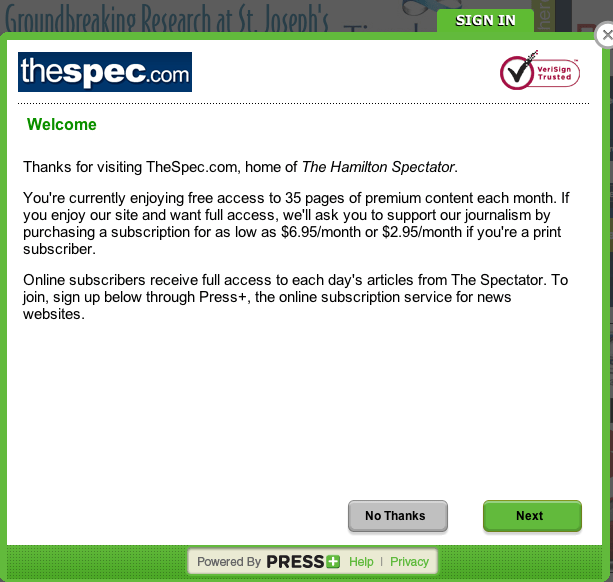
    The Spec paywall
    This appears to be Torstar’s first experiment with the paywall model. (I could be wrong, so feel free to provide me with additional info in the comments below). Similar to Postmedia’s paywall experiment and the paywall experiments of the NY Times and others, Torstar is now entering the fray to try to monetize it’s content.

    I’m curious to know why it took a month for the paywall message to appear for me – I am a regular reader of The Spec online and I should have received a notification on earlier visits to the site as well, no?

    One thing that strikes me as a bit odd is the cap on free stories each month: The Spec is offering free access to 35 stories a month, after which visitors will be required to pay $6.95 a month ($2.95 a month if you are already a print subscriber) to read additional content.

    35 stories a month? That’s almost double what the New York Times and the Postmedia papers (the Montreal Gazette and the Victoria Times Colonist) are capping. And, Torstar’s flagship paper, The Toronto Star, has no paywall. For years, my dad used to complain that The Hamilton Spectator was “full of yesterday’s news. Why should I read about it again?” And that was 15 years ago! I really enjoy the crime reporting in The Spec (go Susan Clairmont!), but I think I’ll be hard pressed to find 35 stories that can only be found on thespec.com, and that will thus force me to embrace the paywall.

    Might we infer from the 35 story cap that The Spec is inferior to other major papers? If that’s the case, then is this a good test of the Paywall model for Torstar? Alternately, is this a different test of the paywall model with a higher cap? If so, I hope that site visitors will be sufficiently tempted by unique content to want to read 35+ stories on the site per month. And, I also wonder if there’s a way around the paywall, similar to the NY Times’ unfortunate paywall sidestepping issue (is that a bug or a feature?).

    One last thing: It would be great to see some metrics from the companies that are testing the paywall model. Similar to the old high school “hypothesis, test, analyze, report” way of doing things, I’d love to see some objective reporting on the true measure of paywall effectiveness. Does such reporting exist yet? If so, can you please provide links to that kind of research in the comments below?

    It’ll be interesting to see how this experiment pans out. I’m all for trying to monetize content, and time’ll tell if this model works. Good luck to Torstar and their paywall experiment!

    Todd