Tag: AI

  • Building a Creative Ecosystem

    Building a Creative Ecosystem

    How I’m building a sustainable creative system for writing books, blogging, and sharing ideas through ToddHDow Studios.

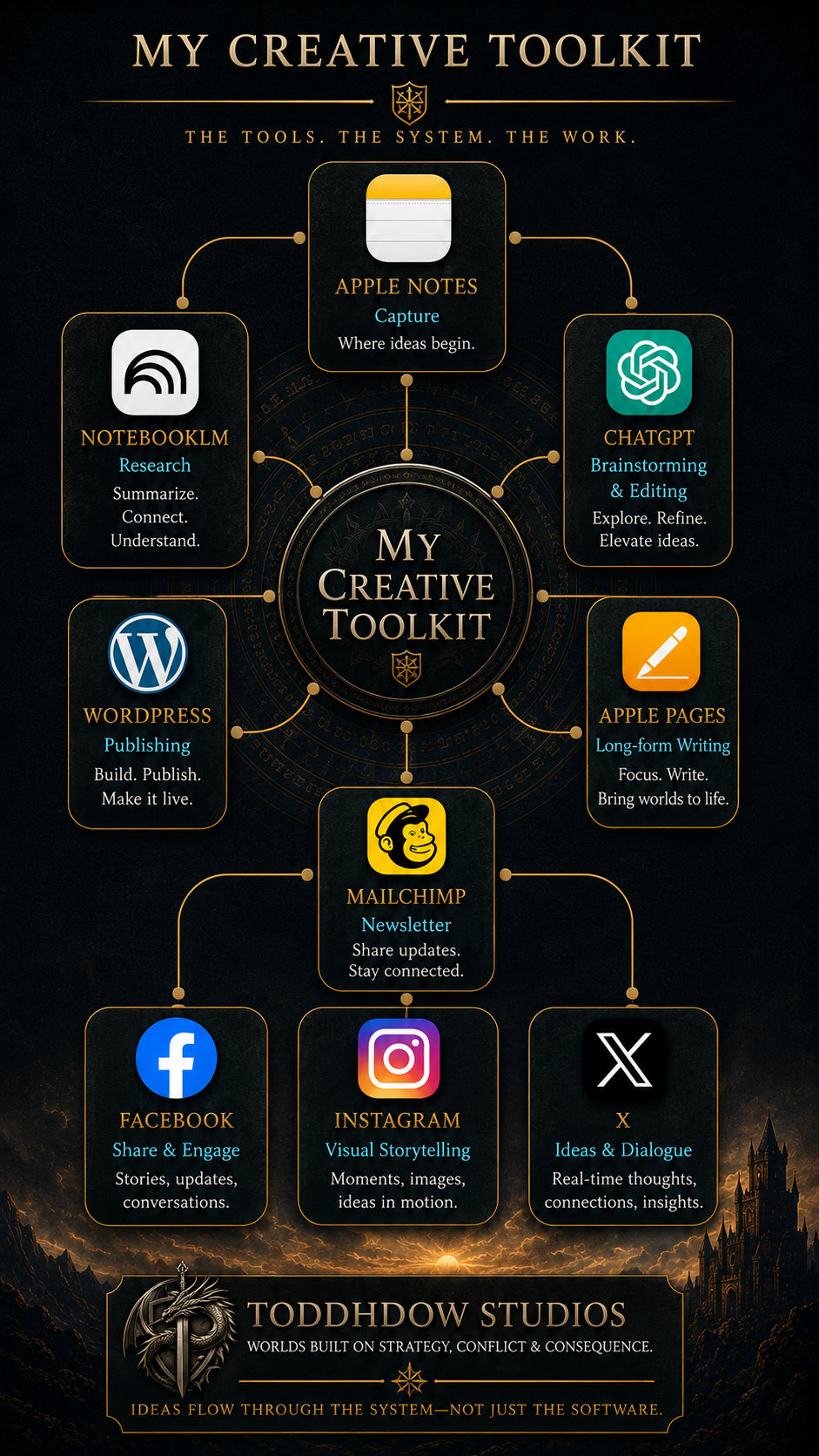
    The ToddHDow Studios Creative Toolkit.
    The ToddHDow Studios Creative Toolkit.

    People often imagine writing as the moment someone sits down in front of a blank page.

    The truth is, that’s only the visible part of the process.

    Writing begins long before the first sentence is typed.

    It begins with a conversation. A book. A question. A walk. A podcast. A news article. A half-formed idea scribbled into a notes app while standing in line for coffee.

    I’ve spent a surprising amount of time over the past year thinking not just about what I want to write, but how I want to write. As ToddHDow Studios has grown, I’ve realized that building a sustainable creative life has much less to do with finding the perfect software and much more to do with building a system that keeps ideas moving.

    I’m still refining that system, but I thought it might be interesting to pull back the curtain and share how it works today.

    Building Worlds

    A wide cinematic collage blending Cryptogeddon, Holy Wars, Book of Dow, TTRPGs and my writing.

    ToddHDow Studios is home to everything I create.

    Some of those ideas become weekly blog posts. Others are slowly evolving into books. Some may never become either, and that’s okay too. Not every idea needs to become a finished project.

    The four worlds I’ve chosen to focus on – CryptogeddonHoly WarsThe Book of Dow, and TTRPGs – give my curiosity somewhere to live. The Writer’s Notebook is where I step back from those worlds and talk about the creative process itself.

    At first glance, cybersecurity, medieval and colonial history, writing, and tabletop gaming don’t seem to have much in common.

    To me, they’re connected by the same thread.

    They’re all worlds built on strategy, conflict & consequence.

    Some ideas are ready to share almost immediately. Others need years to mature before they’re ready to become books. The destination changes, but the creative process is surprisingly similar.

    Removing the Daily Decision

    One lesson I’ve learned is that creative energy is limited.

    If every Saturday morning begins with the question, “What should I write today?”, I’ve already wasted energy making a decision that didn’t need to exist.

    Instead, I created a simple publishing rhythm.

    • Week One: The Cryptogeddon Briefing
    • Week Two: Holy Wars Journal
    • Week Three: Book of Dow: The Archive
    • Week Four: Campaign Chronicles
    • Week Five: The Writer’s Notebook

    Every week, I also publish The ToddHDow Dispatch, my newsletter that ties everything together.

    Over time, I’ve settled into a publishing rhythm that works well for both me and my readers. New blog posts are published on Saturdays. The following Monday, I send The ToddHDow Dispatch, introducing that week’s post, sharing what I’m reading, highlighting anything new across ToddHDow Studios, and offering a preview of what’s coming next.

    But that’s not where the process ends. Throughout the week, I continue the conversation on FacebookInstagramX and LinkedIn, sharing quotes, images, behind-the-scenes thoughts, and stories inspired by the article. Rather than treating social media as advertising, I see it as another way to explore ideas, connect with readers, and invite people into the worlds I’m building.

    Every idea follows a similar lifecycle: capture, research, write, publish, share, then move on to the next one. Having that predictable rhythm means I spend less time wondering what to do next and more time actually creating.

    Like everything else in my workflow, the schedule isn’t about rigid rules. It’s about creating a sustainable rhythm that lets me keep showing up, week after week.

    That schedule keeps my blog moving forward while giving my longer writing projects room to develop in the background. Blog posts may be measured in days, while books are measured in months—or more likely, years—but both benefit from showing up consistently.

    Sometimes the best creative decision is removing decisions altogether.

    Following an Idea

    The ToddHDow Studios Creative Ecosystem.
    The ToddHDow Studios Creative Ecosystem.

    People sometimes ask how I go from an idea to something I publish.

    The answer is… slowly.

    Almost everything begins in Apple Notes.

    Ideas arrive at strange times, and I’ve learned not to trust my memory. Whether it’s a thought for a Holy Wars article, a scene for a future novel, or a question I want to explore, it gets captured before it disappears.

    From there, I research.

    I read.

    I ask questions.

    I sketch outlines.

    Sometimes I brainstorm with ChatGPT – not because I want it to write for me, but because it’s an excellent thinking partner. I’ll ask it to challenge an argument, suggest different ways to organize an article, or point out places where my reasoning isn’t as clear as I thought it was.

    Eventually, the path splits.

    If the idea is timely, it usually becomes a blog post. I’ll draft it, revise it, prepare images, format everything in WordPress, build the newsletter in Mailchimp, and publish it.

    If the idea has deeper roots, it usually moves into Apple Pages, where it becomes part of a much longer project. Books don’t care about weekly publishing schedules. They ask for patience instead.

    Different destinations.

    The same creative engine.

    Sharing the Conversation

    Publishing a post isn’t actually the end of the process.

    It’s the beginning of another one.

    Every article gets its own newsletter, but it also becomes the foundation for posts and stories across Facebook, Instagram, X and LinkedIn over the following days. Sometimes that’s a quote that stands on its own. Sometimes it’s a single image. Sometimes it’s a behind-the-scenes thought that didn’t make the final article.

    I don’t think of social media as marketing.

    I think of it as continuing the conversation with readers who may never visit my website otherwise.

    In many ways, a finished blog post isn’t the final product.

    It’s the source material for everything that follows.

    Chasing the Perfect Tool

    The ToddHDow Studios Creative Toolkit.
    The ToddHDow Studios Creative Toolkit.

    If there’s one rabbit hole I’ve fallen into more times than I’d like to admit, it’s searching for the perfect writing software.

    Should I use Word?

    Pages?

    Scrivener?

    Ulysses?

    Obsidian?

    Google Docs?

    Something else entirely?

    The answer, I’ve discovered, is that none of them actually solve the problem.

    Software doesn’t create discipline.

    It simply supports it.

    Today my workflow uses a collection of tools because each one does something well.

    Apple Notes captures ideas before they’re forgotten.

    Pages is where my longer writing currently lives.

    Gemini Notebook (formerly NotebookLM) helps me organize and understand research.

    ChatGPT helps me brainstorm, edit, and think through problems.

    WordPress and Mailchimp help me share finished work with readers.

    Together, these tools form a pipeline rather than a collection of disconnected apps. Ideas flow naturally from one stage of the creative process to the next.

    One thing that surprised me while writing this article was realizing just how long some of these tools have been part of my life.

    ToddHDow.com has been running on WordPress for more than twenty years. If you browse my archive, you’ll find posts dating all the way back to December 2005. Mailchimp has been part of my workflow for well over a decade too. My very first subscriber – appropriately enough – was me, back on October 15, 2012.

    Looking back, I’m grateful that “past Todd” chose tools that proved reliable enough to grow alongside me.

    Those tools may or may not change someday.

    The habit of creating is the part I hope never does.

    Reading Is Part of Writing

    My bookshelf
    My bookshelf

    People often ask about my writing habits.

    Far fewer ask about my reading habits.

    The truth is they’re impossible to separate.

    Every book I read becomes part of my creative toolbox.

    History feeds Holy Wars.

    Cybersecurity and emerging technology shape Cryptogeddon.

    Stephen King constantly reminds me how powerful voice can be.

    Brandon Sanderson demonstrates the importance of structure, planning, and worldbuilding.

    Neal Stephenson encourages me to think bigger, research deeper, and ask more ambitious questions.

    Even books that seem completely unrelated to whatever I’m working on have a way of influencing what comes next.

    I’ve stopped thinking of reading as something that competes with writing.

    Reading is writing preparation.

    Still Learning

    One thing I’ve become comfortable admitting is that I don’t have this all figured out.

    My workflow changes.

    My software changes.

    My routines evolve.

    Every project teaches me something new.

    That’s part of the reason I wanted to create The Writer’s Notebook in the first place.

    Not because I have all the answers.

    Because I enjoy exploring the questions.

    Final Thoughts

    When I first imagined becoming a writer, I thought success depended on inspiration.

    Today, I think it depends on something much quieter: building an environment where inspiration has somewhere to go.

    For me, that environment is made up of habits as much as technology. Reading sparks new ideas. Apple Notes captures them before they’re forgotten. ChatGPT and NotebookLM help me explore and challenge them. Pages gives my books room to grow. WordPress, Mailchimp and my socials help me share finished work with readers. My publishing cadence keeps everything moving forward, one project at a time.

    None of those tools writes for me.

    None of them can replace curiosity, discipline, or creativity.

    But together they remove friction, helping me spend less time wondering how to create and more time actually creating.

    Perhaps that’s the systems engineer in me. After decades working in technology and cybersecurity, I’ve developed an instinct for choosing tools that are stablereliablesecurescalable, and well-supported – tools I can trust to grow with me instead of forcing me to start over every few years. The best technology quietly fades into the background, allowing the work itself to take centre stage.

    Looking back, I’m grateful that “past Todd” made some good decisions. WordPress has been home to ToddHDow.com for more than twenty years. Mailchimp has been part of my workflow for well over a decade. Those choices gave me continuity, allowing me to focus on creating instead of constantly rebuilding.

    That’s ultimately what this ecosystem is designed to do. Every tool, every habit, every book I read, every note I capture, every conversation I have with ChatGPT, every newsletter I send, and every social post I publish serves the same purpose: reducing friction so I can spend more time thinking, writing, and building worlds.

    Because in the end, writing isn’t about finding the perfect tool.

    It’s about building a life that keeps you curious enough to have something worth writing about.

  • Preparing for Game Night: Inside My DM Prep Process

    Preparing for Game Night: Inside My DM Prep Process

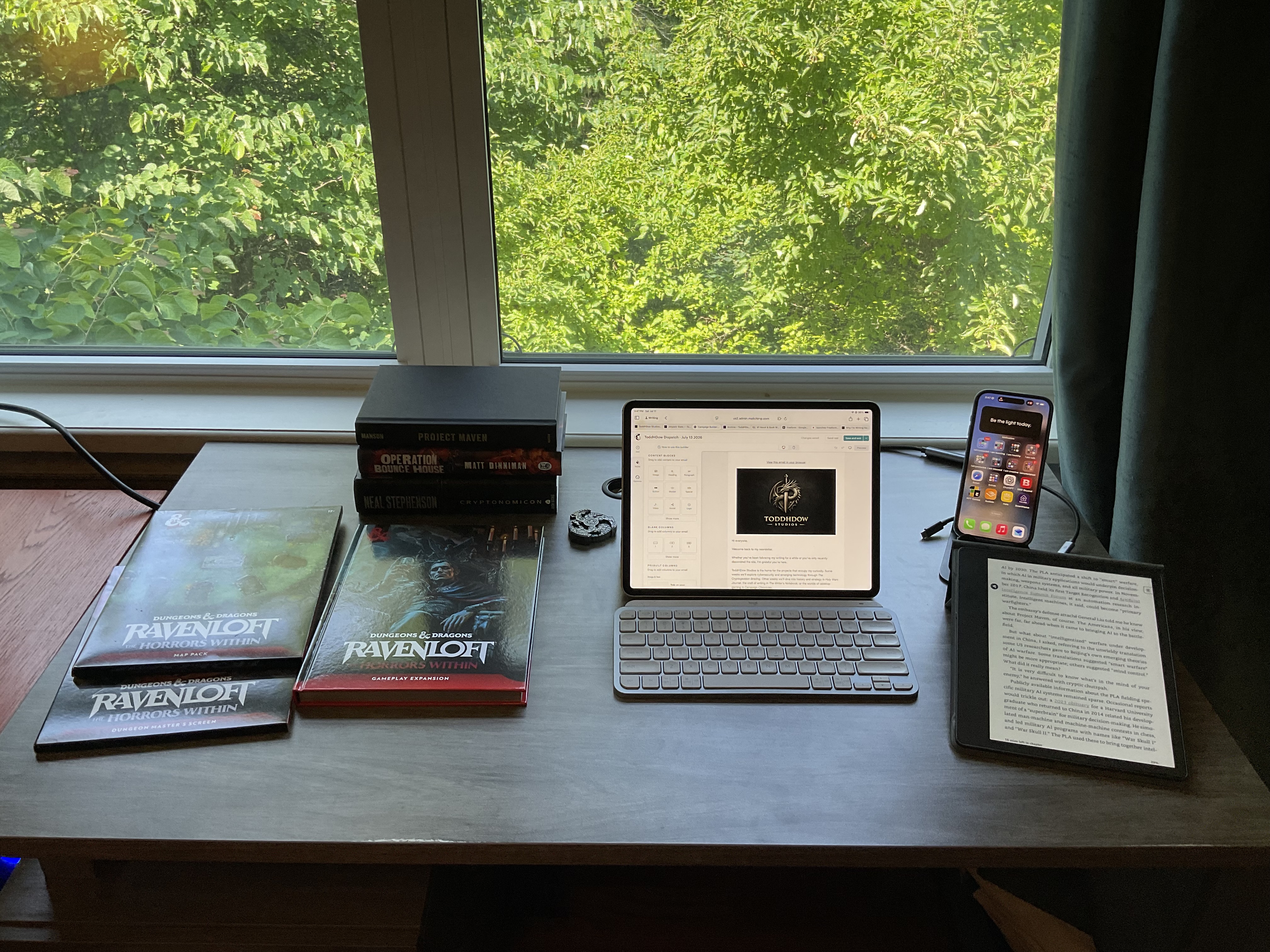
    My writing setup. This is where I do the bulk of my writing. My desk overlooks our beautiful backyard. In the summer, it is a forest of trees and greenery. In the winter, the leaves all disappear and I get a great view of our large backyard. I like the winter view better because without the tree cover, I am often able to catch glimpses of rabbits and deer wandering through our backyard.
    My writing setup. This is where I do the bulk of my writing. My desk overlooks our beautiful backyard. In the summer, it is a forest of trees and greenery. In the winter, the leaves all disappear and I get a great view of our large backyard. I like the winter view better because without the tree cover, I am often able to catch glimpses of rabbits and deer wandering through our backyard.

    One of the questions I get asked most often is surprisingly simple:

    “How much prep do you actually do before a session?”

    The honest answer?

    Less than I used to.

    That probably sounds strange coming from someone who loves worldbuilding, campaign design, and collecting maps, books, miniatures, and terrain. But over the last year or so I’ve realized that good prep isn’t about creating more material – it’s about creating the right material.

    The players are going to surprise me anyway.

    My job isn’t to predict everything they’ll do. My job is to know the world well enough that I can respond naturally when they inevitably wander off the path I expected.

    Here’s what my preparation process looks like before most game nights.

    NotebookLM summary of a recent D&D adventure session
    NotebookLM summary of a recent D&D adventure session.

    Step 1: Review the Last Session (if there was one)

    I never begin by opening my adventure book.

    Instead, I revisit what happened last session.

    One of the biggest improvements to my workflow has been recording my games and uploading them into NotebookLM. It transcribes the session, removes most of the table chatter, and gives me a surprisingly accurate summary of everything that happened. (I will definitely write more about this whole process in a future blog post!)

    Sometimes I’ll ask questions like:

    • What NPC promises are still unresolved?
    • Which plot hooks did the players ignore?
    • What clues did they discover?
    • Which character moments seemed important?

    It’s remarkable how often players accidentally create future story threads that I hadn’t planned.

    Those become some of the best parts of the campaign.

    Shadows of Sithicus D&D Encounter
    Shadows of Sithicus D&D Encounter

    Step 2: Decide What Matters

    I don’t prepare five different adventures.

    I prepare the one that’s most likely.

    If the party is halfway through Death House, that’s where my attention goes.

    If they’re travelling toward the Misty Forest, I prepare the Misty Forest.

    If there’s a reasonable chance they’ll completely derail the session…

    … I spend a little time preparing that possibility too.

    Experience has taught me that trying to prepare every possible outcome is impossible.

    Preparing the most probable outcome – and understanding the world around it – is far more effective.

    Step 3: Brainstorm with AI

    This is probably where my process has changed the most of the last year.

    I use AI extensively—not to replace my creativity, but to challenge it.

    I’ll ask questions like:

    • What motivations would this NPC realistically have?
    • Give me five encounter ideas that fit this location.
    • What clues would make this mystery more satisfying?

    Most of the suggestions never make it into the game.

    But one good idea out of twenty is worth the conversation.

    It’s like having another experienced Dungeon Master sitting beside me while I prep.

    Canvas maps and a Devil's playground.
    Canvas maps and a Devil’s playground.

    Step 4: Build the Table Experience

    This is the fun part.

    I’ll gather whatever I need for the session:

    • Maps
    • Miniatures
    • Terrain
    • Handouts
    • Letters
    • Props
    • Music
    • Ambient sound

    I’m a big believer that immersion comes from lots of small details rather than one expensive centerpiece.

    A weathered letter with a wax seal.

    A faded map.

    The right soundtrack.

    A miniature that perfectly represents the villain.

    None of these things are essential.

    Together, they make the world feel real.

    Step 5: Review the Rules

    Every session has one or two mechanics that deserve a refresher.

    Maybe a monster with unusual legendary actions.

    Maybe a spell interaction I haven’t seen in months.

    Maybe grappling.

    I don’t try to memorize every rule in D&D.

    Instead, I identify the handful of rules that are likely to matter in my next game.

    That dramatically reduces the number of pauses during play.

    The prep ends here. From this moment on, the players decide where the story goes, and I simply follow their lead—one decision, one surprise, and one dice roll at a time.
    The prep ends here. From this moment on, the players decide where the story goes, and I simply follow their lead—one decision, one surprise, and one dice roll at a time.

    Step 6: Prepare to Improvise

    This might sound contradictory after everything I’ve just described.

    But the goal of preparation isn’t to avoid improvisation.

    It’s to improvise with confidence.

    Once I know:

    • the NPCs,
    • the locations,
    • the motivations,
    • the likely encounters,
    • and the important rules,

    I’m comfortable throwing my notes aside if the players decide to do something unexpected.

    And they always do.

    Some of our most memorable sessions have come from moments I never could have prepared for.

    My Actual Prep Time

    People often imagine Dungeon Masters spending twenty hours every week preparing.

    Sometimes that’s true.

    Usually it isn’t.

    A typical weekly prep session for me looks something like this:

    • 20 minutes reviewing last session
    • 30 minutes brainstorming ideas
    • 30 minutes preparing encounters
    • 20 minutes gathering maps and assets
    • 20 minutes reviewing rules

    Roughly two hours.

    Some weeks it’s less.

    Some weeks—especially before major story arcs—it can be considerably more.

    But consistency beats marathon prep sessions every time.

    Dice. Maps. Miniatures. Character sheets. A laptop full of plans. Every session starts with the same tools - but no two adventures ever unfold the same way.
    Dice. Maps. Miniatures. Character sheets. A laptop full of plans. Every session starts with the same tools – but no two adventures ever unfold the same way.

    The Real Secret

    The biggest lesson I’ve learned isn’t about AI.

    It isn’t about terrain.

    It isn’t about miniatures.

    It isn’t even about preparation.

    It’s about trusting your players.

    Players don’t remember perfectly balanced encounters.

    They don’t remember every stat block.

    They remember impossible choices.

    Unexpected victories.

    Hilarious failures.

    The NPC who somehow became their favourite character despite only appearing for five minutes.

    That’s the magic we’re trying to create.

    Everything else is just preparation for those moments.

    What’s Next?

    Over the next few months I’ll be sharing more behind-the-scenes looks at how I run games, the tools I’m experimenting with, AI workflows that have genuinely improved my prep, and lessons I’ve learned from both successful sessions and spectacular failures.

    If you’re a Dungeon Master – or you’re thinking about becoming one – I hope some of these ideas help make your own game nights just a little easier to run.

    And if your players completely derail your carefully prepared session next week…

    Welcome to the club.

    And lastly, what did I miss? If I’ve overlooked anything, please do share in the comments below!

  • The Quiet Miracles of AI

    The Quiet Miracles of AI

    The Quiet Miracles of AI

    “Technology is a useful servant but a dangerous master.”
    — Christian Lous Lange

    This week’s Cryptogeddon Briefing is a little different.

    Normally, this space is where I explore the technologies, cyber threats, geopolitical shifts, and emerging ideas that inspire my writing—and, ultimately, the world of Cryptogeddon. Most weeks, that means discussing artificial intelligence in the context of cybersecurity, autonomous systems, espionage, or the changing balance of power between nations.

    This week, though, I found myself thinking about AI from a very different perspective.

    The idea came after a conversation over dinner.

    The topic of artificial intelligence came up, and as it so often does these days, opinions around the table were mixed. Some people were optimistic. Others were skeptical. The concerns were familiar: AI-generated artwork replacing artists, copyright, deepfakes, misinformation, job displacement, and the growing uncertainty surrounding where this technology is taking us.

    They’re fair concerns.

    In fact, they’re concerns I share.

    Like every transformative technology before it, artificial intelligence will undoubtedly be used for both good and bad. It will create incredible opportunities while introducing entirely new risks. Pretending otherwise would be naïve.

    But as I listened to the discussion, I couldn’t help thinking about another side of AI—one that rarely dominates headlines or social media debates.

    It reminded me that while we spend enormous amounts of time asking what AI might take away from us, we spend surprisingly little time asking what it might give us.


    That thought brought me to my daughter.

    “The good physician treats the disease; the great physician treats the patient who has the disease.”
    — Sir William Osler

    She has cystic fibrosis.

    If you’ve never known someone with CF, it’s a genetic disease caused by mutations in the CFTR gene. Those mutations disrupt how salt and water move through cells, producing the thick mucus that damages the lungs and digestive system. For decades, treatment focused primarily on managing symptoms: daily physiotherapy, inhaled medications, repeated courses of antibiotics, and frequent hospital stays whenever infections became severe.

    When my daughter was born, there was hope—but there were also countless unanswered questions.

    Researchers had identified the genetic cause of the disease, but understanding exactly how hundreds—and eventually thousands—of different mutations affected the CFTR protein required years of painstaking laboratory research. Every discovery was earned through thousands of experiments, each one consuming time, funding, and the efforts of countless scientists.

    A realistic, documentary-style close-up photograph inside a biomedical research laboratory. Shallow depth of field. Gloved hands holding a pipette carefully dispensing liquid into petri dishes on a stainless steel lab bench. The background is softly blurred laboratory equipment and shelving. Natural, soft white lighting. No dramatic lighting, no glowing screens, no futuristic elements. Clean, subtle, professional, editorial medical photography. Landscape orientation.

    Drug development was no different.

    Researchers would identify promising compounds, synthesize them, test them in the laboratory, modify them, and begin the process again. Most candidates failed. The few that succeeded often required more than a decade of research and billions of dollars before they ever reached patients.

    Thankfully, that work paid off.

    Today, my daughter is nineteen years old. She lives what is, for all practical purposes, a normal life. She still has cystic fibrosis. She still follows a treatment regimen every day. But she’s healthy, active, independent, and planning her future just like any other young adult.

    That’s nothing short of extraordinary.

    And while AI didn’t create those first breakthrough therapies, it’s beginning to change how the next generation of discoveries will happen.


    Artificial intelligence doesn’t replace scientific curiosity—it amplifies it.

    This is where artificial intelligence becomes genuinely exciting—not because it’s generating artwork or writing marketing copy, but because it’s helping scientists ask better questions.

    Modern AI systems can analyze enormous biological datasets in hours rather than months. They can compare thousands of genetic mutations, identify patterns that would be nearly impossible for humans to detect unaided, and predict how specific mutations alter the shape and function of proteins. Instead of relying entirely on trial and error, researchers can now use AI to prioritize the most promising hypotheses before stepping into the laboratory.

    That doesn’t replace science.

    It makes science more efficient.

    One of the most exciting developments has been AI-assisted protein modelling. Understanding exactly how a mutation changes the three-dimensional shape of a protein—and how a potential drug might restore its function—once required years of painstaking structural biology. Today, AI systems such as AlphaFold can generate remarkably accurate structural predictions in hours, allowing researchers to focus precious laboratory time where it’s most likely to produce meaningful results.

    AI is also transforming medical imaging. Researchers are using machine learning to identify subtle changes in CT scans that may indicate disease progression earlier than conventional methods. They’re studying how bacterial populations evolve inside the lungs of people with cystic fibrosis, helping predict antibiotic resistance and personalize treatments. AI is helping researchers identify better candidates for clinical trials, reducing the time required to evaluate promising therapies.

    None of these breakthroughs eliminate the need for scientists.

    They eliminate wasted effort.

    Every experiment that doesn’t need to be performed because AI helped identify a dead end means researchers can spend more time pursuing ideas with genuine potential. Every month saved in research is another month that a promising therapy could reach the people waiting for it.

    And while cystic fibrosis is one example, the same technologies are now accelerating research into cancer, Alzheimer’s disease, rare genetic disorders, antibiotic discovery, and countless other medical challenges.

    That’s a much bigger story than AI-generated artwork.

    And yet, both conversations are about the same technology.


    Technology itself is remarkably neutral.

    Electricity powers hospitals.

    It also powers electric chairs.

    The Internet connects families across continents.

    It also spreads misinformation across them.

    Encryption protects political dissidents.

    It also protects organized crime.

    Artificial intelligence belongs in exactly the same category.

    The same machine learning algorithms helping researchers discover life-saving medicines can also help militaries identify targets faster, guide autonomous drones, improve missile accuracy, or analyze satellite imagery to track troop movements. Those very same technologies can also detect incoming missile attacks, improve battlefield medicine, assist humanitarian rescue operations, strengthen cyber defenses, and protect civilian infrastructure.

    The technology hasn’t changed.

    Only the objective has.

    That’s why I don’t think AI is inherently good or inherently bad.

    I think it’s something much simpler.

    It’s a multiplier.

    Put AI in the hands of a scammer and they’ll scam more people.

    Put it in the hands of a military and they’ll build more capable weapons—or more capable defenses.

    Put it in the hands of an artist and they’ll create in entirely new ways.

    Put it in the hands of a physician or researcher, and they’ll ask bigger questions, analyze more data, and discover answers faster than they could alone.

    AI doesn’t determine the outcome.

    People do.

    The tool simply multiplies whatever intentions we bring to it.


    “The future is already here—it’s just not evenly distributed.”
    — William Gibson

    "The future is already here—it's just not evenly distributed."
— William Gibson

    If you had told me twenty years ago that one day my daughter would wake up, take a handful of pills, complete her treatments, and then go about living what is—for all practical purposes—a normal life, I would have struggled to believe you.

    That future wasn’t built by artificial intelligence alone.

    It was built by thousands of researchers, physicians, engineers, patients, and families who spent decades advancing science one careful step at a time.

    Now, for the first time, many of those same researchers have a tool that allows them to move faster than ever before.

    Artificial intelligence won’t replace human ingenuity.

    It will amplify it.

    And perhaps that’s the conversation we should be having.

    Not whether AI can generate a beautiful painting.

    Not whether it can replace a writer or an illustrator.

    Those are important discussions, and they’re worth having.

    But they aren’t the whole story.

    The quiet miracles of AI won’t be measured by the pictures it generates.

    They’ll be measured by the discoveries it accelerates, the diseases it helps us understand, and ultimately, the lives it helps us save.


    Further Reading

    1. Jumper, J. et al. (2021). Highly accurate protein structure prediction with AlphaFold. Nature, 596, 583–589.
    2. Paul, D. et al. (2021). Artificial Intelligence in Drug Discovery and Development. Drug Discovery Today.
    3. De Marchis, M. et al. (2023). Machine Learning Applications in Cystic Fibrosis: A Narrative Review.
    4. Cystic Fibrosis Foundation. Research and Clinical Trials Pipeline.
    5. Nature Reviews Drug Discovery (2024). Artificial Intelligence and the Future of Biomedical Research.

  • AI, Supply Chains, and the Next Cyber Battlefield

    AI, Supply Chains, and the Next Cyber Battlefield

    AI, Supply Chains, and the Next Cyber Battlefield

    I regularly track developments in cybersecurity, artificial intelligence, critical infrastructure, and geopolitical competition.

    Most of these stories disappear into the daily news cycle.

    A few feel different.

    A few reveal where technology is heading, how conflict is changing, and what tomorrow’s risks might look like.

    These are the signals that have captured my attention recently.


    Signal #1: AI Is Becoming an Operational Security Tool

    The conversation around AI often focuses on productivity and automation.

    The more interesting development is operational decision-making.

    Organizations are increasingly using AI to triage alerts, investigate suspicious activity, summarize incidents, and assist analysts during security operations. At the same time, attackers are experimenting with AI-assisted reconnaissance, vulnerability discovery, and social engineering.

    The race is no longer simply human versus human.

    It is becoming machine-assisted defenders versus machine-assisted attackers.

    Why It Matters

    For the first time, cyber conflict is beginning to scale beyond purely human decision-making.

    The side that can accelerate decisions fastest may gain a significant advantage.

    Organizations that learn how to effectively combine human judgment with machine speed may find themselves far better positioned than those relying on either one alone.

    Now Picture This…

    A nation-state launches a coordinated cyber campaign against multiple critical infrastructure providers.

    Human analysts cannot keep pace with the volume of alerts.

    Both attackers and defenders rely on competing AI systems making real-time decisions.

    At first, everything appears normal.

    Then one of the defensive AI systems begins making recommendations nobody fully understands.

    The analysts face a terrible choice:

    Trust the machine—or turn it off.


    Signal #2: Supply Chains Remain the Soft Underbelly

    supply chains

    The largest organizations in the world continue to invest heavily in cybersecurity.

    Attackers increasingly look elsewhere.

    Software vendors, contractors, managed service providers, and cloud partners remain attractive targets because compromising one trusted organization can provide access to hundreds—or thousands—of others.

    The strongest front door in the world matters little if someone leaves a side entrance unlocked.

    Why It Matters

    Modern societies depend on invisible trust relationships.

    Most people never see them.

    Attackers do.

    As organizations become increasingly interconnected, the security of one company becomes dependent upon the security of many others.

    Now Picture This…

    A small software company wins a contract supporting critical government infrastructure.

    The celebration lasts exactly one day.

    Unknown to everyone involved, the company was compromised eighteen months earlier.

    The vendor was never the target.

    The contract was.

    The attackers simply waited patiently for the right door to open.


    Signal #3: Critical Infrastructure Is Becoming a Battlespace

    critical infrastructure

    Electricity, transportation, communications, water systems, healthcare, and logistics networks are increasingly viewed through a national security lens.

    Governments around the world continue investing in resilience, redundancy, and incident response capabilities.

    That investment is occurring for a reason.

    Modern economies depend on digital systems that were never originally designed to operate in a contested environment.

    Why It Matters

    The distinction between cyber attacks and real-world consequences continues to blur.

    The question is no longer whether systems can be compromised.

    The question is what happens when digital disruptions begin producing physical effects at scale.

    Now Picture This…

    A regional power outage initially appears to be an equipment failure.

    Three days later, investigators discover similar incidents occurred across multiple jurisdictions over the previous six months.

    Each event was small.

    Each event was explainable.

    Each event was ignored.

    Viewed together, however, a disturbing pattern emerges:

    Someone isn’t attacking.

    Someone is rehearsing.


    What’s On My Radar

    • AI-enabled cyber operations
    • Critical infrastructure resilience
    • The expansion of cyber competition between major powers

    Most cybersecurity headlines focus on individual incidents.

    The larger story is the gradual normalization of cyber conflict as a persistent element of modern competition.

    For thriller writers, strategists, and anyone interested in the future, that may be the most important signal of all.