

Every writer eventually gets asked the same question:
“Why are you writing this?”
Over the last few weeks, a few people have asked me why I’m so interested in the Crusades, religious conflict, and Christian history. On the surface, it probably seems like an odd direction for someone who spends his days working in cybersecurity and his evenings writing about technology, AI, Dungeons & Dragons, and speculative fiction.
It’s a fair question.
The short answer is that Holy Wars has been quietly taking shape in my mind for more than twenty years.
The longer answer is much more interesting.
This isn’t simply a story about medieval Europe, knights, or the Crusades. It isn’t an attempt to defend Christianity, nor is it an attempt to attack it. It’s the culmination of a lifelong fascination with one question:
Why do people believe what they believe?
That question has shaped nearly every major decision in my adult life. It led me back to university. It influenced my career, my reading, and my writing. It challenged assumptions I had held since childhood. And ultimately, it became the foundation for Holy Wars.
“Holy Wars isn’t the story of what I believe. It’s the story of why I’ve spent more than twenty years asking why people believe what they do.”
It Started With Questions
I grew up attending an Alliance church.
Like many kids, Sunday mornings meant church services, Sunday school, and Bible stories. Faith was simply part of life.
Then I became a teenager.
Sports, friends, work, and life gradually replaced church attendance. I didn’t reject Christianity; I simply drifted away from it. By the time I entered my twenties, I wasn’t spending much time thinking about religion at all.
That changed when I became engaged.
I was marrying into a deeply Christian family, and for the first time I realized that inherited beliefs weren’t enough anymore. If I was going to build a life with someone whose faith was central to who they were, I owed it to myself—and to her—to understand what I actually believed.
Not what my parents believed.
Not what my church believed.
Not what my friends believed.
What I believed.
And perhaps more importantly…
Why?
Choosing Questions Over Certainty
Around that same time, I decided to return to school.
I already had a college diploma and had spent several years working full-time in information technology, but I wanted to earn a university degree. After looking through the programs offered by the University of Toronto, one combination immediately captured my attention: Philosophy and Religious Studies.
When I mentioned the idea to my pastor, he offered some well-intentioned advice.
He told me not to do it.
His concern was that studying philosophy and religion academically would destroy my faith.
I understood where he was coming from. Universities have a reputation—fairly or unfairly—for encouraging students to question everything. From his perspective, that represented a spiritual risk.
I appreciated his concern.
Then I enrolled anyway.
Looking back, I’m glad I did.
Did university ruin my faith? No. It challenged it. It refined it. And perhaps most importantly, it taught me that beliefs worth holding should be strong enough to withstand honest questions.
One of the things I’ve realized about myself over the years is that I can’t simply accept ideas because someone tells me they’re true. I need to understand them. I need to know where they came from. I need to see the historical evidence, hear competing viewpoints, and wrestle with difficult questions before I’m comfortable reaching a conclusion.
That curiosity has served me well throughout my career in cybersecurity, and it served me equally well in the classroom.
I left university with far more questions than answers.
I also left with something much more valuable: the tools to ask better questions.
Four Years That Changed Everything
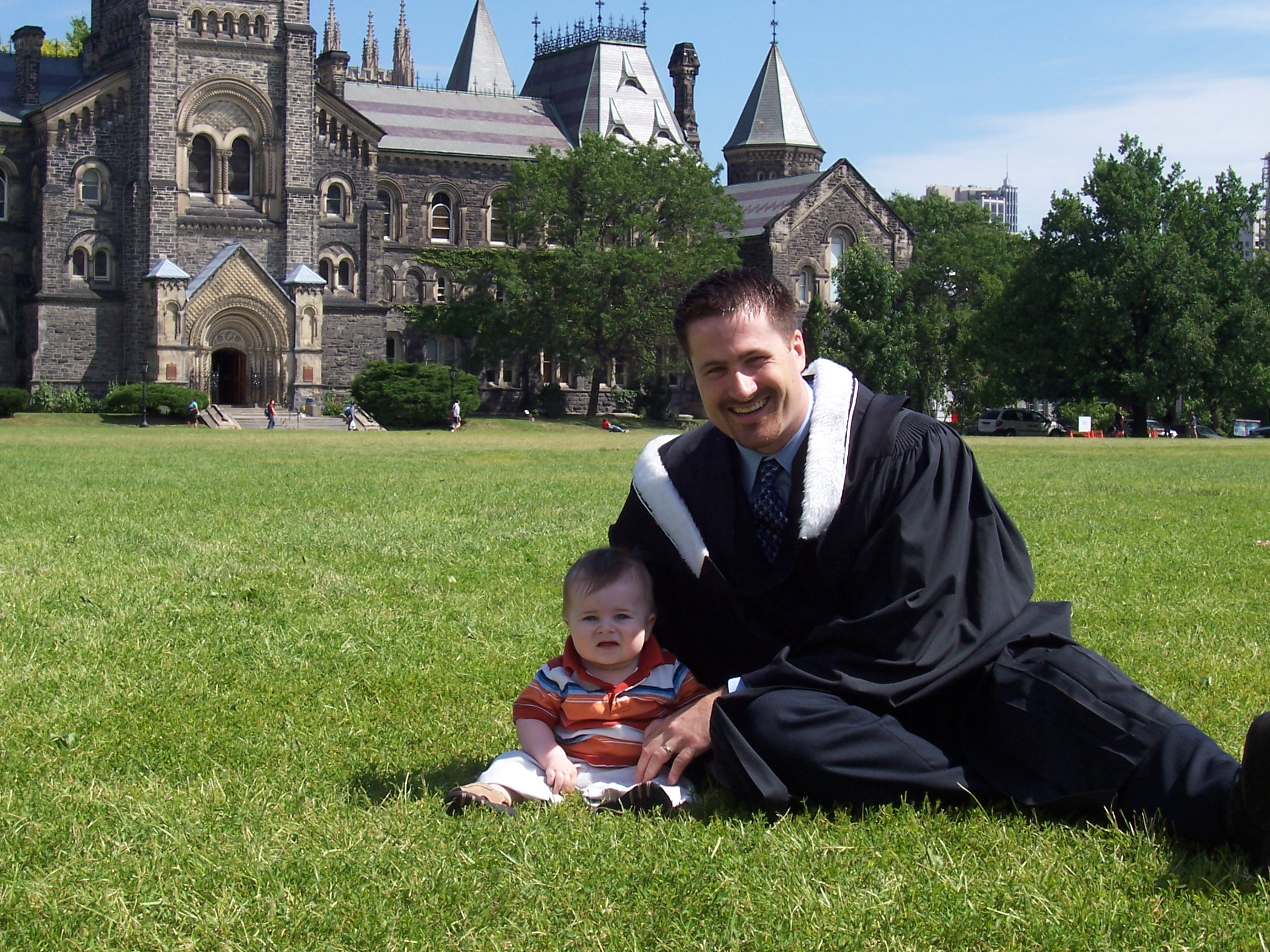
My undergraduate years at the University of Toronto remain some of the most intellectually rewarding years of my life.
They were also among the busiest.
Throughout my degree I continued working full-time.
During my final year, life became almost absurdly busy. I was two years into my marriage. My son Noah had just been born. I was working a full-time job while carrying a full-time course load.

Looking back now, I’m honestly not sure how I managed it.
There wasn’t much free time.
There were a lot of late nights.
There was a constant balancing act between work, family, and school.
But somehow, one assignment at a time, I made it through.
When things became overwhelming, I found myself drawing on lessons I had learned years earlier through martial arts. In my early twenties, I earned black belts in karate, taekwondo, and jiu-jitsu. Beyond the physical training, martial arts taught me discipline, perseverance, and how to dig deep when every part of me wanted to quit. More importantly, it taught me to finish what I started.
That mindset carried me through university just as much as any study habit ever did.
More importantly, those years reinforced that learning wasn’t simply something I enjoyed—it was part of who I was.
The Course That Started Holy Wars
One opportunity during my fourth year changed the trajectory of my thinking forever.
I was fortunate enough to complete a full-year independent study under the supervision of one of my professors. Rather than following a standard curriculum, I was able to design an entire year’s worth of research around a single topic of my choosing.
I chose Christianity, Pacifism, and Just War Theory.
Together, my professor and I built a curriculum that traced Christian thought on violence from the ministry of Jesus through the Roman Empire, Constantine, Augustine, the Crusades, the Reformation, and into the modern world.
For an entire academic year, I immersed myself in one question:
How did a religion founded by a man who taught his followers to love their enemies become intertwined with armies, kingdoms, crusades, revolutions, and wars?
The deeper I dug, the more fascinating the story became.
Nothing was as simple as I expected.
History rarely is.
The people involved weren’t cartoon heroes or villains. They were complex individuals making decisions inside political systems, cultural pressures, and historical moments very different from our own.
That realization has stayed with me ever since.
In many ways, Holy Wars began there—not as a novel, but as a question that refused to let go.
I Thought I Was Going to Become a Pastor
After graduating from the University of Toronto, I wasn’t ready to stop learning.
In fact, I felt called to continue.
I enrolled at McMaster Divinity College and began working toward a Master of Divinity degree.
At the time, I seriously believed pastoral ministry might become my future.
I loved studying theology.
I loved church history.
I loved wrestling with difficult biblical and philosophical questions.
For a while, becoming a pastor felt like a very real possibility.
Life, however, had other plans.
My daughter Katie was diagnosed with Cystic Fibrosis.
Around the same time, my father was battling leukemia.
Family responsibilities naturally became my priority.
Eventually I made the difficult decision to put graduate school on hold.
I completed roughly half of the degree before stepping away.
I’ve often thought about going back.
Whether it’s to finish an M.Div. or pursue something more focused on Christian history or historical research, I still feel that pull.
I suspect I always will.
What I Learned About Myself
Ironically, the more I studied Christianity, the more I realized I probably wasn’t meant for pastoral ministry.
Not because I lost interest.
Quite the opposite.
I discovered that what excited me most wasn’t preaching.
It wasn’t leading a congregation.
It wasn’t pastoral care.
It was history.
Research.
Ideas.
Questions.
I love understanding how ideas evolve over centuries.
I love seeing how theology intersects with politics, economics, philosophy, warfare, and culture.
I enjoy following evidence wherever it leads—even when the answers are uncomfortable or incomplete.
That’s simply how my mind works.
So…What Do I Believe?
People occasionally ask me where all of that studying ultimately left my own faith.
The honest answer is…
I’m still figuring it out.
If you asked me today, I’d probably describe myself as agnostic. Some days that leans a little closer to faith. Other days it leans a little closer to skepticism. The older I get, the more comfortable I’ve become admitting that I don’t have every answer.
Beliefs aren’t static.
Mine certainly haven’t been.
Different seasons of life have caused me to revisit old questions with new perspectives.
Ironically, studying religion taught me humility more than certainty.
And I’m okay with that.
What Holy Wars Really Is
Some readers may assume Holy Wars is intended to make an argument about Christianity.
It isn’t.
Others may assume it’s an attempt to criticize religion.
It isn’t that, either.
At its heart, Holy Wars is about something much bigger.
It’s about what happens when human beings become absolutely convinced they’re right.
Holy Wars isn’t about proving anyone right or wrong. It’s about understanding how beliefs shape individuals, civilizations and history itself.
It’s about conviction.
Identity.
Power.
Tribalism.
Politics.
Fear.
Hope.
Love.
Violence.
Forgiveness.
These aren’t medieval questions.
They’re human questions.
They’re just as relevant in today’s polarized world as they were a thousand years ago.
History simply gives us enough distance to examine them honestly.
Why Historical Fiction?
The story I’m writing isn’t a history textbook.
Nor is it fantasy.
It’s historical fiction because history already provides an extraordinary foundation.
The facts are remarkable.
The people are fascinating.
The events are almost unbelievable.
Historical fiction simply allows me to weave those threads together into a narrative that, I hope, helps readers experience history rather than merely observe it.
I’ve spent years reading, researching, outlining, and quietly connecting ideas that first emerged during that independent study course at the University of Toronto.
Little by little, those ideas have grown into something much larger than I ever imagined.
The Story Has Been Waiting
For years, the final paper from that fourth-year independent study has remained alive in the back of my mind.
Not literally.
But intellectually.
Every book I’ve read.
Every documentary I’ve watched.
Every historical rabbit hole I’ve wandered into has added another piece to the puzzle.
Eventually those pieces began fitting together into something unexpected.
A saga.
One that spans centuries.
One that blends carefully researched history with compelling fiction.
One filled with twists, unexpected connections, and the reminder that history is often stranger than anything we could invent.
That story became Holy Wars.
Whether you share my beliefs, reject them entirely, or are still asking your own questions, my hope is that you’ll find something worthwhile in the journey.
Because Holy Wars isn’t ultimately about proving anyone right or wrong.
It’s about understanding how beliefs shape individuals, civilizations, and history itself.
And perhaps, along the way, understanding a little more about ourselves.
I’d love to hear from you.
Have you ever had a book, a class, or a conversation that fundamentally changed how you think about the world?
Leave a comment below. I’d genuinely be interested to hear your story.


 When I first started blogging, I had already established my IT career. I had spent time working at AOL Canada as a web geek, I had worked in a couple of internal IT departments (at Celestica and Toronto Rehab Institute) and I had recently returned to the online space when I started working at Postmedia (then called Canwest) in early 2006. When I joined Postmedia, I was just wrapping up my undergrad degree from the University of Toronto (in Philosophy and Religious Studies) and I was beginning a masters degree (Master of Divinity) at McMaster University. I have since put my studies aside and continue to focus (and greatly enjoy!) on my IT career.
 Tools? That’s it? Yes. Some are prettier than others. But at the end of the day, they are tools that we use to communicate. I’m writing this blog post on my wife’s Macbook Air. It’s my favourite writing instrument. It is lighter and faster than my aging Macbook Pro (which I fear may have finally died for good – it’s either got a failed hard drive or a failed logic board). Her Macbook Air has an SSD drive, it’s less than 3 lbs and it has 12 hours of battery life. Oooohhh… Aaaahh… Are you excited yet?
 Nowadays, these things are commodity devices. Most of us just need a web browser. We keep in touch via webmail, Facebook, Twitter, Instagram, . All of this could be done with a Chromebook. If you need MS Office or some other productivity tools, then a full blown laptop is still needed. But Apple has almost replaced laptops with tablets with their latest iteration of the iPad Pro.
 The internet is this age’s Gutenberg. Anyone with a commodity device is equipped to reach the world. There has never been such a democratization of free speech in history. And I feel fortunate to be able to participate in this free speech.
 Does this make me any smarter? Nope. If anything, it makes me feel more foolish for sharing my incomplete and/or inarticulate thoughts with others. But I have made some stronger relationships from my writing. And I have learned how to more clearly state my case as well.