Tag: NotebookLM

  • Building a Creative Ecosystem

    Building a Creative Ecosystem

    How I’m building a sustainable creative system for writing books, blogging, and sharing ideas through ToddHDow Studios.

    The ToddHDow Studios Creative Toolkit.
    The ToddHDow Studios Creative Toolkit.

    People often imagine writing as the moment someone sits down in front of a blank page.

    The truth is, that’s only the visible part of the process.

    Writing begins long before the first sentence is typed.

    It begins with a conversation. A book. A question. A walk. A podcast. A news article. A half-formed idea scribbled into a notes app while standing in line for coffee.

    I’ve spent a surprising amount of time over the past year thinking not just about what I want to write, but how I want to write. As ToddHDow Studios has grown, I’ve realized that building a sustainable creative life has much less to do with finding the perfect software and much more to do with building a system that keeps ideas moving.

    I’m still refining that system, but I thought it might be interesting to pull back the curtain and share how it works today.

    Building Worlds

    A wide cinematic collage blending Cryptogeddon, Holy Wars, Book of Dow, TTRPGs and my writing.

    ToddHDow Studios is home to everything I create.

    Some of those ideas become weekly blog posts. Others are slowly evolving into books. Some may never become either, and that’s okay too. Not every idea needs to become a finished project.

    The four worlds I’ve chosen to focus on – Cryptogeddon, Holy Wars, The Book of Dow, and TTRPGs – give my curiosity somewhere to live. The Writer’s Notebook is where I step back from those worlds and talk about the creative process itself.

    At first glance, cybersecurity, medieval and colonial history, writing, and tabletop gaming don’t seem to have much in common.

    To me, they’re connected by the same thread.

    They’re all worlds built on strategy, conflict & consequence.

    Some ideas are ready to share almost immediately. Others need years to mature before they’re ready to become books. The destination changes, but the creative process is surprisingly similar.

    Removing the Daily Decision

    One lesson I’ve learned is that creative energy is limited.

    If every Saturday morning begins with the question, “What should I write today?”, I’ve already wasted energy making a decision that didn’t need to exist.

    Instead, I created a simple publishing rhythm.

    • Week One: The Cryptogeddon Briefing
    • Week Two: Holy Wars Journal
    • Week Three: Book of Dow: The Archive
    • Week Four: Campaign Chronicles
    • Week Five: The Writer’s Notebook

    Every week, I also publish The ToddHDow Dispatch, my newsletter that ties everything together.

    Over time, I’ve settled into a publishing rhythm that works well for both me and my readers. New blog posts are published on Saturdays. The following Monday, I send The ToddHDow Dispatch, introducing that week’s post, sharing what I’m reading, highlighting anything new across ToddHDow Studios, and offering a preview of what’s coming next.

    But that’s not where the process ends. Throughout the week, I continue the conversation on Facebook, Instagram, X and LinkedIn, sharing quotes, images, behind-the-scenes thoughts, and stories inspired by the article. Rather than treating social media as advertising, I see it as another way to explore ideas, connect with readers, and invite people into the worlds I’m building.

    Every idea follows a similar lifecycle: capture, research, write, publish, share, then move on to the next one. Having that predictable rhythm means I spend less time wondering what to do next and more time actually creating.

    Like everything else in my workflow, the schedule isn’t about rigid rules. It’s about creating a sustainable rhythm that lets me keep showing up, week after week.

    That schedule keeps my blog moving forward while giving my longer writing projects room to develop in the background. Blog posts may be measured in days, while books are measured in months—or more likely, years—but both benefit from showing up consistently.

    Sometimes the best creative decision is removing decisions altogether.

    Following an Idea

    The ToddHDow Studios Creative Ecosystem.
    The ToddHDow Studios Creative Ecosystem.

    People sometimes ask how I go from an idea to something I publish.

    The answer is… slowly.

    Almost everything begins in Apple Notes.

    Ideas arrive at strange times, and I’ve learned not to trust my memory. Whether it’s a thought for a Holy Wars article, a scene for a future novel, or a question I want to explore, it gets captured before it disappears.

    From there, I research.

    I read.

    I ask questions.

    I sketch outlines.

    Sometimes I brainstorm with ChatGPT – not because I want it to write for me, but because it’s an excellent thinking partner. I’ll ask it to challenge an argument, suggest different ways to organize an article, or point out places where my reasoning isn’t as clear as I thought it was.

    Eventually, the path splits.

    If the idea is timely, it usually becomes a blog post. I’ll draft it, revise it, prepare images, format everything in WordPress, build the newsletter in Mailchimp, and publish it.

    If the idea has deeper roots, it usually moves into Apple Pages, where it becomes part of a much longer project. Books don’t care about weekly publishing schedules. They ask for patience instead.

    Different destinations.

    The same creative engine.

    Sharing the Conversation

    Publishing a post isn’t actually the end of the process.

    It’s the beginning of another one.

    Every article gets its own newsletter, but it also becomes the foundation for posts and stories across Facebook, Instagram, X and LinkedIn over the following days. Sometimes that’s a quote that stands on its own. Sometimes it’s a single image. Sometimes it’s a behind-the-scenes thought that didn’t make the final article.

    I don’t think of social media as marketing.

    I think of it as continuing the conversation with readers who may never visit my website otherwise.

    In many ways, a finished blog post isn’t the final product.

    It’s the source material for everything that follows.

    Chasing the Perfect Tool

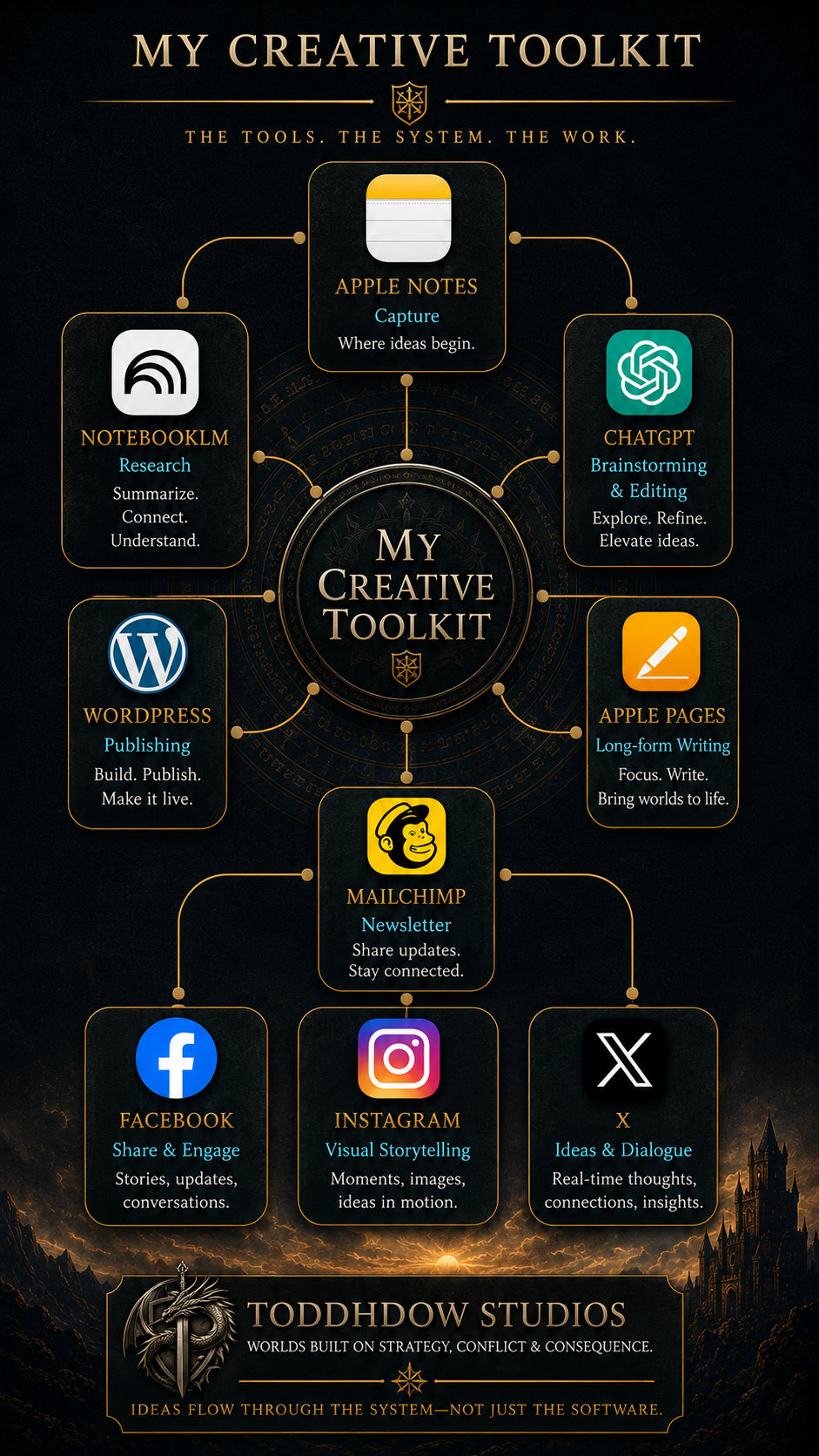
    The ToddHDow Studios Creative Toolkit.
    The ToddHDow Studios Creative Toolkit.

    If there’s one rabbit hole I’ve fallen into more times than I’d like to admit, it’s searching for the perfect writing software.

    Should I use Word?

    Pages?

    Scrivener?

    Ulysses?

    Obsidian?

    Google Docs?

    Something else entirely?

    The answer, I’ve discovered, is that none of them actually solve the problem.

    Software doesn’t create discipline.

    It simply supports it.

    Today my workflow uses a collection of tools because each one does something well.

    Apple Notes captures ideas before they’re forgotten.

    Pages is where my longer writing currently lives.

    Gemini Notebook (formerly NotebookLM) helps me organize and understand research.

    ChatGPT helps me brainstorm, edit, and think through problems.

    WordPress and Mailchimp help me share finished work with readers.

    Together, these tools form a pipeline rather than a collection of disconnected apps. Ideas flow naturally from one stage of the creative process to the next.

    One thing that surprised me while writing this article was realizing just how long some of these tools have been part of my life.

    ToddHDow.com has been running on WordPress for more than twenty years. If you browse my archive, you’ll find posts dating all the way back to December 2005. Mailchimp has been part of my workflow for well over a decade too. My very first subscriber – appropriately enough – was me, back on October 15, 2012.

    Looking back, I’m grateful that “past Todd” chose tools that proved reliable enough to grow alongside me.

    Those tools may or may not change someday.

    The habit of creating is the part I hope never does.

    Reading Is Part of Writing

    My bookshelf
    My bookshelf

    People often ask about my writing habits.

    Far fewer ask about my reading habits.

    The truth is they’re impossible to separate.

    Every book I read becomes part of my creative toolbox.

    History feeds Holy Wars.

    Cybersecurity and emerging technology shape Cryptogeddon.

    Stephen King constantly reminds me how powerful voice can be.

    Brandon Sanderson demonstrates the importance of structure, planning, and worldbuilding.

    Neal Stephenson encourages me to think bigger, research deeper, and ask more ambitious questions.

    Even books that seem completely unrelated to whatever I’m working on have a way of influencing what comes next.

    I’ve stopped thinking of reading as something that competes with writing.

    Reading is writing preparation.

    Still Learning

    One thing I’ve become comfortable admitting is that I don’t have this all figured out.

    My workflow changes.

    My software changes.

    My routines evolve.

    Every project teaches me something new.

    That’s part of the reason I wanted to create The Writer’s Notebook in the first place.

    Not because I have all the answers.

    Because I enjoy exploring the questions.

    Final Thoughts

    When I first imagined becoming a writer, I thought success depended on inspiration.

    Today, I think it depends on something much quieter: building an environment where inspiration has somewhere to go.

    For me, that environment is made up of habits as much as technology. Reading sparks new ideas. Apple Notes captures them before they’re forgotten. ChatGPT and NotebookLM help me explore and challenge them. Pages gives my books room to grow. WordPress, Mailchimp and my socials help me share finished work with readers. My publishing cadence keeps everything moving forward, one project at a time.

    None of those tools writes for me.

    None of them can replace curiosity, discipline, or creativity.

    But together they remove friction, helping me spend less time wondering how to create and more time actually creating.

    Perhaps that’s the systems engineer in me. After decades working in technology and cybersecurity, I’ve developed an instinct for choosing tools that are stable, reliable, secure, scalable, and well-supported – tools I can trust to grow with me instead of forcing me to start over every few years. The best technology quietly fades into the background, allowing the work itself to take centre stage.

    Looking back, I’m grateful that “past Todd” made some good decisions. WordPress has been home to ToddHDow.com for more than twenty years. Mailchimp has been part of my workflow for well over a decade. Those choices gave me continuity, allowing me to focus on creating instead of constantly rebuilding.

    That’s ultimately what this ecosystem is designed to do. Every tool, every habit, every book I read, every note I capture, every conversation I have with ChatGPT, every newsletter I send, and every social post I publish serves the same purpose: reducing friction so I can spend more time thinking, writing, and building worlds.

    Because in the end, writing isn’t about finding the perfect tool.

    It’s about building a life that keeps you curious enough to have something worth writing about.
  • Preparing for Game Night: Inside My DM Prep Process

    Preparing for Game Night: Inside My DM Prep Process

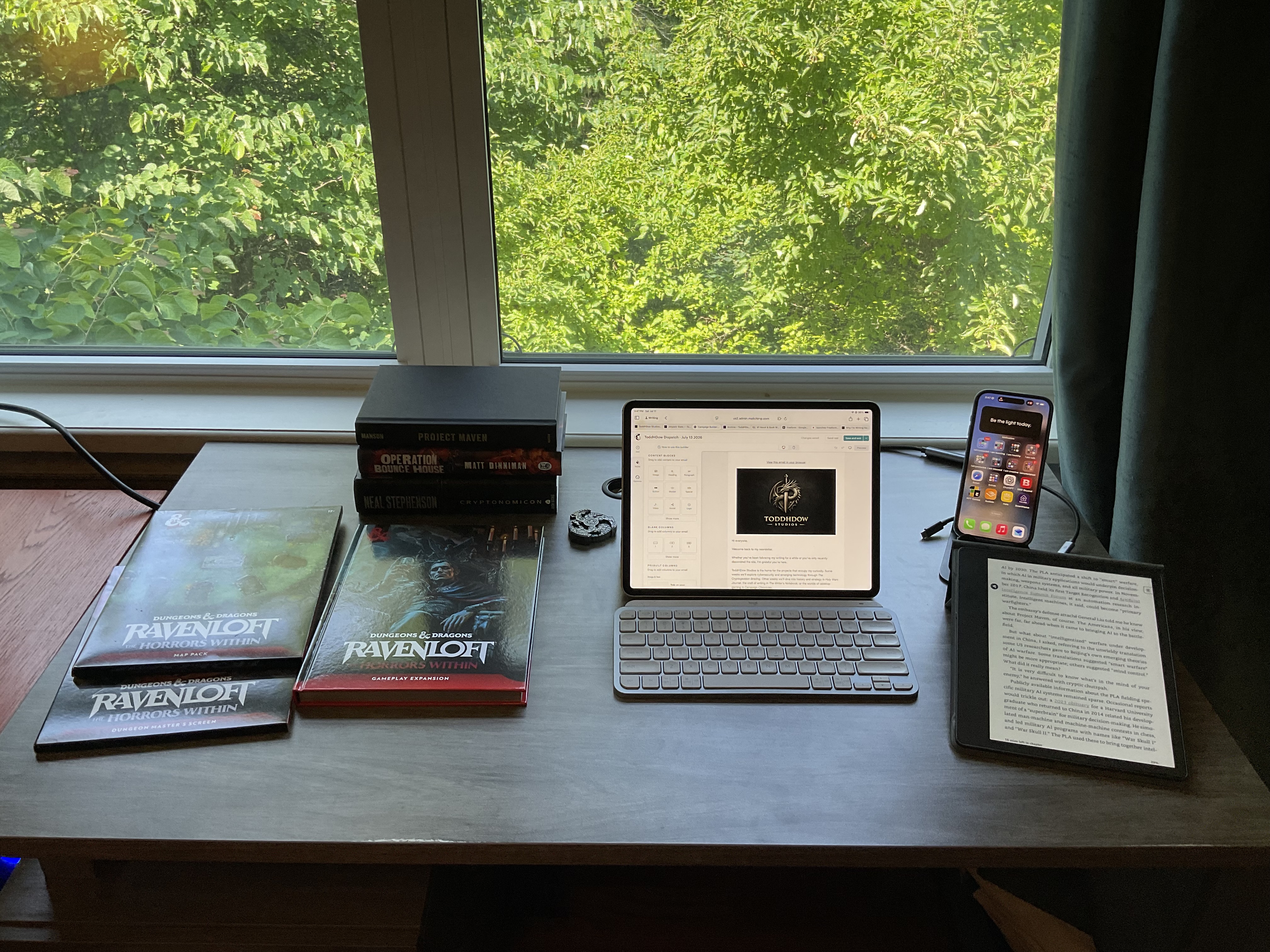
    My writing setup. This is where I do the bulk of my writing. My desk overlooks our beautiful backyard. In the summer, it is a forest of trees and greenery. In the winter, the leaves all disappear and I get a great view of our large backyard. I like the winter view better because without the tree cover, I am often able to catch glimpses of rabbits and deer wandering through our backyard.
    My writing setup. This is where I do the bulk of my writing. My desk overlooks our beautiful backyard. In the summer, it is a forest of trees and greenery. In the winter, the leaves all disappear and I get a great view of our large backyard. I like the winter view better because without the tree cover, I am often able to catch glimpses of rabbits and deer wandering through our backyard.

    One of the questions I get asked most often is surprisingly simple:

    “How much prep do you actually do before a session?”

    The honest answer?

    Less than I used to.

    That probably sounds strange coming from someone who loves worldbuilding, campaign design, and collecting maps, books, miniatures, and terrain. But over the last year or so I’ve realized that good prep isn’t about creating more material – it’s about creating the right material.

    The players are going to surprise me anyway.

    My job isn’t to predict everything they’ll do. My job is to know the world well enough that I can respond naturally when they inevitably wander off the path I expected.

    Here’s what my preparation process looks like before most game nights.

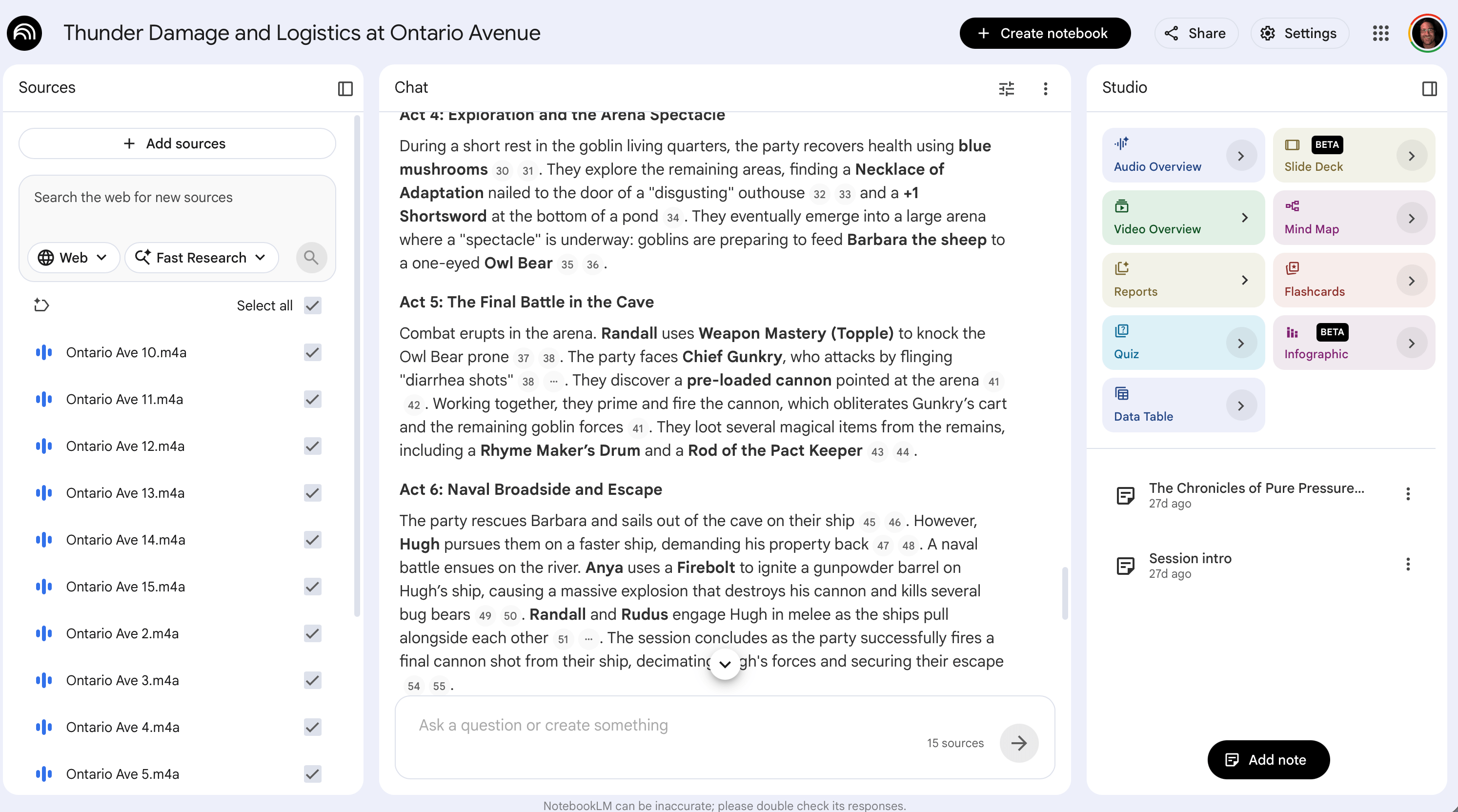
    NotebookLM summary of a recent D&D adventure session
    NotebookLM summary of a recent D&D adventure session.

    Step 1: Review the Last Session (if there was one)

    I never begin by opening my adventure book.

    Instead, I revisit what happened last session.

    One of the biggest improvements to my workflow has been recording my games and uploading them into NotebookLM. It transcribes the session, removes most of the table chatter, and gives me a surprisingly accurate summary of everything that happened. (I will definitely write more about this whole process in a future blog post!)

    Sometimes I’ll ask questions like:

    • What NPC promises are still unresolved?
    • Which plot hooks did the players ignore?
    • What clues did they discover?
    • Which character moments seemed important?

    It’s remarkable how often players accidentally create future story threads that I hadn’t planned.

    Those become some of the best parts of the campaign.

    Shadows of Sithicus D&D Encounter
    Shadows of Sithicus D&D Encounter

    Step 2: Decide What Matters

    I don’t prepare five different adventures.

    I prepare the one that’s most likely.

    If the party is halfway through Death House, that’s where my attention goes.

    If they’re travelling toward the Misty Forest, I prepare the Misty Forest.

    If there’s a reasonable chance they’ll completely derail the session…

    … I spend a little time preparing that possibility too.

    Experience has taught me that trying to prepare every possible outcome is impossible.

    Preparing the most probable outcome – and understanding the world around it – is far more effective.

    Step 3: Brainstorm with AI

    This is probably where my process has changed the most of the last year.

    I use AI extensively—not to replace my creativity, but to challenge it.

    I’ll ask questions like:

    • What motivations would this NPC realistically have?
    • Give me five encounter ideas that fit this location.
    • What clues would make this mystery more satisfying?

    Most of the suggestions never make it into the game.

    But one good idea out of twenty is worth the conversation.

    It’s like having another experienced Dungeon Master sitting beside me while I prep.

    Canvas maps and a Devil's playground.
    Canvas maps and a Devil’s playground.

    Step 4: Build the Table Experience

    This is the fun part.

    I’ll gather whatever I need for the session:

    • Maps
    • Miniatures
    • Terrain
    • Handouts
    • Letters
    • Props
    • Music
    • Ambient sound

    I’m a big believer that immersion comes from lots of small details rather than one expensive centerpiece.

    A weathered letter with a wax seal.

    A faded map.

    The right soundtrack.

    A miniature that perfectly represents the villain.

    None of these things are essential.

    Together, they make the world feel real.

    Step 5: Review the Rules

    Every session has one or two mechanics that deserve a refresher.

    Maybe a monster with unusual legendary actions.

    Maybe a spell interaction I haven’t seen in months.

    Maybe grappling.

    I don’t try to memorize every rule in D&D.

    Instead, I identify the handful of rules that are likely to matter in my next game.

    That dramatically reduces the number of pauses during play.

    The prep ends here. From this moment on, the players decide where the story goes, and I simply follow their lead—one decision, one surprise, and one dice roll at a time.
    The prep ends here. From this moment on, the players decide where the story goes, and I simply follow their lead—one decision, one surprise, and one dice roll at a time.

    Step 6: Prepare to Improvise

    This might sound contradictory after everything I’ve just described.

    But the goal of preparation isn’t to avoid improvisation.

    It’s to improvise with confidence.

    Once I know:

    • the NPCs,
    • the locations,
    • the motivations,
    • the likely encounters,
    • and the important rules,

    I’m comfortable throwing my notes aside if the players decide to do something unexpected.

    And they always do.

    Some of our most memorable sessions have come from moments I never could have prepared for.

    My Actual Prep Time

    People often imagine Dungeon Masters spending twenty hours every week preparing.

    Sometimes that’s true.

    Usually it isn’t.

    A typical weekly prep session for me looks something like this:

    • 20 minutes reviewing last session
    • 30 minutes brainstorming ideas
    • 30 minutes preparing encounters
    • 20 minutes gathering maps and assets
    • 20 minutes reviewing rules

    Roughly two hours.

    Some weeks it’s less.

    Some weeks—especially before major story arcs—it can be considerably more.

    But consistency beats marathon prep sessions every time.

    Dice. Maps. Miniatures. Character sheets. A laptop full of plans. Every session starts with the same tools - but no two adventures ever unfold the same way.
    Dice. Maps. Miniatures. Character sheets. A laptop full of plans. Every session starts with the same tools – but no two adventures ever unfold the same way.

    The Real Secret

    The biggest lesson I’ve learned isn’t about AI.

    It isn’t about terrain.

    It isn’t about miniatures.

    It isn’t even about preparation.

    It’s about trusting your players.

    Players don’t remember perfectly balanced encounters.

    They don’t remember every stat block.

    They remember impossible choices.

    Unexpected victories.

    Hilarious failures.

    The NPC who somehow became their favourite character despite only appearing for five minutes.

    That’s the magic we’re trying to create.

    Everything else is just preparation for those moments.

    What’s Next?

    Over the next few months I’ll be sharing more behind-the-scenes looks at how I run games, the tools I’m experimenting with, AI workflows that have genuinely improved my prep, and lessons I’ve learned from both successful sessions and spectacular failures.

    If you’re a Dungeon Master – or you’re thinking about becoming one – I hope some of these ideas help make your own game nights just a little easier to run.

    And if your players completely derail your carefully prepared session next week…

    Welcome to the club.

    And lastly, what did I miss? If I’ve overlooked anything, please do share in the comments below!

  • How I Use AI to Become a Better Dungeon Master

    How I Use AI to Become a Better Dungeon Master

    Artificial Intelligence has become one of the most valuable tools behind my DM screen.

    Whenever I mention that, people tend to assume one of two things. Either they think AI is somehow running my games for me, or they think it’s a gimmick that produces generic fantasy content.

    In reality, it’s neither.

    AI doesn’t replace my creativity. It amplifies it.

    It doesn’t run my campaigns. It helps me spend less time on administrative work and more time creating memorable experiences for my players.

    As both a professional in the cybersecurity industry and a lifelong Dungeons & Dragons enthusiast, I’ve spent a lot of time experimenting with AI tools. Some have been useful. Some have been disappointing. But over the past year, I’ve developed a workflow that has become a permanent part of how I prepare and run games.

    These are the five areas where AI has had the biggest impact on my Dungeon Mastering.


    1. Session Recaps and Campaign Memory

    If you’ve ever run a long campaign, you know that one of the biggest challenges isn’t creating content—it’s remembering everything that has already happened.

    Players forget details.

    Dungeon Masters forget details.

    That mysterious NPC from six months ago suddenly becomes important again, and everyone is frantically searching through old notes trying to remember who they were.

    This is where AI has become an absolute game changer.

    For my games, I record sessions and upload the recordings to NotebookLM. It automatically transcribes the audio and produces surprisingly accurate summaries of what happened during the session.

    What impresses me most isn’t the transcription. It’s the understanding.

    Anyone who has played D&D knows that a four-hour session isn’t four hours of story. There are side conversations, jokes, pizza discussions, technical issues, and random tangents.

    NotebookLM does an excellent job separating the signal from the noise.

    It identifies the important story beats, character decisions, combat outcomes, discoveries, clues, and roleplaying moments while largely ignoring the table chatter that isn’t relevant to the campaign.

    The result is a clean summary that I can reference later.

    I’ve also experimented with Claude and ChatGPT for campaign summaries, and both work very well once I have a transcript. However, NotebookLM is currently the only tool in my workflow that allows me to start with the raw session recording itself.

    The practical result is simple:

    My campaign notes are dramatically better than they used to be.

    I can quickly review previous sessions, refresh my memory before game night, and maintain continuity across long-running campaigns without spending hours writing notes after every session.


    2. Campaign Planning, NPC Development, and Encounter Design

    This is probably where AI saves me the most preparation time.

    One of the biggest misconceptions about AI is that it generates creativity.

    I don’t think that’s true.

    What it does exceptionally well is stimulate creativity.

    Every Dungeon Master has experienced creative roadblocks.

    You know where the story is going, but you’re not sure how to connect the dots.

    You have a villain, but their motivation feels weak.

    You have a dungeon, but the encounters feel repetitive.

    AI is an outstanding brainstorming partner.

    I regularly use it to explore:

    • Villain motivations
    • Political intrigue
    • Faction relationships
    • Campaign twists
    • Adventure hooks
    • Character backgrounds
    • Quest complications
    • Alternative story paths

    The same applies to NPCs.

    When players inevitably become fascinated by the one random merchant or tavern owner you never expected them to care about, AI can help generate personality traits, goals, fears, secrets, and relationships within minutes.

    Encounter design benefits as well.

    Rather than simply asking, “How many monsters should be in this room?” I can explore questions like:

    • What tactics would these creatures realistically use?
    • How would an intelligent villain prepare for this battle?
    • What environmental hazards would make this encounter more memorable?
    • What objectives exist besides defeating every enemy?

    The final decisions are always mine.

    But AI helps me explore possibilities much faster than I could on my own.


    3. Handouts, Letters, and Props

    One of the easiest ways to increase immersion in a campaign is to give players something tangible.

    A letter.

    A journal.

    A proclamation.

    A wanted poster.

    A cryptic note discovered in an abandoned ruin.

    The problem is that creating convincing props takes time.

    AI dramatically accelerates this process.

    Need a centuries-old journal entry from a doomed explorer?

    A noble’s formal letter to a rival family?

    A cultist’s encoded message?

    A desperate plea for help written during a siege?

    AI can produce a strong first draft in seconds.

    I still edit the final result to ensure it fits my campaign, but starting from a solid draft is much faster than staring at a blank page.

    For horror campaigns like Curse of Strahd or other Ravenloft adventures, this has been especially useful.

    Handouts make the world feel real.

    Players engage differently when they’re holding a physical document instead of simply listening to a description.

    AI allows me to create more of those immersive moments with significantly less preparation time.


    4. Generating Artwork

    I love visual aids.

    The challenge is that I am a writer, not an artist.

    Historically, Dungeon Masters had limited options for custom artwork.

    You could draw it yourself.

    Commission an artist.

    Search endlessly online hoping someone had already created something similar.

    Or simply go without.

    AI-generated art has changed that.

    Today I can create custom artwork for:

    • NPC portraits
    • Villains
    • Magic items
    • Cities
    • Taverns
    • Dungeons
    • Campaign scenes
    • Adventure handouts

    The most valuable aspect isn’t necessarily the quality of the art.

    It’s the specificity.

    When I create a completely original NPC, there usually isn’t existing artwork available that perfectly matches my vision.

    AI allows me to create visuals tailored specifically to my campaign.

    That means players are seeing my villain, not a random image pulled from a Google search.

    The same applies to locations, artifacts, and story moments.

    The world becomes more visually cohesive and immersive because the artwork is built specifically for that campaign.


    5. Answering Questions During the Game

    This might be the most underrated use of AI.

    Players ask questions.

    A lot of questions.

    Some are rules questions.

    Some are lore questions.

    Some are questions about events that happened twenty sessions ago.

    Others are questions that come completely out of nowhere.

    No Dungeon Master can remember everything.

    AI has become an incredibly useful assistant for helping answer questions quickly.

    Need clarification on a rules interaction?

    Need to remember the name of an NPC from months ago?

    Need to verify a piece of Forgotten Realms lore?

    Need a quick summary of a faction’s history?

    AI can often provide the answer faster than digging through books, notes, websites, and PDFs.

    That doesn’t mean I blindly trust every response.

    Like any tool, AI occasionally makes mistakes.

    But as a first-pass research assistant, it has become remarkably useful.

    In many cases it helps keep the game moving rather than bringing the session to a halt while everyone searches for information.


    The Real Value of AI for Dungeon Masters

    The biggest lesson I’ve learned from using AI is that it doesn’t replace the role of the Dungeon Master.

    It removes friction.

    The creativity still comes from me.

    The storytelling still comes from me.

    The worldbuilding still comes from me.

    The emotional moments, dramatic reveals, and memorable victories still happen between real people sitting around a table.

    What AI does is eliminate some of the busywork that gets in the way.

    It helps me remember more.

    Create more.

    Prepare more efficiently.

    And ultimately deliver a better experience for my players.

    That’s why AI has earned a permanent seat at my gaming table—not as the Dungeon Master, but as the Dungeon Master’s assistant.