How Christianity Got from “Turn the Other Cheek” to Holy War

About Holy Wars
Holy Wars is my ongoing exploration of the collision between religion, power, politics and violence—from the ancient world through the Crusades and beyond. It’s also part of a larger writing project examining how people come to believe that conflict can be sacred. [Read why I’m writing Holy Wars →]
Jesus did not die with a sword in his hand.
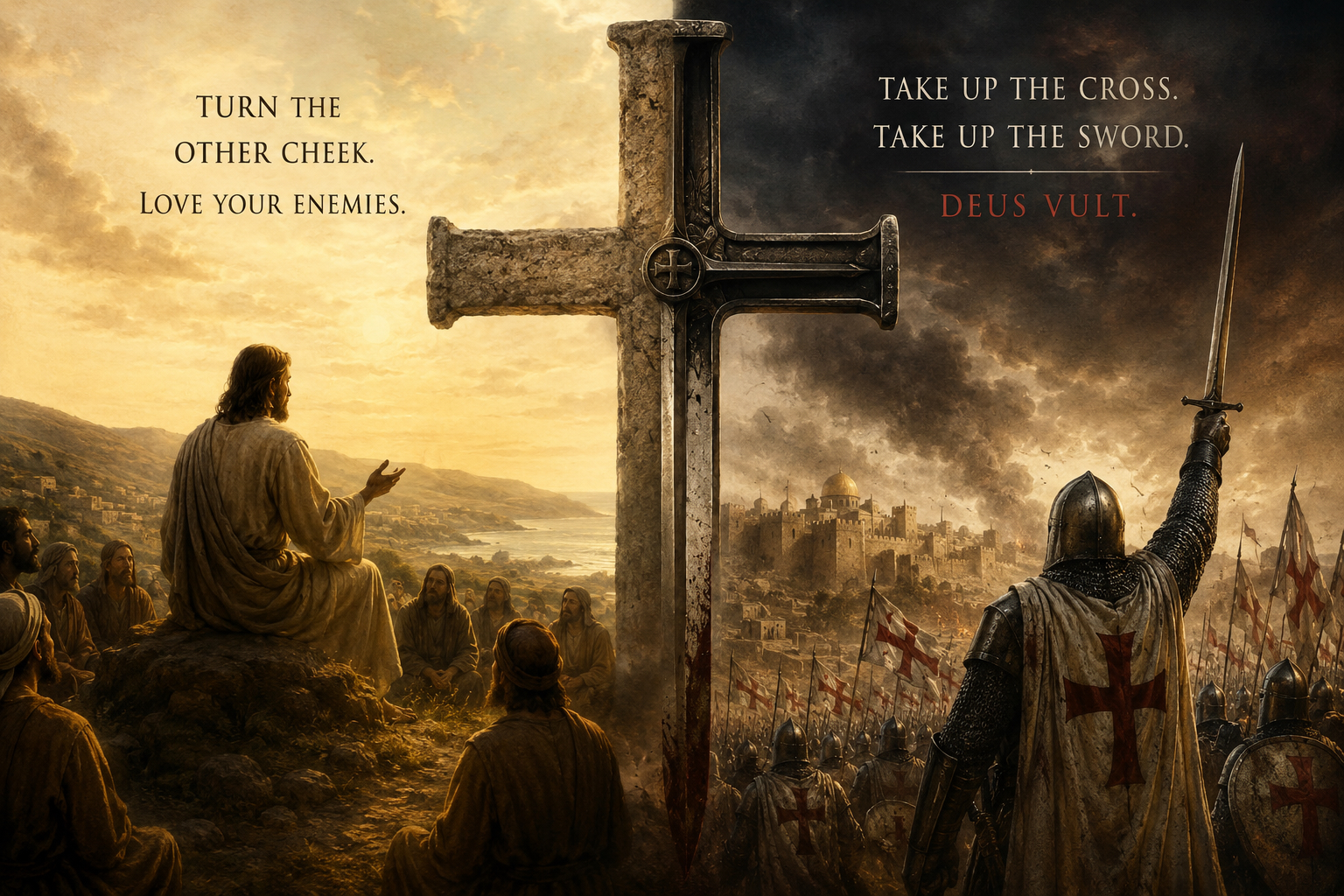
According to the Gospels, when one of his followers drew a weapon during his arrest, Jesus told him to put it away. In the Sermon on the Mount, he told his followers not merely to refrain from vengeance, but to turn the other cheek, love their enemies, and pray for those who persecuted them.
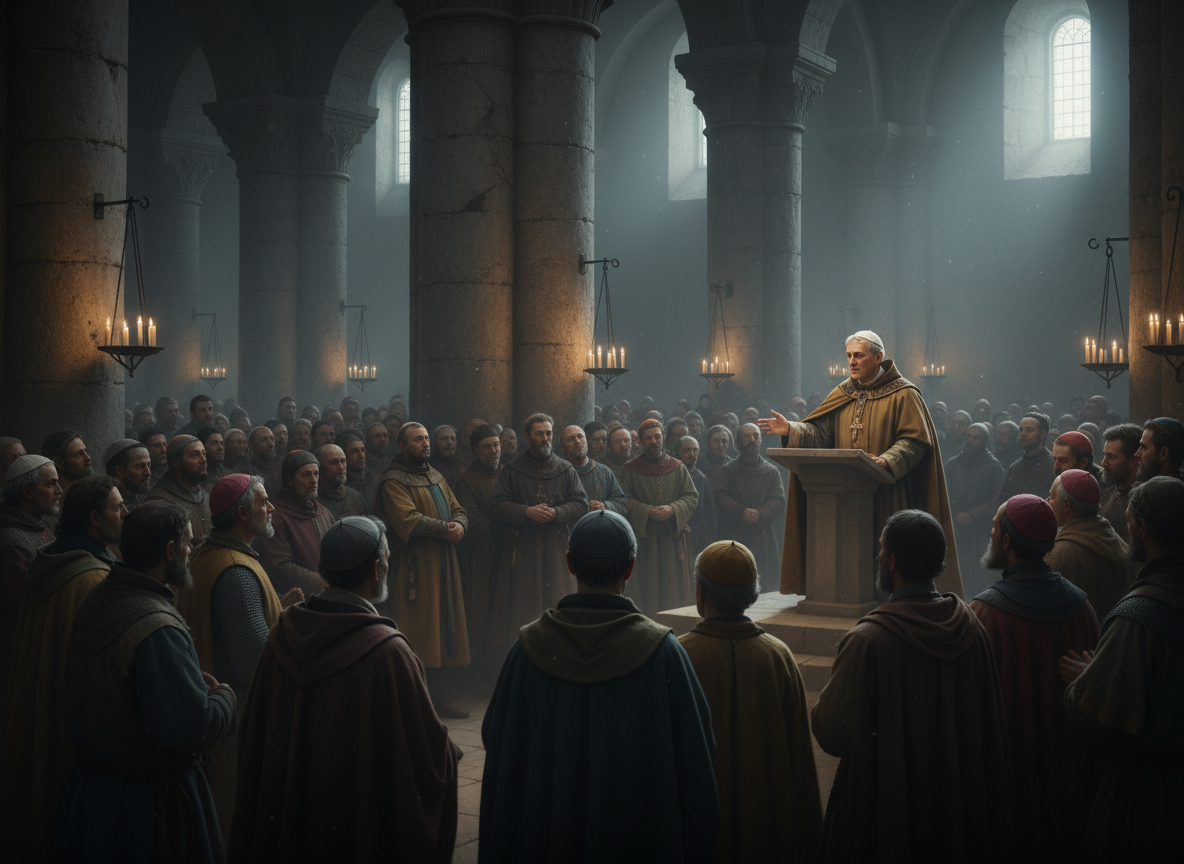
Then, nearly eleven centuries later, a pope stood before an assembly in France and called Christian warriors to march east.
They would sew crosses onto their clothing.
They would carry weapons into battle.
And according to surviving accounts of Pope Urban II’s speech at Clermont in 1095, those who undertook the expedition could receive remission of sins for doing so. Warfare had become intertwined with pilgrimage, penance, and the service of God.
It is difficult to imagine a more dramatic transformation.
How did a religion built around an executed teacher preaching love of enemies become a religion capable of producing armies marching beneath the cross?
The answer is not that Christians simply forgot what Jesus had said.
Nor did some medieval pope suddenly discover a convenient loophole in the Sermon on the Mount.
The transformation took centuries.
Christianity had to move from the margins of the Roman world to its centre. Christians had to stop thinking only about how an individual believer should respond to violence and begin asking what a Christian ruler should do when cities were attacked, borders crossed, innocents threatened, or order collapsed.
And somewhere along the way, the question changed.
First Christians asked:
Can a follower of Christ kill?
Later they asked:
When may a Christian fight?
Eventually, they would ask something more dangerous:
Could God actually want Christians to go to war?
That final question would change history.
A Religion Without an Army
The earliest Christians lived inside someone else’s empire.
They commanded no legions.
They controlled no borders.
They had no Christian king to advise, no Christian state to defend, and no Christian army to send into battle.
That matters.
For a persecuted religious minority, Jesus’ teachings about nonviolence could be taken with extraordinary seriousness. Martyrdom—not armed resistance—became one of early Christianity’s most powerful ideals.
Some early Christian writers were deeply suspicious of military service.
Around the beginning of the third century, Tertullian asked how a Christian could go to war when Christ had taken away the sword, famously connecting military violence with Jesus’ command to Peter to put away his weapon.
Origen likewise argued that Christians served the Roman Empire through prayer rather than by taking up arms. Christian writers could imagine themselves engaged in warfare—but their battlefield was spiritual. Their enemies were demons, sin, temptation, and evil.
Yet the picture was never completely simple.
Christians did serve in the Roman army. The surviving evidence makes that clear, and historians continue to debate how widespread early Christian pacifism really was. Objections to military service could also involve the pagan rituals, sacrifices, oaths, and imperial cult surrounding Roman military life—not simply the act of killing itself. Early Christian attitudes toward warfare were therefore complicated rather than uniformly pacifist.
Still, the dominant problem facing the early Church was clear.
Christians were trying to figure out how to live faithfully under imperial power.
Then came Constantine.
And Christians suddenly had to figure out what to do with it.
In This Sign, Conquer

On October 28, 312, Constantine fought his rival Maxentius outside Rome at the Battle of the Milvian Bridge.
What happened before the battle has become one of the most famous stories in Christian history.
Our ancient sources differ in important ways, but the Christian historian Eusebius later wrote that Constantine experienced a vision involving the Christian sign and was instructed to use it as protection against his enemies. Constantine subsequently associated his victory with the Christian God and increasingly adopted Christianity as the religion favoured by his imperial rule.
The symbolism is almost impossible to miss.
A religion whose founder had been executed by Rome was becoming associated with the Roman emperor.
And the cross—the instrument of that execution—was becoming a symbol of imperial victory.
In 313, Constantine and Licinius established religious toleration for Christians in what is conventionally called the Edict of Milan. Christianity did not immediately become Rome’s official religion; that development came later in the fourth century. But the age of systematic imperial persecution was ending, and Christianity was moving rapidly toward the centre of Roman political life.
That created an enormous theological problem.
It is relatively easy to condemn violence when someone else is responsible for defending the roads you travel, the cities you inhabit, and the borders behind which you live.
But what happens when the emperor himself becomes Christian?
What happens when soldiers become Christians?
What happens when the people responsible for maintaining order, punishing criminals, defending cities, and fighting invading armies are expected to follow a religion whose founder said:
Love your enemies.
Christianity now needed a theology not merely for martyrs.
It needed a theology for rulers.
Augustine and the Necessary Evil

No thinker would become more important to that transformation than Augustine of Hippo.
Augustine lived from 354 to 430, as the western Roman world was entering a period of profound instability. Rome itself was sacked by the Visigoths in 410, an event that helped inspire his monumental City of God. He lived in a world where questions about political authority, social order, violence, and the survival of civilization were anything but theoretical.
Augustine did not celebrate war.
That is crucial.
For him, warfare belonged to humanity’s fallen condition. A perfectly ordered world would have no need for it.
But Augustine also believed that refusing to confront evil could itself become morally irresponsible.
A ruler might sometimes be required to use force precisely because he had obligations to other people.
The Christian command to love an enemy therefore did not necessarily mean allowing that enemy to murder the innocent.
The important questions became why violence was being used, who had authorized it, and what the person using it intended to accomplish.
Across Augustine’s writings emerged ideas that later thinkers would develop into the Christian tradition of just war.
War required legitimate authority.
It required a just cause.
And it had to be directed toward justice and ultimately toward peace—not conquest, hatred, revenge, or bloodlust.
Augustine did not present these ideas as the neat checklist later generations sometimes attribute to him. His thoughts about war are scattered through works such as Contra Faustum, The City of God, and his letters. But the foundations are unmistakable.
Even a just war remained something tragic.
Augustine argued that the wise person should lament the necessity of such wars rather than rejoice in them.
War might sometimes be necessary.
It might even be just.
But it was not yet holy.
And that distinction is everything.
Just War Is Not Holy War
A just war says:
Sometimes Christians may fight without sinning.
A holy war says something considerably more powerful:
Sometimes Christians may fight because God wants them to.
Those are not the same idea.
Augustine helped open the theological door to Christian participation in warfare, but he did not preach medieval crusading centuries before it existed.
His framework primarily restrained warfare.
Violence required justification. Authority mattered. Motive mattered. Peace remained the proper goal. Augustine could appeal to biblical examples of wars commanded by God, but ordinary political violence did not automatically become sacred simply because Christians participated in it.
But once Christianity accepted that some wars could be morally righteous, another possibility existed.
If a war could be just, could certain wars become sacred?
That transformation would unfold slowly across the centuries after Rome.
The Warrior Enters Christendom
As the western Roman Empire disappeared, Christianity did not disappear with it.
Instead, it became one of the institutions around which medieval Europe rebuilt itself.
Kings became Christian kings.
Warriors became Christian warriors.
Battles were fought by armies carrying Christian symbols. Rulers sought divine favour. Priests blessed soldiers. Relics accompanied armies. Masses were celebrated for victory. Saints became associated with kingdoms and military campaigns.
None of this automatically created holy war.
But warfare was increasingly taking place inside a Christian moral universe.
The sword and the cross were no longer symbols belonging to separate worlds.
Over centuries, they were learning to coexist.
And medieval Christianity also faced a persistent contradiction.
Its warrior aristocracy was extraordinarily violent.
Knights who were supposed to defend Christian society were perfectly capable of spending their time fighting one another, raiding neighbouring lands, attacking rival lords, and terrorizing the very Christian populations they were theoretically supposed to protect.
The Church repeatedly tried to control that violence.
Movements such as the Peace of God and Truce of God attempted to restrict whom warriors could attack and when they could fight.
But another possibility gradually emerged.
What if knightly violence could be redirected?
What if warriors who normally fought other Christians could instead fight for Christendom?
That idea would prove revolutionary.
Scholars of medieval warfare describe the eleventh-century papacy as particularly important in the movement from just war toward holy war and ultimately crusade.
And in 1095, the pieces finally came together.
When War Became Penance

At Clermont, Pope Urban II called western Christians to aid Christians in the East and to journey toward Jerusalem.
We do not possess a verbatim transcript of his speech. The surviving versions were written afterward and differ in their details, so famous quotations from Clermont have to be treated carefully.
But on one point the tradition is remarkably significant.
The expedition was not presented merely as another war.
It carried spiritual consequences.
Participants took vows.
They adopted the cross as their sign.
The expedition was understood as a form of pilgrimage.
And remission of sins was attached to participation in the enterprise.
This was something new.
The Christian warrior no longer needed merely to ask whether fighting could be excused.
Under the right circumstances, fighting itself could become part of a penitential religious act.
The warrior became a pilgrim.
The military expedition became a sacred journey.
And the cross became not merely something a soldier prayed before.
It was something he carried into battle.
The long transformation was complete.
From the Cheek to the Sword

It would be easy to tell this story as one of simple corruption.
Jesus preached peace.
The Church acquired power.
Power corrupted Christianity.
The Crusades followed.
There is truth hidden inside that interpretation—but history is rarely that clean.
Christian rulers faced problems the earliest Christians had never been required to solve.
Could a Christian government allow its citizens to be slaughtered rather than resist?
Could it punish criminals?
Could it defend a city?
Could soldiers remain Christian?
Could violence ever protect rather than merely destroy?
Those were real moral questions.
Augustine’s answer was not that violence had suddenly become good.
It was that in a broken world, the refusal to use force could sometimes permit an even greater injustice.
That insight produced the Christian just-war tradition.
But ideas rarely remain exactly where their creators leave them.
Over the following centuries, permission became justification.
Justification became sanctification.
And eventually sanctified violence became crusade.
By 1095, Christians were no longer merely arguing that a soldier might fight and still remain a Christian.
They could be told that under extraordinary circumstances a Christian might take up the sword, march beneath the cross, and serve God through war.
That is the world from which the cry Deus vult emerged.
And it required nearly a thousand years to build.
The cross did not simply replace the sword.
Something far more consequential happened.
Christianity taught the sword how to carry the cross.
Sources & Further Reading
Primary sources
Tertullian, On Idolatry, especially Chapter 19, on Christian military service.
Eusebius of Caesarea, Life of Constantine, for the Christian tradition surrounding Constantine’s conversion, military victories, and adoption of Christian symbols.
Augustine, Contra Faustum, Book XXII, especially his discussion of warfare, legitimate authority, and divinely commanded violence.
Augustine, The City of God, especially Books IV and XIX, on war, justice, and peace.
Fulcher of Chartres and other surviving accounts of Pope Urban II’s speech at Clermont, collected by Fordham University’s Internet Medieval Sourcebook.
Modern scholarship
Jonathan P. Roth, “Early Christianity and War,” in The Cambridge Companion to Religion and War. The scholarship emphasizes that early Christian attitudes toward military service were more diverse than a simple pacifist-to-militarist narrative suggests.
Connor Wilson, “Rome, Byzantium, and the Idea of Holy War,” in The Cambridge Companion to the Literature of the Crusades.
The Cambridge World History of Violence discussion of medieval Latin Christianity emphasizes the particularly important role of the eleventh-century papacy in the transition from just war to holy war and crusading.