Tag: religion

  • The God Solution Promotion

    The God Solution Promotion

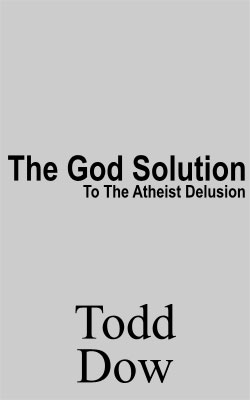
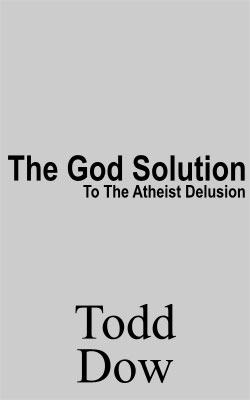
    The God Solution on Amazon.comThe God Solution on Kobobooks.comOver the next few posts, I’ll be promoting my new book, The God Solution To The Atheist Delusion. I’ll be posting portions of each chapter to give readers a chance to read some of my book.

    And, I’ll be offering a prize for one lucky reader: a $10 gift card to the online book seller of your choice (amazon.com, amazon.ca or kobobooks.com)!

    To win, you need to tweet a link to your answer this question: “Do you agree or disagree with the book, a particular chapter or an idea presented within a chapter of The God Solution?”

    You can answer this question as a response to one of my series posts on this blog or as a review on amazon.comamazon.cakobobooks.com or on goodreads.com.

    And then, you simply tweet a link to your review, including @toddhdow and #GodSolution in your tweet.

    At the end of this series (10 chapters, an appendix and a wrap-up post, I’ll select my favourite reply (yes, very subjective!) and award that person with a $10 gift card for their favourite online bookseller (amazon.com, amazon.ca or kobobooks.com). And I am open minded: I don’t discriminate against people that disagree with me. I’m looking for good quality responses, regardless of your perspective.

    So get your creative juices flowing. I look forward to seeing your responses!

    Todd

    The eBook “The God Solution” by Todd Dow can be purchased at amazon.com, amazon.ca and kobobooks.com.

  • The God Solution – available now on Kobo and Amazon!

    The God Solution – available now on Kobo and Amazon!

    The God Solution on Amazon.comThe God Solution on Kobobooks.comMy first published book is now available for purchase as an ebook on both Amazon and Kobo. This means that you can read it on pretty much any device out there (ipod, iphone, android, etc.)

    Here’s a synopsis of the book:

    In 2008, Richard Dawkins wrote a book called “The God Delusion”. The book offered a controversial critique of belief in God. I felt that his critique was flawed on numerous fronts. This book is a summary of my thoughts and a defence of my faith.

    Richard Dawkins’ book, The God Delusion, has become a go to source for Atheists when they attempt to dispel the validity of religion. Unfortunately, Dawkins’ arguments are flawed. In this thought provoking book, Todd Dow refutes The God Delusion through a thorough analysis of Dawkins’ arguments. Chapter by chapter, I pinpoint the issues with Dawkins’ arguments, outlining the flaws in Dawkins’ logic and offering valid and sound responses to each of the issues that Dawkins addresses.

    The following topics are addressed:
    Straw Men – Dawkins’ weak proofs of God
    The Ultimate 747 – Is that the best he’s got?
    Problems with Organized Religion
    The objective roots of morality
    The Historical Jesus
    The problem with fundamentalism
    The slippery slope of abortion
    Why not rid ourselves of religion, politics and economics?
    Childhood abuse and brainwashing
    On evolution and concluding thoughts

    And, as an added bonus, I have included an appendix that contains a thought experiment entitled, “Should Atheists Have Children?”

    Please do go pick up a copy of my book and let me know what you think – feel free to offer your feedback in the comments below and (more importantly) provide your feedback on my book page on Amazon.com or Kobobooks.com.

    Happy reading!

    Todd

  • The God Solution – available now!

    The God Solution

    It’s official! My first published book is now available for purchase.

    The book is now available as an ebook and you can read it on your Kindle or on the Kindle Reader, which works on pretty much every device out there (ipod, iphone, android, etc.).

    In 2008, Richard Dawkins wrote a book called “The God Delusion”. The book offered a controversial critique of belief in God. I felt that his critique was flawed on numerous fronts. This book is a summary of my thoughts and a defence of my faith.

    Richard Dawkins’ book, The God Delusion, has become a go to source for Atheists when they attempt to dispel the validity of religion. Unfortunately, Dawkins’ arguments are flawed. In this thought provoking book, Todd Dow refutes The God Delusion through a thorough analysis of Dawkins’ arguments. Chapter by chapter, I pinpoint the issues with Dawkins’ arguments, outlining the flaws in Dawkins’ logic and offering valid and sound responses to each of the issues that Dawkins addresses.

    The following topics are addressed:
    Straw Men – Dawkins’ weak proofs of God
    The Ultimate 747 – Is that the best he’s got?
    Problems with Organized Religion
    The objective roots of morality
    The Historical Jesus
    The problem with fundamentalism
    The slippery slope of abortion
    Why not rid ourselves of religion, politics and economics?
    Childhood abuse and brainwashing
    On evolution and concluding thoughts

    And, as an added bonus, I have included an appendix that contains a thought experiment entitled, “Should Atheists Have Children?”

    Please do go pick up a copy of my book and let me know what you think – feel free to offer your feedback in the comments below and (more importantly) provide your feedback on my book page on Amazon.com.

    Happy reading!

    Todd

  • The God Solution – available soon!

    The God Solution – available soon!

    The God SolutionI am finally publishing a book! My first effort at book writing is currently “in review” at Amazon. I expect it to be available for sale within the next day or so on amazon.com. The book will be available as an ebook and you’ll be able to read it on your Kindle or on the Kindle Reader, which works on pretty much every device out there (ipod, iphone, android, etc.).

    In 2008, Richard Dawkins wrote a book called “The God Delusion”. The book offered a controversial critique of belief in God. I felt that his critique was flawed on numerous fronts. This book is a summary of my thoughts and a defence of my faith.

    Richard Dawkins’ book, The God Delusion, has become a go to source for Atheists when they attempt to dispel the validity of religion. Unfortunately, Dawkins’ arguments are flawed. In this thought provoking book, Todd Dow refutes The God Delusion through a thorough analysis of Dawkins’ arguments. Chapter by chapter, I pinpoint the issues with Dawkins’ arguments, outlining the flaws in Dawkins’ logic and offering valid and sound responses to each of the issues that Dawkins addresses.

    The following topics are addressed:
    Straw Men – Dawkins’ weak proofs of God
    The Ultimate 747 – Is that the best he’s got?
    Problems with Organized Religion
    The objective roots of morality
    The Historical Jesus
    The problem with fundamentalism
    The slippery slope of abortion
    Why not rid ourselves of religion, politics and economics?
    Childhood abuse and brainwashing
    On evolution and concluding thoughts

    And, as an added bonus, I have included an appendix that contains a thought experiment entitled, “Should Atheists Have Children?”

    Stay tuned – I’ll update my blog as soon as the book is available for sale.

    Todd


  • Tension in Tolerence: A Review of Brian McLaren’s “A Generous Orthodoxy” – Part IV

    While I do value the dynamic nature of McLaren’s system, I am concerned with how it is conceived. McLaren’s grounding is not clear. Are we to start with scripture? If so, how are we to interpret it? Or are we supposed to start with our own intuition? Or do we abandon established belief in favour of a new mash-up that includes socially acceptable rules while doing away with the more unpopular ideas?

    I do support the idea of cross-denominational collaboration. And by extension, I also support the idea of inter-faith dialogue as well. McLaren’s approach lends itself well to generating the kind of humility that is required to open up a positive dialogue between competing denominations. The current decentralized model of Christian ministry and mission are valuable in terms of covering a wide variety of causes and needs, but I often wonder how much more effective some Christian ministries would be had they aligned or pooled their resources with other Christian denominations to accomplish the same goals. The impact of these “coalitions” would be tremendous.

    And while I do appreciate McLaren’s attempt to adapt Christian thought with contemporary issues like postmodernism and secularization, I do find myself drawn to the “Radical Reformation” approach of the Anabaptists, whereby they forgo many of the progressive technological advancements in favour of a simpler way of life as a conscious decision to focus more on community than on “speed, style, technology, convenience, efficiency and mechanization” (McLaren, 230). To me, the Anabaptist approach of making Jesus Christ central and keeping uncluttered lives makes a great deal of sense. And, that ideal seems to be unchanged over time, which suggests that theological adaptations to contemporary issues are not required.

    The urgency of discerning an appropriate worldview has recently been on the front burner for me. My father has been struggling with a blood disorder for the last year and it has just recently manifested itself in acute leukemia. This affliction is terminal and it will soon result in my father’s death. Thus, the need for “an accurate orthodoxy” in my life is quite pressing. Ultimately, we cannot be certain of any of our beliefs. McLaren offers a hopeful enterprise by suggesting that we simplify our approach to theology by focusing not on the divisive aspects, but instead focusing on the similarities of different denominational attitudes. I like this approach, as it suggests an inclusiveness that we can all participate in. I find this particularly settling for me as I contemplate my father’s destiny as he negotiates his peace with God.

    I believe that McLaren’s strategy is viable, helpful and constructive. It provides an inclusive nature in which anyone can recognize their own denominational strengths, while also marginalizing their weaknesses. One can only hope that the strengths continue to be accentuated while the weaknesses are actually suppressed. As a whole, I enjoyed the book. It does present a tension that cannot be easily settled, but I believe that this tension is part of the beauty of the book. Without addressing the tension between denominations, the hope for interfaith fellowship cannot be attained. And without a central discussion, the kingdom of God cannot be fully realized nor can Jesus’ directive to live in love be fully experienced.

    Todd Dow