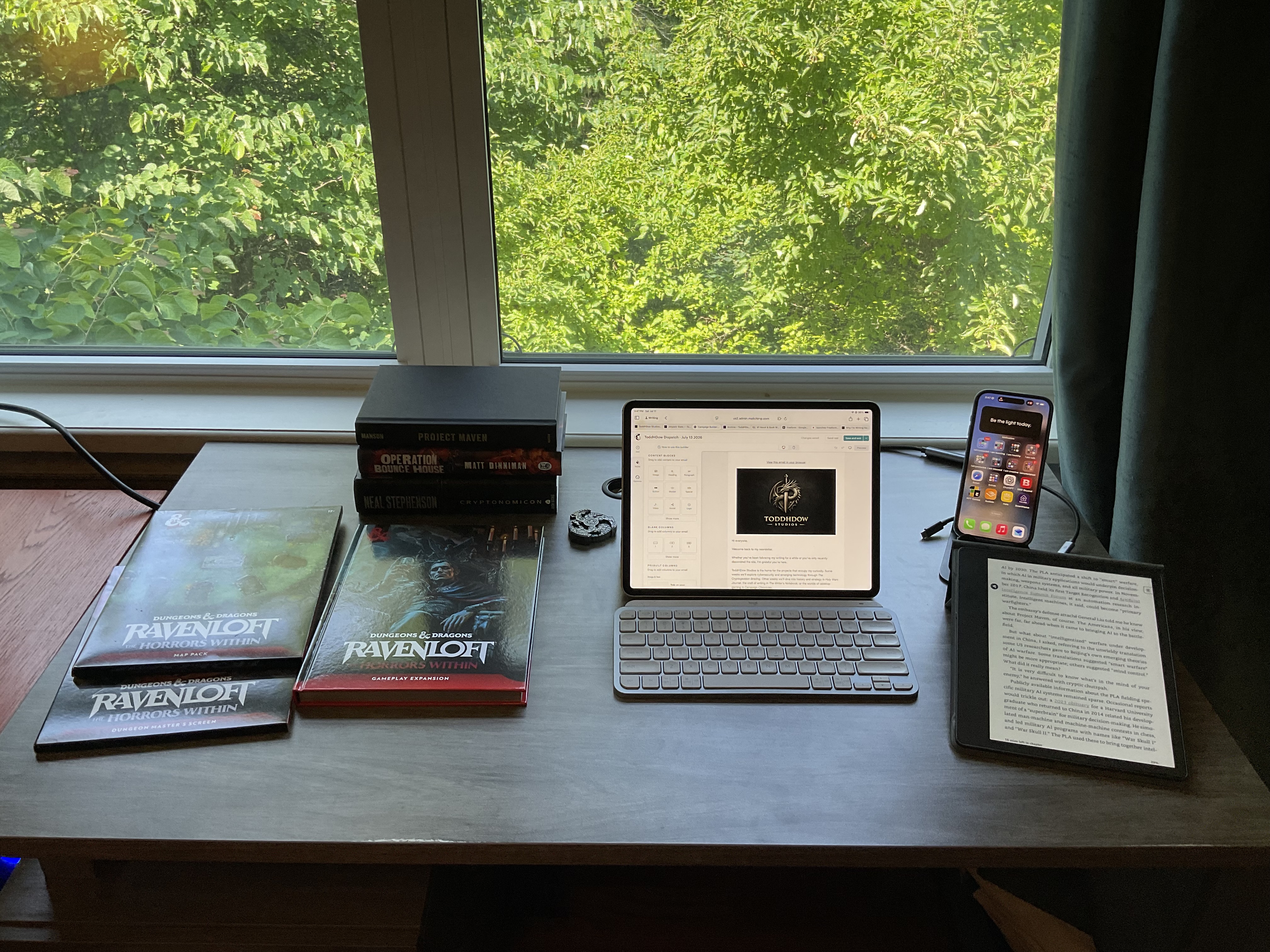

There is a dangerous thing that happens when you decide to run Curse of Strahd and you also happen to really like maps, miniatures and terrain.
You start thinking you need to build Barovia.
Not metaphorically.
Actually build it.
Castle walls. Village streets. Crypts. Graveyards. Haunted houses. Forests. Taverns. Ruined churches. Coffins. Gallows. Furniture. Hundreds of miniatures.
And because Curse of Strahd may be one of the most visually evocative Dungeons & Dragons campaigns ever written, there is always something else you can buy.
Over the past several months, I’ve been trying to figure out how I want this campaign to look and feel at my table. I’ve experimented with printed maps. I’ve built rooms with WarLock Tiles. I’ve accumulated undead miniatures. I’ve looked at gothic terrain, buildings, roofs, dungeon systems and some very expensive premium campaign products.
And somewhere along the way, I realized I was asking the wrong question.
The question isn’t:
How do I physically recreate Barovia?
It’s:
Which moments in Barovia deserve to become physical?
That distinction has changed almost everything about how I’m preparing this campaign.
Death House Taught Me the Problem

Death House was my first real experiment.
I love physical D&D. I like putting miniatures on the table. I like walls around the characters. I like doors that actually open and furniture scattered around rooms.
Especially in horror.
There is something very different about telling the players that their characters are descending into a dark basement and actually putting a narrow stone corridor in front of them.
So naturally, I started building.
I have a substantial collection of WarLock Tiles, including the Mega-Dungeon sets and various dungeon accessories. They’re fantastic pieces. The walls look great, the doors work, and once everything is assembled the result feels much more like a place than a drawing on a battle mat.
But Death House revealed two problems very quickly.
The first was scale.
My gaming table is about 39 by 82 inches. A properly scaled Death House map with one-inch squares is roughly 34 by 47 inches.
That’s one house.
Castle Ravenloft makes Death House look like a garden shed.
The second problem was prep.
Building an entire dungeon from WarLock Tiles is cool.
Building an entire dungeon from WarLock Tiles before every game is something else entirely.
It takes time. You need enormous numbers of pieces. You inevitably discover that the wall you need is the one wall you ran out of. And once everything is finished, you have to store it, move it, reveal it to the players without exposing half the dungeon, and eventually take the entire thing apart again.
Death House also taught me something else that I didn’t fully appreciate at first:
It’s unusually well suited to this treatment.
It’s a self-contained haunted house. The rooms are relatively small. The dungeon beneath it is compact. The geography matters. Doors, hallways, stairs and room positioning all contribute to the claustrophobic feeling of exploring the place.
In other words, Death House is one of the relatively few major locations in Curse of Strahd where reproducing almost the entire thing at true miniature scale actually makes sense.
Once the campaign opens up, that gets harder.
Barovia becomes villages, forests, wineries, abbeys, ruined mansions, swamps, mountains, temples and, eventually, an enormous castle.
Trying to give all of those places the Death House treatment would become a campaign unto itself.
At some point I had to admit something:
More terrain does not automatically mean a better game.
Sometimes it means I’ve spent an hour building a hallway my players will walk through in thirty seconds.
That realization became the foundation for how I’m approaching the rest of Barovia.
Maps Are Becoming My Foundation

The biggest breakthrough for me has probably been the maps.
Rather than trying to build every important location entirely out of terrain, I’ve started having the actual Curse of Strahd battlemaps I use through D&D Beyond printed as large physical canvas maps for my table.
And I love them.
For most of the maps, I’m aiming for roughly 33 × 44 inches, with some smaller locations around 22 × 33 inches. The important part is preserving something close to a one-inch grid, because I don’t want these to be decorative maps. I want standard miniatures to work naturally on them.
I worked with a local printer to get the sizing right, measuring the maps so that the grid reproduces at approximately miniature scale. We experimented with different approaches, and canvas quickly became my preferred option.
It’s durable.
It rolls up.
It has a satisfying physical presence when it hits the table.
And, perhaps appropriately for Curse of Strahd, there is something about unrolling a large canvas map that feels more like revealing an old map than putting down a giant poster.
More importantly, it solves the problem Death House exposed.
Instead of rebuilding every wall, room and corridor with plastic terrain, the canvas map can provide the entire architectural foundation of the encounter.
Then I build up from it.

Doors.
Tables.
Stairs.
Coffins.
Rubble.
Pillars.
Bodies.
Trees.
Walls where sightlines particularly matter.
And, of course, miniatures.
The map does the architecture.
Terrain provides the texture.
Miniatures provide the characters and threats.
And my description provides everything else.
That’s increasingly feeling like the sweet spot for the way I want to run Curse of Strahd.
Premium Isn’t Automatically Better

This process has also changed how I think about some of the premium products available for the campaign.
At one point I was seriously considering spending roughly C$550 on the Beadle & Grimm’s Curse of Strahd set.
And to be clear: it’s an impressive product.
There is a tremendous amount of physical material in that box, including a huge collection of maps. For someone who wants a premium, ready-to-run physical presentation of the campaign, I completely understand the appeal.
But when I looked closely at the maps themselves, I realized something slightly inconvenient:
I preferred mine (or rather, the DNDBeyond versions of mine).
Not because the Beadle & Grimm’s maps are badly made. It’s purely an aesthetic preference. I’m simply not particularly fond of the artistic styling they’ve chosen for some of them.
I prefer the maps I’ve already been using while preparing Curse of Strahd through D&D Beyond.
They look like my Barovia.

I’ve spent hours reading the adventure while looking at those locations. I know where things are. I recognize the visual language. And now I can take those same maps, have them printed on canvas at a size that works with my miniatures, and bring that version of the campaign directly onto my table.
That made me realize that premium doesn’t necessarily mean better for my game.
I’m obviously willing to spend money on this hobby. But I’m becoming more selective about where I spend it.
The question isn’t whether something is impressive.
It’s whether it actually makes the game I’m trying to run better.
Sometimes the expensive boxed solution will be exactly what I want.
Sometimes a canvas print from my local printer will make me happier.
I’m getting much better at recognizing the difference.
Castle Ravenloft Changes Everything

Castle Ravenloft is where this philosophy gets its biggest test.
It is enormous.
Trying to reproduce the entire castle at true one-inch miniature scale would require a ridiculous amount of table space, an equally ridiculous number of maps or terrain pieces and an extraordinary amount of preparation.
And I don’t think it would actually improve the game.
More importantly, I’ve realized that Castle Ravenloft presents two completely different mapping problems.
The first is exploration.
Much of Ravenloft is about moving through the castle.
Characters wander corridors, climb staircases, open doors, enter strange rooms, double back, descend into crypts and gradually develop a mental picture of this enormous gothic labyrinth.
That doesn’t require every five-foot square to exist physically on my table.
In fact, I think trying to do that might actually hurt the experience.
For exploration, the published map scale works perfectly well. I can track the party’s movement behind the DM screen while describing what they see and letting the castle form in their imaginations.
That’s effectively the strategic map of Ravenloft.
But then there is the second problem:
Combat and drama.
If the party enters the chapel and something terrible is waiting for them…
If they reach the Heart of Sorrow…
If they descend into an important section of the catacombs…
If they enter Sergei’s tomb…
Or if the Tarokka reading ultimately sends them to some particular room for the final confrontation with Strahd…
Then suddenly exact positioning matters.
That’s when I want a tactical map.
One-inch scale.
Miniatures.
Terrain.
Doors.
Furniture.
Elevation where I can create it.
The whole table changes.
So Castle Ravenloft isn’t really a choice between physical maps and theatre of the mind.
It’s both.
Strategic mapping for exploration. Tactical mapping when combat or drama warrants it.
And I think that’s going to work far better than trying to reproduce an entire castle just because I technically could.
It also creates something I’m increasingly interested in using deliberately:
contrast.
If every room gets an elaborate physical setup, eventually elaborate becomes normal.
But if we’ve spent twenty minutes exploring Ravenloft through description and imagination and then I suddenly unroll a massive canvas map, start placing terrain and reach for the miniature case?
The players immediately know something has changed.
This place matters.
That’s exactly the feeling I want.
Terrain as Set Dressing, Not Architecture

That has also changed what kinds of terrain I’m interested in buying.
Originally, I was looking at terrain primarily as a way to construct locations.
Now I increasingly think of terrain as set dressing.
WarLock Tiles are still incredibly useful. Dirt Cheap Dungeons is interesting because it offers another flexible way to create rooms without needing thousands of individual plastic pieces.
But I’m also much more interested in things that can transform an otherwise flat map.
A staircase.
A ruined wall.
A tomb.
A statue.
A fireplace.
A table covered with food.
A gallows.
A pile of bones.
A few trees.
A crypt entrance.
Those things don’t have to reproduce every square inch of the adventure.
They simply have to make the players believe in the space.
I’ve bought Gamemat.eu’s gothic terrain with exactly this in mind. The same is true of village-building pieces and roof systems that can give places like Barovia and Vallaki some verticality without requiring me to construct an entire model village.
I already have things like the Yawning Portal Inn terrain that can be repurposed for tavern interiors and other buildings.
That’s increasingly how I want the collection to work.
Not:
This piece belongs to this encounter.
But:
This piece belongs to Barovia.
Miniatures Are Different

Miniatures are the area where I’m still willing to get fairly specific.
Partly because I love them.
But also because monsters are where physical representation has the greatest tactical value.
Death House made that obvious.
I’ve had to make sure I have things like ghouls, shadows, ghasts, a grick, a mimic, ghostly children, a specter, cultists and, eventually, something suitably horrible to represent the shambling mound.
I’ve also been steadily building out the larger population of Barovia: undead, vampires and other Ravenloft creatures, including WizKids’ Denizens of Barovia and Denizens of Castle Ravenloft collections.
Here again, though, I’m trying to think in terms of reuse.
Four good ghoul miniatures aren’t Death House miniatures.
They’re Barovia miniatures.
Skeletons, zombies, wolves, ghosts, cultists and vampire spawn are going to appear again.
Those are easy purchases to justify.
An incredibly specific creature that appears once for ten minutes?
Maybe it gets a miniature.
Maybe it doesn’t.
And I’m becoming increasingly comfortable with that.
What I’m Not Doing

This might actually be the most important part of the entire project.
I’m learning what not to buy.
I’m not building a gaming table with an embedded television.
I’ve considered digital-table solutions, and I use digital tools extensively for preparation—especially D&D Beyond Maps and, when I want more automation, Foundry.
But I don’t want my home game centred around a television screen.
I like dice.
I like miniatures.
I like players physically moving characters around a map.
I want this particular campaign to feel tactile.
I’m also not trying to physically build the entirety of Castle Ravenloft.
I’m not buying custom terrain for every cabin, road encounter and abandoned room.
And I’m not automatically buying the most elaborate version of something simply because it exists.
That’s probably the biggest shift in my thinking.
When I started preparing Curse of Strahd, there was a part of me that looked at premium terrain, collector’s editions and giant campaign boxes and thought:
Well, obviously the ultimate version of this campaign requires the ultimate version of all this stuff.
It doesn’t.
The best version of Barovia isn’t necessarily the one that costs the most money.
It’s the one where the things I put on the table actually contribute to the experience.
I don’t really want someone else’s complete physical version of Barovia.
I want to build my version of it.
Slowly.
Selectively.
So Which Locations Get Canvas Maps?
This list will undoubtedly change as the campaign develops, but these are the locations I’m currently most interested in giving proper physical maps – or particularly elaborate physical treatment.
Definitely
- Death House – the prototype, and probably the best example of an entire location that works at miniature scale.
- Old Bonegrinder – compact, memorable and almost guaranteed to become an important encounter.
- The Coffin Maker’s Shop – exactly the kind of smaller location where tactical geography could suddenly matter a great deal.
- The Wizard of Wines – a major encounter location with enough moving parts to benefit from having the battlefield clearly represented.
- Yester Hill – visually dramatic, tactically interesting and almost begging for terrain.
- Argynvostholt – another location where selective physical presentation could make the place feel much more substantial.
- The Abbey of Saint Markovia – strange enough, important enough and memorable enough to deserve something special.
- Berez – swamp terrain, ruined buildings and Baba Lysaga offer enormous potential for a fantastic table.
- The Amber Temple – one of the defining locations of the campaign and exactly the sort of place where I want the physical table to reinforce its importance.
Castle Ravenloft
Ravenloft gets its own category because I don’t intend to print the entire castle at one-inch scale.
Instead, I want tactical maps available for the rooms that become important in our campaign.
That might include:
- The chapel
- The dining hall
- The audience hall
- The Heart of Sorrow
- Important portions of the catacombs
- Sergei’s tomb
- Any room identified by the Tarokka reading as especially significant
- And, obviously, wherever the final confrontation with Strahd ultimately happens
Some of those maps may never come out.
That’s fine.
The point isn’t to put every map I’ve made onto the table.
The point is to have the right one when the moment deserves it.
Probably Not
And then there are all the places that don’t need bespoke physical maps at all.
A random road encounter in the Svalich Woods?
I have forest terrain.
A fight in an unnamed cottage?
Generic interiors work.
A crossroads?
A clearing?
A small crypt?
A campsite?
A minor encounter on a village street?
Those can happen on reusable battlemats, generic terrain or entirely through theatre of the mind.
Not every place needs to become an artifact.
The places that matter can.
The Table Is Part of the Story

I think that’s the biggest lesson I’ve learned from all of this.
Maps, terrain and miniatures aren’t the game.
They’re tools for controlling attention.
When the players walk into an ordinary room, maybe I describe it.
When something starts moving in the darkness, maybe a few miniatures appear.
When they enter one of the defining locations of the campaign, suddenly a massive canvas map rolls across the table and the terrain comes out.
That’s storytelling.
The physical table becomes another way of changing the camera angle.
And because I’m not trying to make every moment visually spectacular, I can spend more time – and money – making the important moments unforgettable.
That’s the Barovia I want my players to remember.
Not a perfectly reconstructed model of every building Strahd von Zarovich owns.
A foggy road imagined in their heads.
A tavern assembled from familiar terrain.
A graveyard appearing beneath their miniatures.
A dungeon slowly filling with ghouls and shadows.
A swamp covered in ruins as Baba Lysaga’s hut rises in front of them.
And then, much later, the moment when they finally enter a room in Castle Ravenloft and realize from what I’ve put in front of them:
Oh.
This is where it’s going to happen.
I’m still building Barovia.
I’m just learning that I don’t need to build all of it.
How do you handle maps and terrain in your games? Do you build elaborate encounters, use printed battlemaps, play mostly theatre of the mind—or, like me, keep changing your mind and buying more miniatures anyway?