

A family history, a forgotten genealogy, and a project that may become something stranger

In October 2023, I stood on a street in Newburyport, Massachusetts, trying to picture a house that had disappeared centuries ago.
Cars moved past us. People walked between shops and restaurants. Across the road stood the public library where Jen and I had spent part of the day poring over maps and speaking with local historians. A seventeenth-century property transfer and a map drawn decades later had helped us narrow the location. Somewhere near where I was standing had been the home of Thomas Dow, my earliest currently known ancestor.
Thomas arrived in Newbury in 1639 with his wife, Phoebe, and at least one child. Nearly four hundred years later, I had come looking for him.
It was a strange and powerful feeling to think that I might be walking over the same ground he had once walked. The town around me had changed beyond anything he could have imagined, but the place itself remained. For a moment, the distance between 1639 and the present did not feel quite so enormous.
That moment was part of a search that had begun many years earlier, with an old book passed from my father to me.
The Book My Father Gave Me

My copy of The Book of Dow was published in 1929.
Its full title is The Book of Dow: Genealogical Memoirs of the Descendants of Henry Dow 1637, Thomas Dow 1639 and Others of the Name, Immigrants to America During Colonial Times. Written and compiled by Robert Piercy Dow, it contains hundreds of pages of names, dates, marriages, migrations, military service, occupations, scandals, tragedies and small glimpses into lives that would otherwise have disappeared completely.
My dad had told me about the book over the years. When I became interested in researching our family history, he gladly handed it down to me.
I cannot remember precisely when that happened. I was either studying at university as a mature student or had received it not long before my father died. He was battling leukaemia during those years, and much of that period now blends together in my memory.
What I do remember is that he knew the book mattered to me.
At the time, I likely thought of it primarily as a useful research tool. Looking back, I understand that he was giving me something more than information. He was passing along a connection to our family’s past—and perhaps, without either of us quite realizing it, the responsibility to keep asking questions.
My father died in 2009.
The book remains with me.
A Family Tree That Begins with a Mystery

According to The Book of Dow, my direct paternal line reaches back to Thomas Dow, who appears in Newbury in 1639.
Before that, the trail goes cold.
Robert Piercy Dow and the researchers who preceded him tried extensively to establish Thomas’s origins in England, Scotland or Ireland. They found far too many men with the same name and no reliable way to identify which – if any – was the man who crossed the Atlantic.
The book remarks that twelve men named Thomas Dow were buried in Dublin in a single year. In Scotland, the recorded Thomas Dows from the fifty years preceding 1639 were supposedly too numerous to fit on a page.
And so my documented family history begins not with an answer, but with a dead end.
In 1639, Thomas Dow simply appears.
He was a Puritan living in the Massachusetts Bay Colony. He was admitted as a freeman in 1642. He and Phoebe had several children. The family appears to have been desperately poor, and the book suggests that Thomas suffered from malnutrition. He later moved to Haverhill, where he died in 1654 at approximately thirty-nine years old.
That is where the known story begins.
But where did he come from?
Why did he leave?
What did he expect to find in New England?
What kind of man risks an Atlantic crossing with a young family, only to spend the remaining years of his life struggling against poverty?
Those are questions a genealogy can point toward without being able to answer.
They are also the kinds of questions that begin to sound less like entries in a family tree and more like the opening of a story.
The “Durndest Queer” Family

Opposite the copyright page in The Book of Dow are several quotations about the family.
My favourite is this one:
“Of all the queer families I ever see, the Dows is the durndest queer.”
The remark is attributed to Harvey Nourse, identified in the book as a descendant of Rebecca Nourse, one of the victims of the Salem witch trials.
My dad, my sister and I always found the quote funny.
There are, admittedly, some quirks in the Dow family.
My sister and I recognize them in one another. We saw them in our father and in his siblings. Certain habits, attitudes and personality traits seem to echo through the family strongly enough that they feel inherited.
That raises one of the questions at the centre of this project.
How far back do those echoes go?
I am not suggesting that personality passes cleanly and predictably through twelve generations. Families are shaped by environment, culture, circumstance and the stories they tell about themselves as much as by biology.
Still, it is difficult not to wonder.
What is the first cause of the quirky Dow personality?
Would I recognize anything of my father in his grandfather? Would I recognize anything of myself in a man who lived in Haverhill in 1670? Could a turn of phrase, a stubborn impulse, a restless curiosity or an unfortunate tendency to worry have survived, in some form, across centuries?
That may be impossible to prove.
It is still worth exploring.
The quote also opened an unexpected door. Rebecca Nourse was executed during the Salem witch trials, although The Book of Dow incorrectly says that she was burned. She was, in fact, hanged.
That single error is a valuable reminder of how this research must be approached. The Book of Dow is an extraordinary achievement, but it is not an infallible authority. I use it as a map. Whenever possible, I verify its claims using deeds, wills, church registers, court proceedings and other primary sources.
Sometimes the evidence confirms what the book says.
Sometimes it complicates the story.
Sometimes it contradicts it.
And occasionally, one strange sentence on an introductory page leads into an entirely new mystery.
Following the Paper Trail
Once I learned that Newbury was the first known home of my earliest documented ancestor, I knew I wanted to visit.
That opportunity finally came in October 2023.
A work trip took me to Boston for several days, and I added some personal time afterward. Jen flew down to join me, and we spent three days staying in an Airbnb in what is now Newburyport. We divided our time between research and simply enjoying the area.
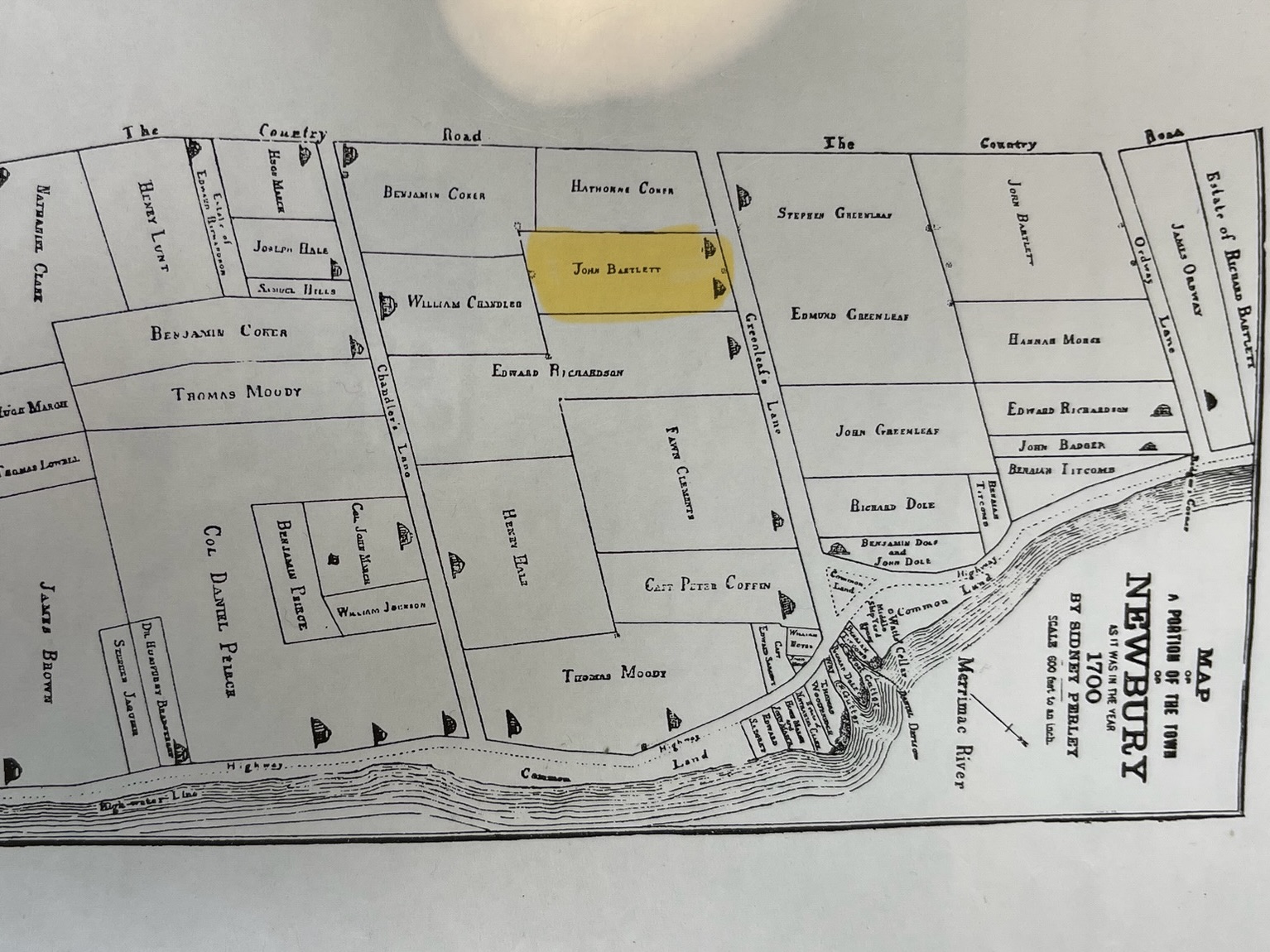
One of the most important clues came from a property transfer recorded after Thomas’s death. His Newbury house was conveyed to John Bartlett on May 29, 1660. Thomas had died six years earlier, but that transaction created a link between the original Dow property and later records.
I had also uncovered a map from around 1700 showing John Bartlett’s land with two houses on it. By comparing that map with historical descriptions of Thomas’s property and the layout of present-day Newburyport, we were able to narrow the likely location considerably.
The property was described as lying on the southerly side of Greenleaf’s Lane—now State Street—leading toward an area once known as Watt’s Cellar.
The exact boundaries have changed. The original house is long gone. There is no plaque announcing that Thomas Dow once lived there.
Nevertheless, the paper trail brought us remarkably close.
The likely site was just across the road from the library where we had been conducting our research.
Standing there, the investigation suddenly became physical.
Thomas was no longer simply a name followed by dates in a book.
He had occupied a particular piece of ground.
He had looked out at a real landscape.
He had walked through an early settlement whose modern streets I could now follow.
The Unmarked Grave

The library historians also helped us identify the cemetery in Haverhill where Thomas was buried.
Jen and I drove there.
The cemetery is old and not especially well maintained. Many of its earliest graves are no longer marked, and there is no known stone identifying Thomas’s resting place.
We walked among the graves anyway.
In one area of the cemetery, I felt a sudden wave of goosebumps and a powerful sense that Thomas was somewhere nearby.
I know exactly how that sounds.
I am trained in historical research. I believe in documentation, evidence, corroboration and primary sources. Intuition is not a valid method of locating a seventeenth-century grave.
But I felt something.
I cannot document it.
I cannot prove it.
I would never present it as historical fact.
Still, when I picture where Thomas Dow lies, I picture that place.
History is made from evidence.
Our connection to history is often emotional.
The two should never be confused.
Neither should either be ignored.
What Is Book of Dow Becoming?

Back row (left to right): Leonard, Gene, and David.
Front row (left to right): Peter (my dad), Jenny, and Ronald.
Photograph taken in the early 1980s.
That question remains unanswered.
This project may become a work of family history: an updated, carefully sourced account of one branch of the Dow family from colonial Massachusetts through New Brunswick and eventually to Hamilton, Ontario.
It may become something more personal – a combination of genealogy, memoir and travel writing about fathers, sons, inheritance and the ways families preserve or lose their stories.
It may become historical fiction.
The material certainly invites it.
My ancestors lived through Puritan New England, frontier conflict, migration, poverty, religious upheaval, the American Revolution, settlement along the Saint John River and the building of communities in New Brunswick.
They lived close to Salem during and after the witch trials. I have not found evidence that my direct ancestors participated in the accusations or proceedings, and I will not invent such a connection for the sake of a better story. But they inhabited the same religious and cultural world – a society capable of transforming fear, suspicion and private conflict into something deadly.
Perhaps Book of Dow will eventually exist in more than one form.
At this stage, I don’t want to force it into a category before I understand what I have.
For now, my job is simply to keep opening the archive.
Following the Threads

There are already more stories than I could fit into a single post.
There is Stephen Dow, apprenticed at nine years old because his family could not support him.
There is another Stephen who reportedly learned to imitate an Indigenous whistle and used it during conflicts around Haverhill.
There is David Dow, who travelled to New Brunswick and was reportedly killed when a tree he was chopping fell on him.
There is Jesse Dow, whose enormous family was said to include more surviving lineal descendants at the time of his funeral than any other Dow recorded in the genealogy.
There is Esther Dow, who according to The Book of Dow converted to Mormonism, moved to Utah, became a plural wife and, according to family tradition, never again communicated with her family.
There are farmers, lumbermen, preachers, soldiers, merchants, mothers, children and people who appear for only a sentence before vanishing from the record.
Then the line reaches my grandfather, Burpee Dow, who owned a general store in Hartland, New Brunswick.
It reaches my father, Peter Dow, who left New Brunswick as a young man, moved to Hamilton and spent his adult life working in construction.
And eventually, it reaches me.
The line continues through my children.
Between Thomas’s arrival in 1639 and the present lies nearly four centuries of choices, accidents, migrations, losses and survival. Every person in the chain had to live long enough to create the next link. Every movement – from Newbury to Haverhill, from Massachusetts to New Brunswick, and from New Brunswick to Ontario – changed the lives that followed.
That is more than a list of names.
It is a chain of consequences.
The Archive Is Open

I do not yet know whether Book of Dow will become nonfiction, memoir, historical fiction, a supernatural thriller or something that combines several of those forms.
I’m comfortable not knowing.
The original Book of Dow gives me a foundation, but it also gives me errors to correct, gaps to investigate and stories that deserve more than a line or two in an old genealogy.
My father gave me the book because I had shown an interest in where we came from.
Years later, I stood in Newbury on the ground where our known American story began. I walked through the cemetery where Thomas was buried. I came home with more information than I had before—and far more questions.
This series is where I will follow those questions.
One ancestor.
One place.
One document.
One mystery at a time.
The archive is open.
Series: Book of Dow: The Archive
Archive: No. 001
Research Status: Ongoing
Primary Time Period: 1639–Present
Location: Newbury, Massachusetts → Haverhill, Massachusetts → New Brunswick → Ontario