Tag: Writing process

  • Where AI Fits Into My Writing Process – and Where It Doesn’t

    Where AI Fits Into My Writing Process – and Where It Doesn’t

    I use AI in almost everything I write. That does not mean AI does the writing.

    A writer works by hand at a desk while digital research, historical sources, maps and cybersecurity diagrams surround him.
    AI can surround the writing process without becoming the writer.

    I use artificial intelligence in almost everything I write – but probably not in the way people assume.

    That sentence requires some explanation, because “I use AI” has become almost meaningless.

    It can mean asking a search engine for help finding a source. It can mean using a chatbot to challenge an argument or organize research. It can also mean entering a prompt, receiving several thousand words and publishing them under your own name.

    Those are not the same thing.

    So, before I describe my process, I want to draw the most important line clearly:

    AI does not write my books. Every word in my manuscripts is my own.

    I use AI while researching Cryptogeddon, Holy Wars and other projects. I use it to explore technologies, interrogate ideas, identify gaps in my knowledge and find sources worth reading. But when it is time to write the book, I write it.

    My blog workflow is somewhat more flexible. A weekly article has a different purpose, lifespan and production cycle than a novel. AI may help me organize the argument, test structures, identify repetition or refine a difficult passage. Even there, however, I am not asking it to invent a subject and then publishing whatever comes back.

    AI participates in the process. It does not own the work.

    Here is what that actually looks like.

    The Process Begins Before AI

    My writing rarely begins with a prompt.

    It begins with something that catches my attention: a book, a news story, an historical question, a development in cybersecurity, an experience at the gaming table or an idea that refuses to leave me alone.

    I capture those thoughts in Apple Notes. Some are only a sentence. Others grow into collections of links, quotations, questions and fragments. Most never become finished pieces at all.

    Before I involve AI, I try to know at least three things:

    1. What am I curious about?
    2. Why does it matter to me?
    3. What question am I trying to answer?

    Those decisions need to come from me. Otherwise, I am not using AI to develop an idea. I am asking it to supply one.

    That may produce content. It is unlikely to produce anything only I could have written.

    Stage One: Mapping the Territory

    Once I have a subject, I often use AI to help me understand its shape.

    Suppose I am researching a technology for Cryptogeddon. I may begin with broad questions:

    • How does this system work?
    • What would have to go wrong for it to fail?
    • Who controls it?
    • What assumptions does it depend upon?
    • How might an attacker abuse it?
    • What secondary consequences am I overlooking?
    • What terminology should I understand before researching further?

    The purpose is not to collect prose for the manuscript. It is to improve my mental model of the subject.

    AI is particularly good at revealing the structure of an unfamiliar field. It can identify major concepts, show how they relate and suggest questions I would not have known to ask. That makes it a useful starting point.

    But a starting point is not a source.

    A writer examines an interconnected wall of historical documents, maps, cybersecurity systems and research questions.
    AI helps me map unfamiliar territory, identify connections and discover better questions.

    Stage Two: Moving From Answers to Sources

    Language models are dangerously good at sounding authoritative.

    They can present established fact, reasonable inference and complete invention in exactly the same confident tone. A polished answer can be helpful, but fluency is not evidence.

    My research loop therefore looks like this:

    1. Ask AI to help map the subject.
    2. Identify the claims that matter.
    3. Find the original or most authoritative sources.
    4. Read those sources myself.
    5. Compare competing interpretations.
    6. Ask better follow-up questions.
    7. Keep only what the evidence supports.

    For technology and cybersecurity, that may mean technical documentation, research papers, incident reports or reporting from sources I trust. For Holy Wars, it may mean historical scholarship, primary accounts and competing interpretations of the same event.

    The AI conversation helps me navigate. The sources determine what I can responsibly claim.

    My rule is simple:

    AI can help me discover a claim. It cannot be the authority for that claim.

    Stage Three: Using AI to Create Friction

    The most valuable thing AI gives me is not an answer. It is resistance.

    Once I have developed an idea, I can ask the machine to attack it:

    • What is the strongest objection?
    • Which assumption is doing too much work?
    • What evidence would weaken my conclusion?
    • Am I confusing correlation with causation?
    • Which stakeholder am I ignoring?
    • Is this genuinely plausible, or merely convenient for the story?
    • What would an informed critic say?

    This is especially useful because writers become attached to their own ideas. After enough time with an argument or story, it becomes difficult to see what we have assumed rather than established.

    AI does not eliminate that problem, and its criticism is not automatically correct. But it can create enough distance for me to reconsider something I had begun treating as settled.

    Sometimes I reject its objection. Sometimes I return to the research. Occasionally, it exposes a weakness that changes the direction of the work.

    The decision remains mine, but it is a better-tested decision.

    Stage Four: The Process Splits

    This is where my book and blog workflows become different.

    For books

    Research, questions, timelines and technical explorations may all involve AI. The manuscript does not.

    When I move from research into scenes, narration, dialogue and chapters, I write the words myself. That boundary is deliberate.

    A novel is more than an efficient delivery system for a plot. Its language carries the author’s sensibility: what receives attention, what remains unsaid, how a character is judged, where a sentence accelerates and where it pauses. Those decisions accumulate into voice.

    I do not want to outsource that discovery.

    I may later use tools to help locate inconsistencies or interrogate whether some technical element is believable. But I do not ask AI to generate chapters for me, rewrite my prose in bulk or manufacture a voice I can claim as my own.

    Every sentence in the book has to pass through my mind and my hands.

    For blog posts

    A weekly blog operates on a shorter cycle. I am often responding to something timely, developing an argument in public or sharing work in progress.

    Here I may use AI more directly as an editorial tool. Depending on the article, I might ask it to:

    • compare two possible outlines;
    • suggest a clearer order for ideas I have already assembled;
    • identify repetition;
    • flag an unsupported leap;
    • show where a reader might misunderstand me;
    • test alternative headlines;
    • or help tighten a passage that is not working.

    That is closer to an extended editorial conversation than manuscript generation.

    The topic, underlying argument, personal perspective and final judgment still have to be mine. I decide what the article says. I decide which suggestions are useful. And I remain responsible for every sentence published under my name.

    The distinction is not that books are sacred while blogs do not matter. It is that the tools are allowed closer to the prose in one workflow than in the other – and even there, they remain tools.

    Stage Five: Knowing When AI Is Making the Work Worse

    AI has a gravitational pull toward competent blandness.

    It likes orderly explanations, symmetrical lists and conclusions that neatly restate whatever came before. It can turn an awkward but interesting thought into a polished paragraph that sounds like it could have been written by anyone.

    That is useful when clarity is the problem. It is destructive when the awkwardness contains the writer’s voice.

    There are warning signs that AI is getting in the way:

    • the writing becomes smoother but less specific;
    • every argument acquires an artificial balance;
    • uncertainty is replaced with a tidy lesson;
    • the same phrases and rhythms begin appearing repeatedly;
    • the prose explains things the reader already understands;
    • or the article sounds finished before I have decided what I think.

    That last danger may be the most serious.

    Writing is partly how I discover what I believe. If I accept a polished formulation before doing the underlying thinking, I may end up with something coherent that is not actually mine.

    The struggle to articulate an idea is not wasted motion. Often, it is where the insight comes from.

    Stage Six: The Final Human Pass

    Before anything is published, I want to be able to answer several questions:

    • Is this accurate?
    • Do I believe it?
    • Does it sound like me?
    • Is there something specific here, or only a competent summary?
    • Have I distinguished fact from inference?
    • Am I saying anything I would be unwilling to defend?
    • Does every sentence earn the right to carry my name?

    AI cannot answer those questions for me because they are not simply questions about text quality.

    They are questions about authorship.

    The final decision to publish is not a mechanical checkpoint at the end of the pipeline. It is the point at which I accept responsibility for the work.

    What AI Is – and Is Not – in My Writing

    If I reduce the process to its simplest form, AI plays four useful roles:

    1. Research guide – helping me map unfamiliar territory and locate questions worth pursuing.
    2. Sceptical reader – testing assumptions, arguments and plausibility.
    3. Organizational tool – helping me compare structures and manage complicated material.
    4. Editorial assistant – identifying repetition, ambiguity and weak transitions, particularly in shorter work.

    What it is not is the novelist.

    It does not create the pages of Cryptogeddon. It does not choose the language of Holy Wars. It does not decide what my characters fear, what they value or what their choices mean. It does not turn personal experience into something I can falsely claim to have written.

    AI can help me arrive at the blank page better informed, more thoroughly challenged and with a clearer sense of what I am trying to accomplish.

    Then I have to write.

    When the Research Starts Resembling the Fiction

    A thriller writer looks from sketches of AI systems and autonomous networks toward a city where similar technologies are becoming real.
    For a near-future writer, the distance between research and fiction is getting uncomfortably small.

    Lately, AI has begun playing one more role in my writing process: subject matter.

    There is an old expression that reality is stranger than fiction. For someone writing a near-future cyberthriller, that is becoming less an observation than a weekly professional hazard.

    I imagine autonomous systems, coordinated cyberattacks and institutions struggling to control technologies they barely understand. Then I return to the research and discover events uncomfortably close to what I had imagined.

    It is getting harder to invent an AI future that does not begin arriving before I finish the draft.

    That is unsettling.

    It is also irresistible material.

    Next week, in The Cryptogeddon Briefing, I am going to look at some of those recent developments – and ask a question that no longer sounds quite as melodramatic as it once did:

    How scary is AI getting?
  • Building a Creative Ecosystem

    Building a Creative Ecosystem

    How I’m building a sustainable creative system for writing books, blogging, and sharing ideas through ToddHDow Studios.

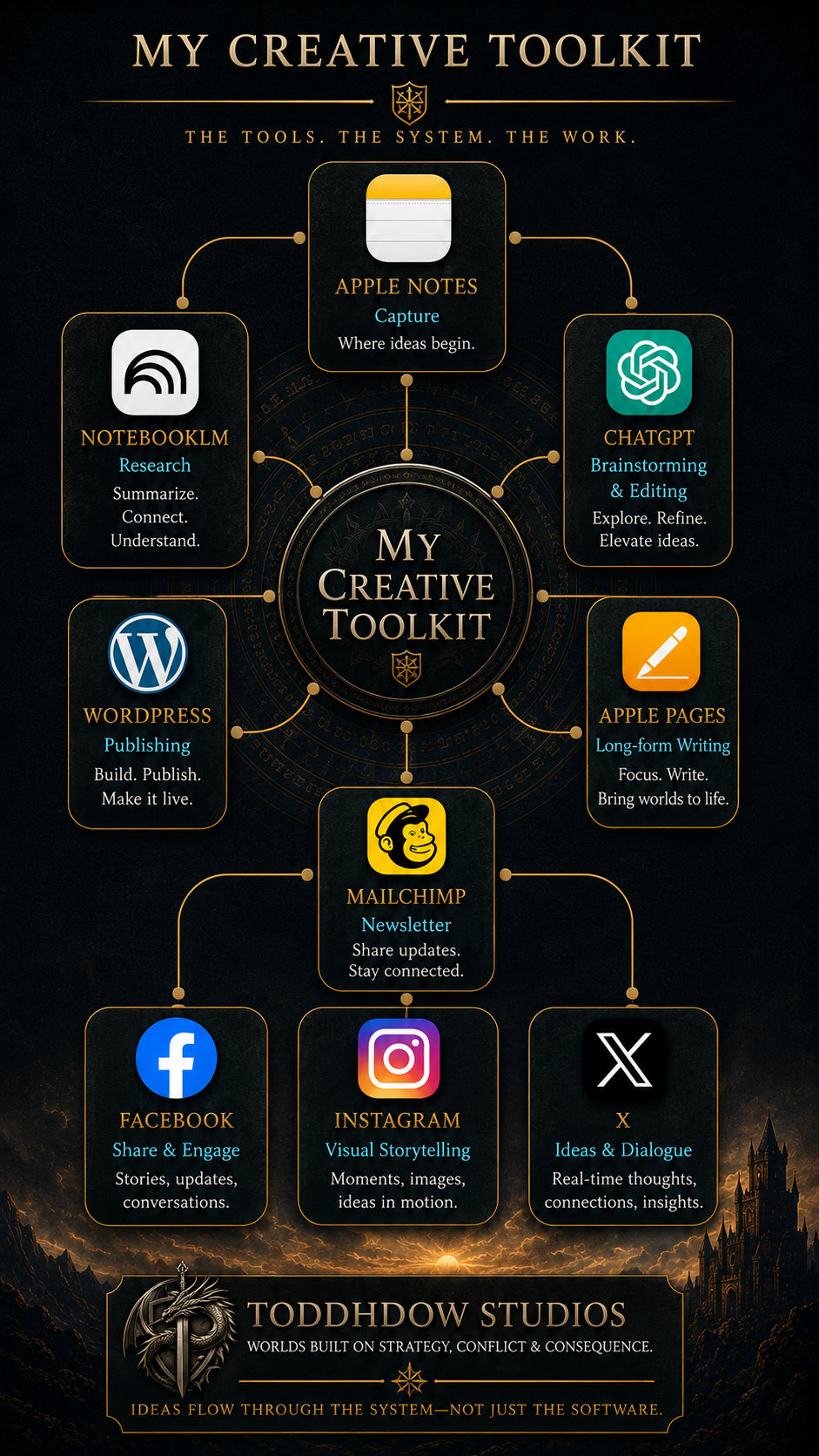
    The ToddHDow Studios Creative Toolkit.
    The ToddHDow Studios Creative Toolkit.

    People often imagine writing as the moment someone sits down in front of a blank page.

    The truth is, that’s only the visible part of the process.

    Writing begins long before the first sentence is typed.

    It begins with a conversation. A book. A question. A walk. A podcast. A news article. A half-formed idea scribbled into a notes app while standing in line for coffee.

    I’ve spent a surprising amount of time over the past year thinking not just about what I want to write, but how I want to write. As ToddHDow Studios has grown, I’ve realized that building a sustainable creative life has much less to do with finding the perfect software and much more to do with building a system that keeps ideas moving.

    I’m still refining that system, but I thought it might be interesting to pull back the curtain and share how it works today.

    Building Worlds

    A wide cinematic collage blending Cryptogeddon, Holy Wars, Book of Dow, TTRPGs and my writing.

    ToddHDow Studios is home to everything I create.

    Some of those ideas become weekly blog posts. Others are slowly evolving into books. Some may never become either, and that’s okay too. Not every idea needs to become a finished project.

    The four worlds I’ve chosen to focus on – CryptogeddonHoly WarsThe Book of Dow, and TTRPGs – give my curiosity somewhere to live. The Writer’s Notebook is where I step back from those worlds and talk about the creative process itself.

    At first glance, cybersecurity, medieval and colonial history, writing, and tabletop gaming don’t seem to have much in common.

    To me, they’re connected by the same thread.

    They’re all worlds built on strategy, conflict & consequence.

    Some ideas are ready to share almost immediately. Others need years to mature before they’re ready to become books. The destination changes, but the creative process is surprisingly similar.

    Removing the Daily Decision

    One lesson I’ve learned is that creative energy is limited.

    If every Saturday morning begins with the question, “What should I write today?”, I’ve already wasted energy making a decision that didn’t need to exist.

    Instead, I created a simple publishing rhythm.

    • Week One: The Cryptogeddon Briefing
    • Week Two: Holy Wars Journal
    • Week Three: Book of Dow: The Archive
    • Week Four: Campaign Chronicles
    • Week Five: The Writer’s Notebook

    Every week, I also publish The ToddHDow Dispatch, my newsletter that ties everything together.

    Over time, I’ve settled into a publishing rhythm that works well for both me and my readers. New blog posts are published on Saturdays. The following Monday, I send The ToddHDow Dispatch, introducing that week’s post, sharing what I’m reading, highlighting anything new across ToddHDow Studios, and offering a preview of what’s coming next.

    But that’s not where the process ends. Throughout the week, I continue the conversation on FacebookInstagramX and LinkedIn, sharing quotes, images, behind-the-scenes thoughts, and stories inspired by the article. Rather than treating social media as advertising, I see it as another way to explore ideas, connect with readers, and invite people into the worlds I’m building.

    Every idea follows a similar lifecycle: capture, research, write, publish, share, then move on to the next one. Having that predictable rhythm means I spend less time wondering what to do next and more time actually creating.

    Like everything else in my workflow, the schedule isn’t about rigid rules. It’s about creating a sustainable rhythm that lets me keep showing up, week after week.

    That schedule keeps my blog moving forward while giving my longer writing projects room to develop in the background. Blog posts may be measured in days, while books are measured in months—or more likely, years—but both benefit from showing up consistently.

    Sometimes the best creative decision is removing decisions altogether.

    Following an Idea

    The ToddHDow Studios Creative Ecosystem.
    The ToddHDow Studios Creative Ecosystem.

    People sometimes ask how I go from an idea to something I publish.

    The answer is… slowly.

    Almost everything begins in Apple Notes.

    Ideas arrive at strange times, and I’ve learned not to trust my memory. Whether it’s a thought for a Holy Wars article, a scene for a future novel, or a question I want to explore, it gets captured before it disappears.

    From there, I research.

    I read.

    I ask questions.

    I sketch outlines.

    Sometimes I brainstorm with ChatGPT – not because I want it to write for me, but because it’s an excellent thinking partner. I’ll ask it to challenge an argument, suggest different ways to organize an article, or point out places where my reasoning isn’t as clear as I thought it was.

    Eventually, the path splits.

    If the idea is timely, it usually becomes a blog post. I’ll draft it, revise it, prepare images, format everything in WordPress, build the newsletter in Mailchimp, and publish it.

    If the idea has deeper roots, it usually moves into Apple Pages, where it becomes part of a much longer project. Books don’t care about weekly publishing schedules. They ask for patience instead.

    Different destinations.

    The same creative engine.

    Sharing the Conversation

    Publishing a post isn’t actually the end of the process.

    It’s the beginning of another one.

    Every article gets its own newsletter, but it also becomes the foundation for posts and stories across Facebook, Instagram, X and LinkedIn over the following days. Sometimes that’s a quote that stands on its own. Sometimes it’s a single image. Sometimes it’s a behind-the-scenes thought that didn’t make the final article.

    I don’t think of social media as marketing.

    I think of it as continuing the conversation with readers who may never visit my website otherwise.

    In many ways, a finished blog post isn’t the final product.

    It’s the source material for everything that follows.

    Chasing the Perfect Tool

    The ToddHDow Studios Creative Toolkit.
    The ToddHDow Studios Creative Toolkit.

    If there’s one rabbit hole I’ve fallen into more times than I’d like to admit, it’s searching for the perfect writing software.

    Should I use Word?

    Pages?

    Scrivener?

    Ulysses?

    Obsidian?

    Google Docs?

    Something else entirely?

    The answer, I’ve discovered, is that none of them actually solve the problem.

    Software doesn’t create discipline.

    It simply supports it.

    Today my workflow uses a collection of tools because each one does something well.

    Apple Notes captures ideas before they’re forgotten.

    Pages is where my longer writing currently lives.

    Gemini Notebook (formerly NotebookLM) helps me organize and understand research.

    ChatGPT helps me brainstorm, edit, and think through problems.

    WordPress and Mailchimp help me share finished work with readers.

    Together, these tools form a pipeline rather than a collection of disconnected apps. Ideas flow naturally from one stage of the creative process to the next.

    One thing that surprised me while writing this article was realizing just how long some of these tools have been part of my life.

    ToddHDow.com has been running on WordPress for more than twenty years. If you browse my archive, you’ll find posts dating all the way back to December 2005. Mailchimp has been part of my workflow for well over a decade too. My very first subscriber – appropriately enough – was me, back on October 15, 2012.

    Looking back, I’m grateful that “past Todd” chose tools that proved reliable enough to grow alongside me.

    Those tools may or may not change someday.

    The habit of creating is the part I hope never does.

    Reading Is Part of Writing

    My bookshelf
    My bookshelf

    People often ask about my writing habits.

    Far fewer ask about my reading habits.

    The truth is they’re impossible to separate.

    Every book I read becomes part of my creative toolbox.

    History feeds Holy Wars.

    Cybersecurity and emerging technology shape Cryptogeddon.

    Stephen King constantly reminds me how powerful voice can be.

    Brandon Sanderson demonstrates the importance of structure, planning, and worldbuilding.

    Neal Stephenson encourages me to think bigger, research deeper, and ask more ambitious questions.

    Even books that seem completely unrelated to whatever I’m working on have a way of influencing what comes next.

    I’ve stopped thinking of reading as something that competes with writing.

    Reading is writing preparation.

    Still Learning

    One thing I’ve become comfortable admitting is that I don’t have this all figured out.

    My workflow changes.

    My software changes.

    My routines evolve.

    Every project teaches me something new.

    That’s part of the reason I wanted to create The Writer’s Notebook in the first place.

    Not because I have all the answers.

    Because I enjoy exploring the questions.

    Final Thoughts

    When I first imagined becoming a writer, I thought success depended on inspiration.

    Today, I think it depends on something much quieter: building an environment where inspiration has somewhere to go.

    For me, that environment is made up of habits as much as technology. Reading sparks new ideas. Apple Notes captures them before they’re forgotten. ChatGPT and NotebookLM help me explore and challenge them. Pages gives my books room to grow. WordPress, Mailchimp and my socials help me share finished work with readers. My publishing cadence keeps everything moving forward, one project at a time.

    None of those tools writes for me.

    None of them can replace curiosity, discipline, or creativity.

    But together they remove friction, helping me spend less time wondering how to create and more time actually creating.

    Perhaps that’s the systems engineer in me. After decades working in technology and cybersecurity, I’ve developed an instinct for choosing tools that are stablereliablesecurescalable, and well-supported – tools I can trust to grow with me instead of forcing me to start over every few years. The best technology quietly fades into the background, allowing the work itself to take centre stage.

    Looking back, I’m grateful that “past Todd” made some good decisions. WordPress has been home to ToddHDow.com for more than twenty years. Mailchimp has been part of my workflow for well over a decade. Those choices gave me continuity, allowing me to focus on creating instead of constantly rebuilding.

    That’s ultimately what this ecosystem is designed to do. Every tool, every habit, every book I read, every note I capture, every conversation I have with ChatGPT, every newsletter I send, and every social post I publish serves the same purpose: reducing friction so I can spend more time thinking, writing, and building worlds.

    Because in the end, writing isn’t about finding the perfect tool.

    It’s about building a life that keeps you curious enough to have something worth writing about.