Tag: writing

  • Building a Creative Ecosystem

    Building a Creative Ecosystem

    How I’m building a sustainable creative system for writing books, blogging, and sharing ideas through ToddHDow Studios.

    The ToddHDow Studios Creative Toolkit.
    The ToddHDow Studios Creative Toolkit.

    People often imagine writing as the moment someone sits down in front of a blank page.

    The truth is, that’s only the visible part of the process.

    Writing begins long before the first sentence is typed.

    It begins with a conversation. A book. A question. A walk. A podcast. A news article. A half-formed idea scribbled into a notes app while standing in line for coffee.

    I’ve spent a surprising amount of time over the past year thinking not just about what I want to write, but how I want to write. As ToddHDow Studios has grown, I’ve realized that building a sustainable creative life has much less to do with finding the perfect software and much more to do with building a system that keeps ideas moving.

    I’m still refining that system, but I thought it might be interesting to pull back the curtain and share how it works today.

    Building Worlds

    A wide cinematic collage blending Cryptogeddon, Holy Wars, Book of Dow, TTRPGs and my writing.

    ToddHDow Studios is home to everything I create.

    Some of those ideas become weekly blog posts. Others are slowly evolving into books. Some may never become either, and that’s okay too. Not every idea needs to become a finished project.

    The four worlds I’ve chosen to focus on – CryptogeddonHoly WarsThe Book of Dow, and TTRPGs – give my curiosity somewhere to live. The Writer’s Notebook is where I step back from those worlds and talk about the creative process itself.

    At first glance, cybersecurity, medieval and colonial history, writing, and tabletop gaming don’t seem to have much in common.

    To me, they’re connected by the same thread.

    They’re all worlds built on strategy, conflict & consequence.

    Some ideas are ready to share almost immediately. Others need years to mature before they’re ready to become books. The destination changes, but the creative process is surprisingly similar.

    Removing the Daily Decision

    One lesson I’ve learned is that creative energy is limited.

    If every Saturday morning begins with the question, “What should I write today?”, I’ve already wasted energy making a decision that didn’t need to exist.

    Instead, I created a simple publishing rhythm.

    • Week One: The Cryptogeddon Briefing
    • Week Two: Holy Wars Journal
    • Week Three: Book of Dow: The Archive
    • Week Four: Campaign Chronicles
    • Week Five: The Writer’s Notebook

    Every week, I also publish The ToddHDow Dispatch, my newsletter that ties everything together.

    Over time, I’ve settled into a publishing rhythm that works well for both me and my readers. New blog posts are published on Saturdays. The following Monday, I send The ToddHDow Dispatch, introducing that week’s post, sharing what I’m reading, highlighting anything new across ToddHDow Studios, and offering a preview of what’s coming next.

    But that’s not where the process ends. Throughout the week, I continue the conversation on FacebookInstagramX and LinkedIn, sharing quotes, images, behind-the-scenes thoughts, and stories inspired by the article. Rather than treating social media as advertising, I see it as another way to explore ideas, connect with readers, and invite people into the worlds I’m building.

    Every idea follows a similar lifecycle: capture, research, write, publish, share, then move on to the next one. Having that predictable rhythm means I spend less time wondering what to do next and more time actually creating.

    Like everything else in my workflow, the schedule isn’t about rigid rules. It’s about creating a sustainable rhythm that lets me keep showing up, week after week.

    That schedule keeps my blog moving forward while giving my longer writing projects room to develop in the background. Blog posts may be measured in days, while books are measured in months—or more likely, years—but both benefit from showing up consistently.

    Sometimes the best creative decision is removing decisions altogether.

    Following an Idea

    The ToddHDow Studios Creative Ecosystem.
    The ToddHDow Studios Creative Ecosystem.

    People sometimes ask how I go from an idea to something I publish.

    The answer is… slowly.

    Almost everything begins in Apple Notes.

    Ideas arrive at strange times, and I’ve learned not to trust my memory. Whether it’s a thought for a Holy Wars article, a scene for a future novel, or a question I want to explore, it gets captured before it disappears.

    From there, I research.

    I read.

    I ask questions.

    I sketch outlines.

    Sometimes I brainstorm with ChatGPT – not because I want it to write for me, but because it’s an excellent thinking partner. I’ll ask it to challenge an argument, suggest different ways to organize an article, or point out places where my reasoning isn’t as clear as I thought it was.

    Eventually, the path splits.

    If the idea is timely, it usually becomes a blog post. I’ll draft it, revise it, prepare images, format everything in WordPress, build the newsletter in Mailchimp, and publish it.

    If the idea has deeper roots, it usually moves into Apple Pages, where it becomes part of a much longer project. Books don’t care about weekly publishing schedules. They ask for patience instead.

    Different destinations.

    The same creative engine.

    Sharing the Conversation

    Publishing a post isn’t actually the end of the process.

    It’s the beginning of another one.

    Every article gets its own newsletter, but it also becomes the foundation for posts and stories across Facebook, Instagram, X and LinkedIn over the following days. Sometimes that’s a quote that stands on its own. Sometimes it’s a single image. Sometimes it’s a behind-the-scenes thought that didn’t make the final article.

    I don’t think of social media as marketing.

    I think of it as continuing the conversation with readers who may never visit my website otherwise.

    In many ways, a finished blog post isn’t the final product.

    It’s the source material for everything that follows.

    Chasing the Perfect Tool

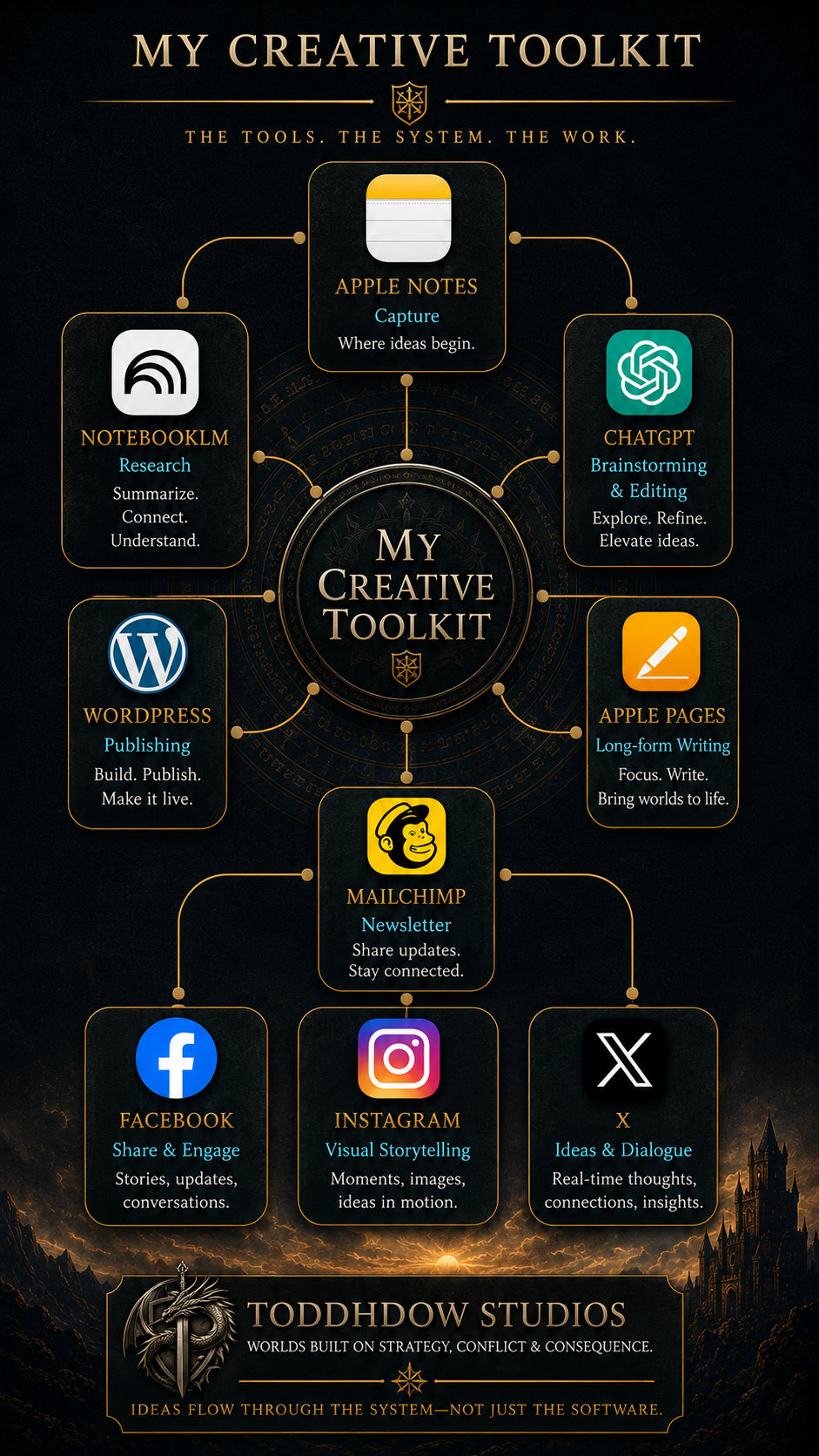
    The ToddHDow Studios Creative Toolkit.
    The ToddHDow Studios Creative Toolkit.

    If there’s one rabbit hole I’ve fallen into more times than I’d like to admit, it’s searching for the perfect writing software.

    Should I use Word?

    Pages?

    Scrivener?

    Ulysses?

    Obsidian?

    Google Docs?

    Something else entirely?

    The answer, I’ve discovered, is that none of them actually solve the problem.

    Software doesn’t create discipline.

    It simply supports it.

    Today my workflow uses a collection of tools because each one does something well.

    Apple Notes captures ideas before they’re forgotten.

    Pages is where my longer writing currently lives.

    Gemini Notebook (formerly NotebookLM) helps me organize and understand research.

    ChatGPT helps me brainstorm, edit, and think through problems.

    WordPress and Mailchimp help me share finished work with readers.

    Together, these tools form a pipeline rather than a collection of disconnected apps. Ideas flow naturally from one stage of the creative process to the next.

    One thing that surprised me while writing this article was realizing just how long some of these tools have been part of my life.

    ToddHDow.com has been running on WordPress for more than twenty years. If you browse my archive, you’ll find posts dating all the way back to December 2005. Mailchimp has been part of my workflow for well over a decade too. My very first subscriber – appropriately enough – was me, back on October 15, 2012.

    Looking back, I’m grateful that “past Todd” chose tools that proved reliable enough to grow alongside me.

    Those tools may or may not change someday.

    The habit of creating is the part I hope never does.

    Reading Is Part of Writing

    My bookshelf
    My bookshelf

    People often ask about my writing habits.

    Far fewer ask about my reading habits.

    The truth is they’re impossible to separate.

    Every book I read becomes part of my creative toolbox.

    History feeds Holy Wars.

    Cybersecurity and emerging technology shape Cryptogeddon.

    Stephen King constantly reminds me how powerful voice can be.

    Brandon Sanderson demonstrates the importance of structure, planning, and worldbuilding.

    Neal Stephenson encourages me to think bigger, research deeper, and ask more ambitious questions.

    Even books that seem completely unrelated to whatever I’m working on have a way of influencing what comes next.

    I’ve stopped thinking of reading as something that competes with writing.

    Reading is writing preparation.

    Still Learning

    One thing I’ve become comfortable admitting is that I don’t have this all figured out.

    My workflow changes.

    My software changes.

    My routines evolve.

    Every project teaches me something new.

    That’s part of the reason I wanted to create The Writer’s Notebook in the first place.

    Not because I have all the answers.

    Because I enjoy exploring the questions.

    Final Thoughts

    When I first imagined becoming a writer, I thought success depended on inspiration.

    Today, I think it depends on something much quieter: building an environment where inspiration has somewhere to go.

    For me, that environment is made up of habits as much as technology. Reading sparks new ideas. Apple Notes captures them before they’re forgotten. ChatGPT and NotebookLM help me explore and challenge them. Pages gives my books room to grow. WordPress, Mailchimp and my socials help me share finished work with readers. My publishing cadence keeps everything moving forward, one project at a time.

    None of those tools writes for me.

    None of them can replace curiosity, discipline, or creativity.

    But together they remove friction, helping me spend less time wondering how to create and more time actually creating.

    Perhaps that’s the systems engineer in me. After decades working in technology and cybersecurity, I’ve developed an instinct for choosing tools that are stablereliablesecurescalable, and well-supported – tools I can trust to grow with me instead of forcing me to start over every few years. The best technology quietly fades into the background, allowing the work itself to take centre stage.

    Looking back, I’m grateful that “past Todd” made some good decisions. WordPress has been home to ToddHDow.com for more than twenty years. Mailchimp has been part of my workflow for well over a decade. Those choices gave me continuity, allowing me to focus on creating instead of constantly rebuilding.

    That’s ultimately what this ecosystem is designed to do. Every tool, every habit, every book I read, every note I capture, every conversation I have with ChatGPT, every newsletter I send, and every social post I publish serves the same purpose: reducing friction so I can spend more time thinking, writing, and building worlds.

    Because in the end, writing isn’t about finding the perfect tool.

    It’s about building a life that keeps you curious enough to have something worth writing about.

  • Welcome to ToddHDow Studios

    Welcome to ToddHDow Studios

    Adjust the existing cinematic workspace image to a wider, landscape orientation suitable for full-width display. Keep all current visual elements exactly the same: 12.9-inch iPad Pro with Logitech keyboard (no number pad), Apple Pencil and mug on the left side, and the WordPress writer’s workflow visible on the screen. Maintain the same dark, moody lighting, dramatic atmosphere, and realistic reflections. Expand the horizontal composition naturally, adding subtle desk and background detail on the sides so it feels intentionally framed for widescreen rather than cropped.

    ToddHDow.com has been part of my life for more than twenty years.

    Over that time it’s been a personal website, a résumé, a place to share projects, and occasionally a home for whatever happened to capture my attention at the time.

    If you’ve visited before, you might notice that things look a little different.

    Not because I’ve started over.

    Because I’ve finally decided to become intentional about where I’m headed.

    For years I’ve talked about writing novels, building worlds, running memorable tabletop RPG campaigns, and exploring the ideas that have fascinated me throughout my life. Those dreams always existed somewhere in the background, squeezed into evenings, weekends, and the occasional burst of inspiration between the demands of career and family.

    Eventually I realized something.

    If I was ever going to take writing seriously, I had to stop treating it like something I fit into the margins of life.

    It deserved the same commitment I’d given my career.

    ToddHDow Studios is that commitment.

    It isn’t a new beginning.

    It’s the next chapter.

    Following the Thread

    I’ve never been particularly good at having just one hobby.

    What I’ve always enjoyed is understanding how things work.

    Sometimes that’s a cyber attack.

    Sometimes it’s a medieval battle.

    Sometimes it’s a fantasy world.

    Sometimes it’s a beautifully crafted collector’s edition sitting on a bookshelf.

    Once something captures my imagination, I tend to dive in completely.

    I’m a lifelong reader and, admittedly, a bit of a book collector. Stephen King’s early novels, the Fighting Fantasy books by Steve Jackson that first taught me how stories could branch based on my decisions, epic fantasy like Brandon Sanderson’s Stormlight Archive and Robert Jordan’s Wheel of Time, modern favourites like Dungeon Crawler Carl—my shelves are filled with stories that reward curiosity and immerse you in carefully built worlds.

    That same curiosity spills into technology. I spend time experimenting with artificial intelligence, software-defined radios, emerging cybersecurity tools, and whatever new technology catches my attention. Not because I need another hobby, but because I genuinely enjoy learning how complex systems fit together.

    For a long time I thought these were separate interests.

    Now I realize they’ve always been connected.

    They’re all about understanding systems, exploring decisions, and seeing how consequences ripple outward.

    From Security Analyst to Storyteller

    I’ve spent more than twenty-five years working in cybersecurity, beginning as a security analyst and eventually serving as Chief Information Security Officer before moving into my current role as a Security Solutions Engineer.

    One of the biggest lessons that career has taught me is that systems rarely fail because of technology alone.

    They fail because people make decisions.

    Good decisions.

    Bad decisions.

    Sometimes impossible decisions.

    Every incident tells a story.

    Every attack begins with a choice.

    Every defense depends on someone seeing the bigger picture before it’s too late.

    Once I recognized that, I started seeing the same patterns everywhere.

    History.

    Politics.

    Business.

    Tabletop games.

    The best novels.

    Different settings.

    The same human questions.

    The Worlds I’m Building

    A wide cinematic collage blending four scenes seamlessly: a futuristic city skyline glowing with digital threat overlays and cascading code; a dramatic medieval battlefield with armored knights and billowing banners in smoky dusk light; a warm candlelit tabletop RPG scene with dice, miniatures, maps and rulebooks; and a close-up of an open writer's notebook with scribbled ideas, ink, and a fountain pen. All four scenes merge together in a moody, atmospheric composite — dramatic shadows, rich colors, cinematic widescreen composition, highly detailed, sophisticated and evocative.

    That’s why ToddHDow Studios is organized around four long-term creative worlds.

    Each one represents something that has shaped my life for decades.

    Cryptogeddon

    A moody cinematic wide illustration of a near-future city at night under subtle digital attack. Glass skyscrapers reflect cascading green and blue code. Faint glowing network lines arc across the sky like constellations. Tension in the atmosphere but not chaos. Dark, high-tech, realistic, dramatic lighting, sophisticated color grading, highly detailed, widescreen composition.

    This project is rooted in the career I’ve spent decades building.

    I’ve watched cybersecurity evolve from antivirus software and firewalls into artificial intelligence, ransomware, nation-state operations, and increasingly fragile digital ecosystems that underpin nearly everything we do.

    Somewhere along the way I stopped asking, “How do we defend against this?”

    I started asking, “What happens if we don’t?”

    Cryptogeddon is where those questions become fiction.

    It’s grounded in the technology I’ve spent my career working with, but ultimately it’s a story about people trying to navigate a world that’s changing faster than they can understand it.

    Holy Wars

    A moody cinematic wide illustration of a medieval battlefield at dawn. Thick mist hangs low over the ground. Armored knights and soldiers stand in silhouette holding banners that ripple in the wind. The sky is dramatic with dark storm clouds breaking to reveal faint early light. Realistic historical tone (not fantasy-heavy). Rich textures, dramatic shadows, sophisticated cinematic color grading, widescreen composition.

    Long before cybersecurity became my profession, I studied Philosophy and Religious Studies at the University of Toronto.

    My honours thesis—The Just War Theory and the Argument for Peace—traced Christian thinking about warfare from the time of Christ to the modern era.

    That research never really left me.

    History isn’t simply a collection of dates and battles.

    It’s a study of ideas.

    Leadership.

    Faith.

    Power.

    Ethics.

    And the stories civilizations tell themselves to justify conflict.

    Holy Wars is where I’ll continue exploring those questions.

    Book of Dow

    Book of Dow

    Every family carries stories.

    Some are preserved in journals and photographs. Others survive only through fragments—old letters, fading gravestones, whispered family legends, and unanswered questions.

    Book of Dow is my attempt to explore those stories.

    Part genealogy, part historical research, and part storytelling, it’s a long-term project inspired by my family’s roots in early New England. Whether that journey ultimately becomes a work of family history, historical fiction, or something that ventures into the supernatural shadows of Salem remains to be seen.

    What matters most is the search itself.

    Because every family has a past.

    Every place has its legends.

    And sometimes the line between history and myth isn’t as clear as we’d like to believe.

    Campaign Chronicles

    A moody cinematic wide illustration of a candlelit tabletop roleplaying game scene. Dice mid-roll across a detailed battle map. Painted miniatures stand in dramatic shadow. A Dungeon Master's screen partially visible. Warm candlelight contrasts with deep shadows. Rich textures, realistic style, sophisticated cinematic color grading. IMPORTANT: true full-bleed composition, no white borders, no letterboxing, no blank canvas space at top or bottom, edge-to-edge artwork filling entire frame.

    I first rolled dice as a kid.

    Like many people, life eventually pulled me away from Dungeons & Dragons.

    Years later I found my way back, and today I enjoy the hobby even more than I did growing up.

    I play around my own table, at friends’ homes, in local game stores, and online with players from around the world.

    As a Dungeon Master I’m drawn to horror, suspense, impossible choices, and campaigns where actions have lasting consequences. Ravenloft, gothic horror, and stories where the world remembers what the players have done.

    I’m also fascinated by how AI and modern technology are transforming tabletop gaming. From worldbuilding and encounter design to handouts, artwork, and campaign management, we’re living through one of the most exciting periods the hobby has ever seen.

    Campaign Chronicles is where I’ll share that journey as both a Dungeon Master and someone building a business around helping others experience unforgettable games.

    The Writer’s Notebook

    A moody cinematic wide illustration of a writer's notebook open on a wooden desk at night. Pages filled with handwritten notes, crossed-out lines, sketches, and margin ideas. A fountain pen rests across the page. A half-empty coffee cup nearby. Warm desk lamp light illuminating the notebook while the rest of the room fades into deep shadow. Atmospheric, reflective, sophisticated tone. Highly detailed, realistic textures, dramatic lighting, widescreen composition.

    Everything eventually comes back to writing.

    This is where I’ll document the journey itself.

    The victories.

    The frustrations.

    The lessons learned.

    The books I’m reading.

    The publishing decisions.

    The creative breakthroughs.

    The moments when everything seems impossible.

    And, hopefully, the moments when it all comes together.

    Because I suspect building these worlds will be every bit as interesting as eventually finishing them.

    Looking Ahead

    ToddHDow.com isn’t becoming something entirely different.

    In many ways, it’s becoming what it was always meant to be.

    A place where my professional experience, academic background, lifelong hobbies, and creative ambitions all come together under one roof.

    Whether you’re here because of cybersecurity, speculative fiction, history, tabletop gaming, writing, or simply because you’re curious about how creative projects grow over time, I’m glad you stopped by.

    My hope is that years from now someone can visit ToddHDow.com and discover something that sparks their own curiosity.

    Maybe it’s a novel.

    Maybe it’s a D&D campaign.

    Maybe it’s a historical essay.

    Maybe it’s an article about cybersecurity or artificial intelligence.

    Different projects.

    Different audiences.

    One philosophy.

    Worlds built on strategy, conflict & consequence.

    Welcome to ToddHDow Studios.

  • Worth reading this week – Creating, Intellivision and feeling alive

    Worth reading this week – Creating, Intellivision and feeling alive

    Quote I’ve been pondering:

    Build something 100 people love, not something 1M people kind of like. – Brian Chesky

    This quote from Brian Chesky, Airbnb co-founder and CEO, is similar to Kevin Kelly’s 1,000 True Fans mantra. I’ve hesitated with my creativity in the past, worrying that too many people would judge me. But the truth is, even the most successful endeavours draw criticism. So instead of focusing on the haters and hiding, focus on the few who appreciate what you are putting out there and grow and flourish instead.


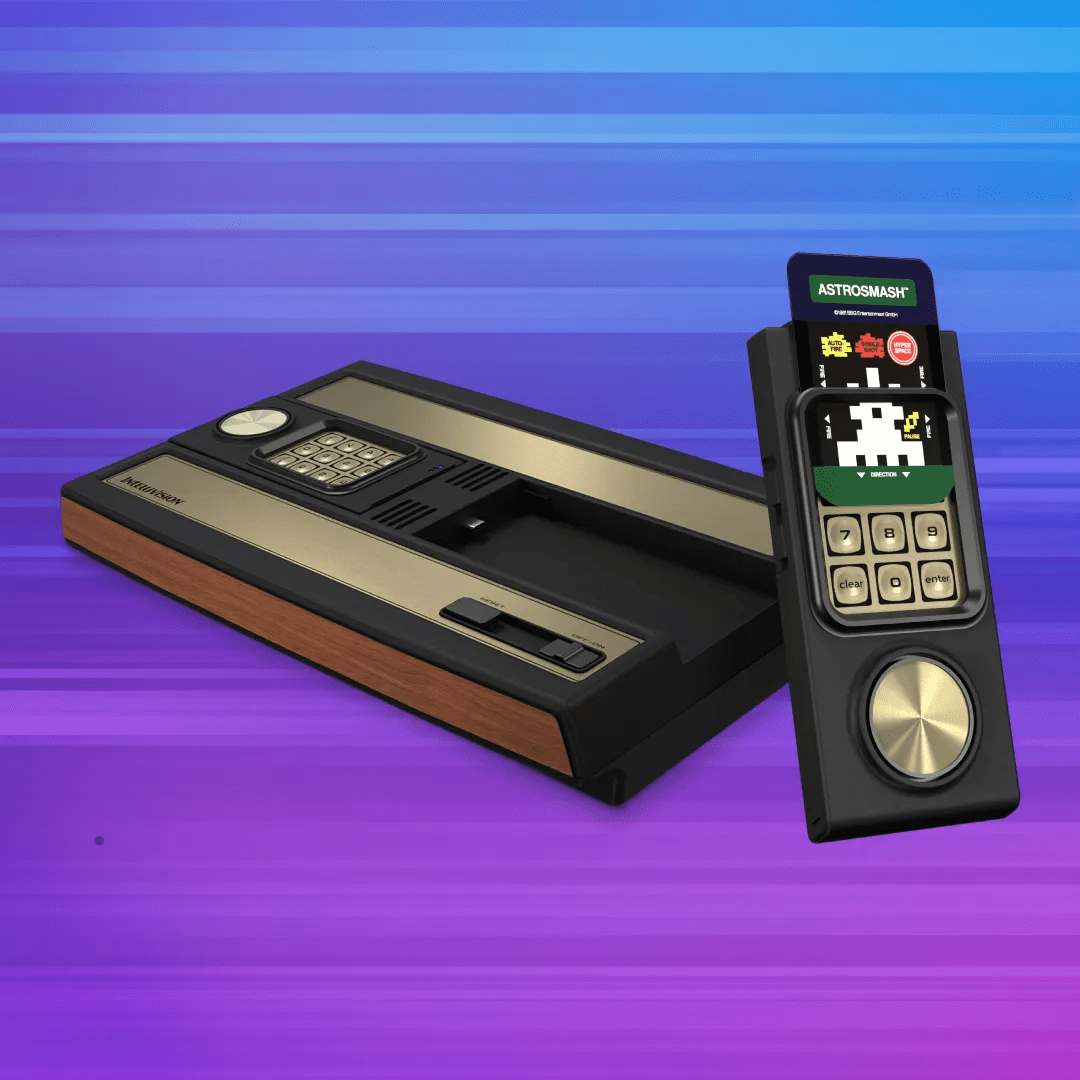
    Who remembers the Intellivision?

    That question is an easy way to separate the Boomers and Gen X’s in the audience from the youngsters who came after. 🙂

    I remember the Intellivision fondly. It was THE only gift I wanted from Santa one Christmas when I was little. I wanted one really really bad. And lucky for me, Christmas did not disappoint! That said, this photo from that Christmas still makes me laugh: there’s me, waiting for a turn on my fancy new video game system while my mom was playing instead.

    And, here’s another pic from later that day or the next day, showing more of the same… “Hey mom, when do I get a turn?!?”

    That Intellivision disappeared years ago. I don’t even remember what happened to it now. It’s old 16 bit graphics were fancy for the time but they are downright archaic when you put them beside a modern Xbox or Playstation. It’s ridiculous to even try and compare the Intellivision to today’s graphics cards, but for starters, modern cards are at least 256 bit, plus a bunch of other fancy tech to accelerate their performance even further.

    But even though the tech is grossly outdated, I jumped as soon as I heard it was being re-released. Atari bought the rights to Intellivision and have now launched the Intellivision Sprint. I ordered one for my mom for Christmas (from Amazon here in Canada – they offered a much cheaper “Canada delivery” option than trying to order from Atari in the USA). Note that amazon.ca is now showing it as Currently Unavailable. I kinda feel like I got away with something because I can’t find anywhere that will deliver it to Canadians right now. I ordered it well in advance of Christmas (sometime in November, if I remember correctly) with a promised delivery date of mid-December. Unfortunately, Amazon didn’t get it here by Dec 25, but it did show up between Christmas and New Years.

    As soon as it arrived, I delivered it to my mom, set it up, and then proceeded to make up for all of the Intellivision beatings she gave me when I was just a helpless little kid. First up was Astrosmash – this was an Intellivision staple back in the day. Immediate nostalgia when this game fired up. Next up, we played Baseball – she begged for the mercy rule to come into effect shortly thereafter. And then we got stuck on Snafu – she is still twitching from the beatings she got in that game. So much fun!

    This was a great reminder that you don’t always need the latest tech to have fun. This decidedly low tech game system will likely never entertain anyone under the age of 40, having already been spoiled by the likes of Super NES and more. But for those of us who aren’t as spry as we once were and who try to argue that their grey hair is just a sign of “experience” and not old age, well… this is a great trip down memory lane that is bound to transport us back to some great childhood memories.


    Speaking of childhood memories… The Angry Therapist wrote this week about how “the parts of you that feel most alive are often the first parts you’re told to lock away.”

    This was so timely for me. I’ve been enjoying a renaissance existence over the last year or so after rediscovering Dungeons & Dragons. I used to play as a kid. I loved D&D. I collected all of the books and adventures. I used to play with my friends at school every day. It was so much fun. I felt so alive – imagining myself as the various characters that I had created and acting out these adventures around a table with my friends.

    But then, I did something I am not proud of. I got caught shoplifting D&D books at the local Coles bookstore. My punishment was that I had to give away all of my D&D books and supplies, and I was not allowed to play D&D anymore. That immediately ended my relationship with D&D.

    Over the next few years, I saw newspaper and magazine headlines that accused D&D of allegedly promoting Satanism, witchcraft, suicide, pornography, and murder. (Dungeons & Dragons controversies – wikipedia) And, D&D and the like have historically been associated with geeks and nerds.

    My initial rogue-based thievery, combined with ongoing societal stigma, kept my childhood enjoyment at bay for way too many years.

    But over time, numerous touchpoint helped bring me back. Lunchtime board game sessions with my co-workers at Postmedia reintroduced me to the joy of games and group play – that group showed me a ton of new games and styles of play that I had no idea existed.

    The Big Bang Theory raised awareness and showed the fun of gaming, even while it grappled with the tension between the cool kids and the nerds.

    But finally, it was a suggestion by a friend of mine, who suggested that I give D&D another chance – “What’s the worst that can happen? You might waste a few hours checking out a game store or two. But it could open up a whole new world of enjoyment to0. You’ve got nothing to lose.” (I”m paraphrasing, but that was the gist of the message.)

    My first stop was at Mecha Games in St Catharines. From there, I bought a couple of D&D books, then a couple more. Then found startplaying.games. Then found a local once a month one-shot. And then I bought a few more books. Then some kickstarters. And now I’m over run with more paraphernalia than I know what to do with.

    And boy is it fun. I haven’t felt this stimulated creativity-wise in years. And I’m finally ready to write. I’ve had some projects tucked away in my head and in various notes for years. But this new creative surge has got me moving and typing and creating in a way that I haven’t done in years. It’s pretty awesome.

    So yeah… I found myself nodding my head repeatedly as I read The Angry Therapist’s post this week. His story had a similar arc. And his call to action couldn’t be more timely for me – but also for all of us:

    What Part of You Have You Locked Away?

    Maybe it’s your creativity. Your playfulness. Your curiosity. Your fearlessness. Your ability to laugh without apologizing for taking up space.

    Whatever it is – it’s still there. Waiting for you to remember it exists.

    You don’t need a complete reinvention. You need a reunion.

    With the version of you that existed before you learned to play small. Before you decided being responsible meant being boring. Before you locked away the parts of yourself that felt too risky, too much, too alive.

    Feel free to share in the comments below… What part of you have you locked away? And why don’t you revisit it?

  • Worth reading this week

    Worth reading this week

    A quote I’ve been pondering lately:

    “One does not accumulate but eliminate. It is not daily increase but daily decrease. The height of cultivation always runs to simplicity.”  — Bruce Lee

    Some interesting stuff that I stumbled across over the last few days:

    Yes, This Photo from Everest Is Real – What happened to the days when Everest was the achievement of a select few? Now it looks like an assembly line of rich people all jockeying to get up and down the hill before they die.

    Why You Should Stop Caring What Other People Think (Taming the Mammoth) – So much of what we do in life is predicated on the decision making of “what will other people think?” This is a great treatise on living on your terms in a way that minimizes the unfound fear that prevents so many of us from pursuing things that can bring us more happiness in the limited time we have.

    You should have a personal web site – I’ve been meaning to get back to blogging for a while. This little article caught my eye and prompted me to dust off my blog and get writing again. Thanks Mark!

    Incognito no more: Publishers close loopholes as paywall blockers emerge – I used to work at an online newspaper and I led some of our paywall integrations. I was always discouraged by the technology because I immediately saw the flaws and workarounds that could be used to skirt them. But seems I’m an outlier. As this article argues, the vast majority of website visitors aren’t tech-savvy enough (or couldn’t be bothered) with trying to go around paywalls (I suspect quite a few just give up and miss out on good content once they hit the end of their free viewing period).

    Have Smartphones Destroyed a Generation? – I haven’t read the whole article yet, but I was directed to this story while reading Digital Minimalism. Really interesting arguments to be made for limiting screen time, especially for kids. I’m still working through the book, but my fav quote so far: “Regular doses of solitude, mixed in with our default mode of socialite, are necessary to flourish as a human being.

    I’m always interested about what you read this week too. Feel free to share what you’ve been reading in the comments below.

    Talk soon!

    Todd

  • True Fans – Even the NY Times knows about them!

    Facebook - Building a Better News FeedIn my recent Wordcamp Hamilton presentation, I talked about how to build your own fanbase to support your writing. In that presentation, I talked about Kevin Kelly’s suggestion that all you need is 1,000 True Fans to support your creative career.

    A recent article on Medium.com by Lydia Polgreen, Editorial Director, NYT Global, entitled “Why people pay to read The New York Times“, mentioned the following:

    We used Facebook to push stories out to potential readers, to get people to sign up for our Spanish-language newsletter, Boletín, and to drive traffic to our home page. Just as it does for so many other businesses, Facebook helped us find our true fans.

    This is spot on with my talk, where I mentioned that you should use social media to drive traffic to your home page and to get people to sign up for your newsletters. Social media is a fantastic generator of eyeballs. The key is to use it to drive traffic to your site. Be wary of building audience on someone else’s turf (like Facebook or Twitter or Snapchat or <insert flavour of the moment here>).

    And, almost on queue, Facebook popped up today to say that they are going to change the behaviour of content delivered to people’s newsfeed on Facebook. Facebook is going to fine tune your feed so that “friends and family come first”. This means less of a focus on publisher’s content and more focus on status updates and photos and videos from your friends. (additional commentary from NYTimes here)

    It’ll be interesting to see how this alters the dynamic between the Social Network and its publishing competitors/partners as they continue their courtship dance in the online world.

    And, let this serve as yet another reminder to build your own home and foster community where you can control it.

    That’s it. G’night!

    Todd