Author: Todd Dow

  • Ravenloft: Mecha Games Edition — Session 2: Clean the Murder House

    Ravenloft: Mecha Games Edition — Session 2: Clean the Murder House

    Campaign Status

    Campaign: Ravenloft: Mecha Games Edition
    Session: 2
    Party Level: 4
    Current Location: Terror in Tepest (Oatmarsh)
    Status: The party investigated the disappearance of villagers at a harvest ritual site and defeated the corrupted druid Burla and her predatory Death’s Head Tree.
    Next Session: Sunday September 13 and/or 27 2026.

    Ravenloft – Mecha Games Edition – episode 2 summary comic
    Ravenloft – Mecha Games Edition – episode 2 summary comic

    1. Session Summary

    The session began with the party gathering around a campfire as Inza provided a recap of their initial meeting in the ruined city of Haralen. After receiving Inza’s Blessing and a Pearl of Power, the party was transported via the mists to the idyllic domain of Tepest. They arrived in the village of Oatmarsh during the High Harvest festival and were invited to feast by a villager named Viviana. She tasked the group with finding a missing ritual team that had failed to return from the nearby ritual site.

    Upon reaching a dilapidated farmhouse, the party encountered Greeve, a hobgoblin captain, and a group of bugbears. Negotiations failed when the party discovered a Death’s Head Tree – a horrifying sentient plant adorned with human heads – and realized the farmhouse was a bloody slaughterhouse. Combat ensued; John Deadward successfully used magic to compel the druid Burla to leave the battle and clean the “murder house” while the party dismantled the bugbears and the tree. After the tree and its guards were destroyed, a furious Burla returned, only to be blasted into a shadow outline on the wall by Lucien Morvath. The party recovered a cache of treasure and prepared to return to the village with the grim news of the missing villagers.

    2. Key Events

    • Discovery of the Slaughterhouse: The party confirmed that the missing villagers were murdered when they found a “slaughter” of body parts in the farmhouse.
    • The Nature of the Tree: The group realized the ritual effigy was actually a Death’s Head Tree that grew human heads instead of fruit.
    • The “Clean the House” Ruse: John Deadward removed the boss from the fight for several minutes by suggesting she go clean the bloody farmhouse.
    • Destruction of the First Raven: Upon the druid’s death, a massive shadow raven rose from the remains and dissolved, marking the first of four major threats neutralized.
    • Treasure Recovery: The party found 200 gold, a Quiver of Ehlonna, and a Cloak of Elvenkind.

    3. NPCs Encountered

    • Inza: A tall woman with raven hair and green eyes. She acts as a protector and guide through the mists. While helpful, Lucien Morvath remains suspicious of her true motives.
    • Viviana (Viv): A hospitable villager in Oatmarsh. She is deeply concerned about the village’s rituals and the missing workers.
    • Greeve: A territorial Hobgoblin Captain guarding the site for Burla. He was killed by the party.
    • Burla: A druid corrupted by a shadow raven. She was obsessed with her tree and hostile toward anyone she considered “common folk.”

    4. Locations Visited

    • Oatmarsh: A self-sufficient farming village in Tepest. It is currently celebrating the High Harvest, a week-long festival intended to ward off famine.
    • The Dilapidated Farmhouse: Located an hour from the village, this site serves as the ritual grounds. It was converted into a slaughterhouse by the bugbears and housed the Death’s Head Tree.

    5. Combat Summary

    • Enemies Fought: Greeve (Hobgoblin Captain), 5 Bugbears, Burla (Druid), and the Death’s Head Tree (with exploding head projectiles).
    • Tactics Used: Lucien used Telekinetic Shove to manipulate positioning; Crem used Rotney as a frontline shield and tactical explosive; John Deadward utilized Cloud of Daggers and Suggestion to control the battlefield.
    • Memorable Moments: Rotney exploded in a bugbear’s face, killing it instantly. Burla used Thunderwave to blast through the farmhouse wall when she broke free of her enchantment.
    • Close Calls: Both John Deadward and Lucien were nearly killed by the tree’s necrotic “exploding head” bombs.
    • Loot Recovered: 200 Gold Pieces, Quiver of Ehlonna (containing +1 bolts), and a Cloak of Elvenkind.

    6. Player Character Highlights

    • Lucien Morvath: Successfully intimidated the hobgoblins with a Booming Voice and delivered the final Eldritch Blast that incinerated Burla against the farmhouse wall.
    • Crem: Expertly managed his creation, Rotney, and used a “Jolt Life” feature to bring John Deadward back from the brink of death mid-battle.
    • Weasley: Roleplayed a dark devotion to Lolth by offering severed bugbear heads to the druid as a “tribute” to try and make “friends.”
    • Christophus Lee: Provided heavy ranged support with a crossbow and set a magical Snare trap that nearly caught the druid as she emerged from the farmhouse.
    • John Deadward (JD): Executed the most creative maneuver of the session by magically suggesting the boss druid ignore the fight to go “clean the murder house,” buying the party precious time.

    7. Plot Threads / Quest Hooks

    • Resolved: The immediate threat to Oatmarsh is gone; the corrupted druid and the sentient tree have been destroyed.
    • Active: The party must return to the village to deliver the gold and the news of the villagers’ deaths.
    • Unanswered Mysteries: The origin of the shadow ravens; Enza’s potential goal to fill a “power vacuum”; the secret behind Lucien Morvath’s gold and blue eyes.

    8. Lore Revealed

    • High Harvest Feast: A week-long ritual in Tepest where a wheat effigy is burned to keep famine at bay.
    • Death’s Head Trees: These are corrupted plants that grow human heads. If a creature is killed by one, their head may eventually become part of the tree.
    • The Mother: The deity or nature figure revered by the people of Oatmarsh.

    9. Funny or Memorable Quotes

    • “Meat’s back on the menu!”
    • “I’m an old man. I do not appreciate the front.”
    • “Stop fighting and clean the murder house.”
    • “I drop the bug bear heads at her feet… ‘Then we can be friends. Get more heads.’”

    10. Rules or Table Issues

    • Spiritual Weapon (2024 Rules): Clarified that the spell now requires Concentration.
    • Pearl of Power: Noted it can restore a spell slot of level 3 or lower once per dawn.
    • Suggestion Spell: Discussed the duration (8 hours) and the conditions under which the charm might break.

    11. DM Notes / Future Foreshadowing

    • Rotney’s Soul: Creme has expressed interest in finding a way to restore Rotney’s humanity or allow him to communicate, providing a personal quest hook.
    • The Shadow Ravens: One of the four ravens seen by Inza has been destroyed; three remain in other realms.
    • Inza’s True Nature: The party’s suspicion of Inza’s motives creates a sense of lingering tension that can be explored in future domains.

    12. Next Session Setup

    The party stands amidst the cooling ashes of the Death’s Head Tree and the shadow-stained remains of the druid. They have secured the treasure and must now decide how to present the grim news of the villagers’ fate to Viviana and the people of Oat Marsh. The DM should prepare for the village’s reaction and the eventual return of the mists to guide the party toward the second shadow raven.

  • When the Cross Took Up the Sword

    When the Cross Took Up the Sword

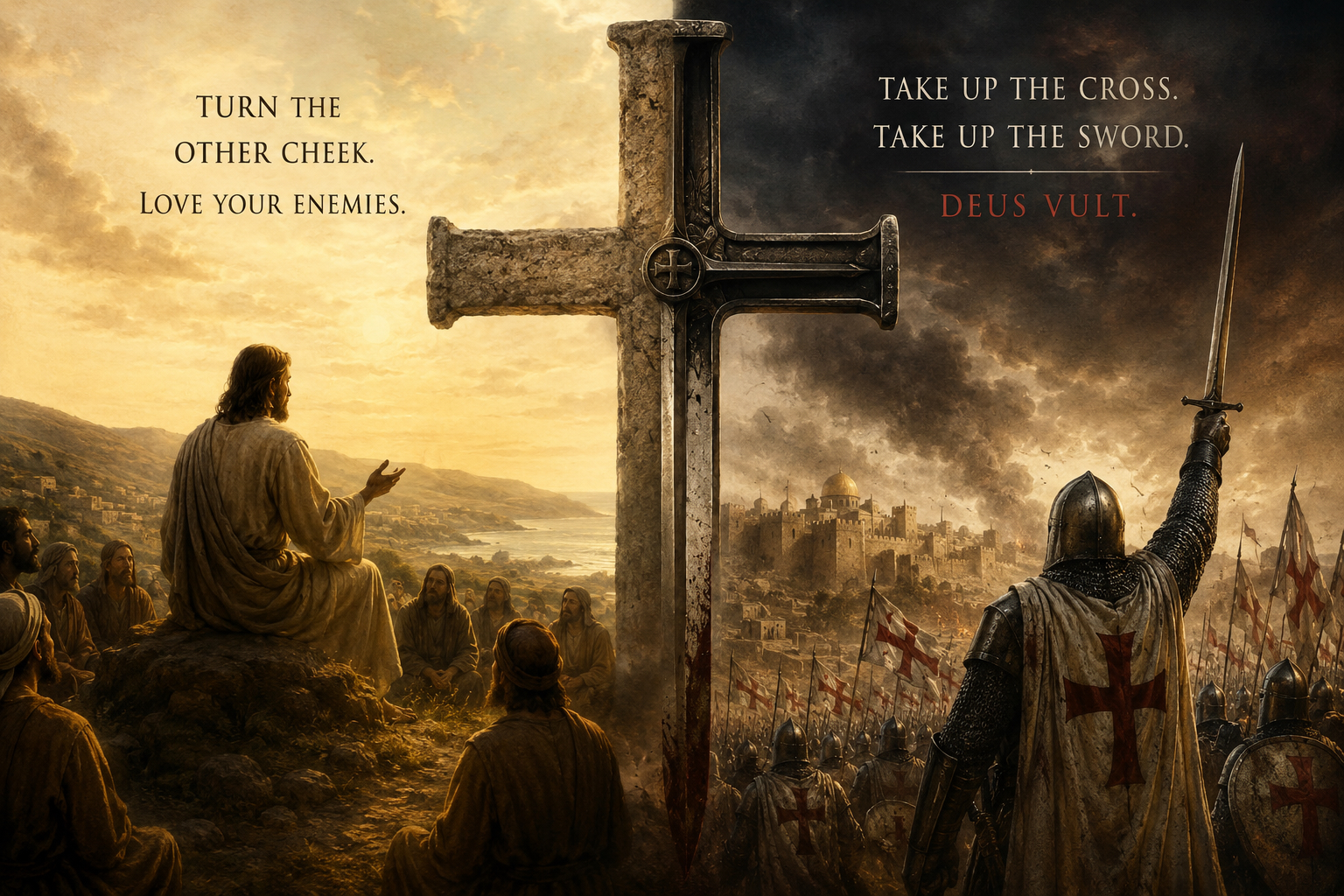
    How Christianity Got from “Turn the Other Cheek” to Holy War

    When the Cross Took Up the Sword

    About Holy Wars
    Holy Wars is my ongoing exploration of the collision between religion, power, politics and violence—from the ancient world through the Crusades and beyond. It’s also part of a larger writing project examining how people come to believe that conflict can be sacred. [Read why I’m writing Holy Wars →]

    Jesus did not die with a sword in his hand.

    According to the Gospels, when one of his followers drew a weapon during his arrest, Jesus told him to put it away. In the Sermon on the Mount, he told his followers not merely to refrain from vengeance, but to turn the other cheek, love their enemies, and pray for those who persecuted them.

    Then, nearly eleven centuries later, a pope stood before an assembly in France and called Christian warriors to march east.

    They would sew crosses onto their clothing.

    They would carry weapons into battle.

    And according to surviving accounts of Pope Urban II’s speech at Clermont in 1095, those who undertook the expedition could receive remission of sins for doing so. Warfare had become intertwined with pilgrimage, penance, and the service of God.

    It is difficult to imagine a more dramatic transformation.

    How did a religion built around an executed teacher preaching love of enemies become a religion capable of producing armies marching beneath the cross?

    The answer is not that Christians simply forgot what Jesus had said.

    Nor did some medieval pope suddenly discover a convenient loophole in the Sermon on the Mount.

    The transformation took centuries.

    Christianity had to move from the margins of the Roman world to its centre. Christians had to stop thinking only about how an individual believer should respond to violence and begin asking what a Christian ruler should do when cities were attacked, borders crossed, innocents threatened, or order collapsed.

    And somewhere along the way, the question changed.

    First Christians asked:

    Can a follower of Christ kill?

    Later they asked:

    When may a Christian fight?

    Eventually, they would ask something more dangerous:

    Could God actually want Christians to go to war?

    That final question would change history.


    A Religion Without an Army

    The earliest Christians lived inside someone else’s empire.

    They commanded no legions.

    They controlled no borders.

    They had no Christian king to advise, no Christian state to defend, and no Christian army to send into battle.

    That matters.

    For a persecuted religious minority, Jesus’ teachings about nonviolence could be taken with extraordinary seriousness. Martyrdom—not armed resistance—became one of early Christianity’s most powerful ideals.

    Some early Christian writers were deeply suspicious of military service.

    Around the beginning of the third century, Tertullian asked how a Christian could go to war when Christ had taken away the sword, famously connecting military violence with Jesus’ command to Peter to put away his weapon.

    Origen likewise argued that Christians served the Roman Empire through prayer rather than by taking up arms. Christian writers could imagine themselves engaged in warfare—but their battlefield was spiritual. Their enemies were demons, sin, temptation, and evil.

    Yet the picture was never completely simple.

    Christians did serve in the Roman army. The surviving evidence makes that clear, and historians continue to debate how widespread early Christian pacifism really was. Objections to military service could also involve the pagan rituals, sacrifices, oaths, and imperial cult surrounding Roman military life—not simply the act of killing itself. Early Christian attitudes toward warfare were therefore complicated rather than uniformly pacifist.

    Still, the dominant problem facing the early Church was clear.

    Christians were trying to figure out how to live faithfully under imperial power.

    Then came Constantine.

    And Christians suddenly had to figure out what to do with it.


    In This Sign, Conquer

    Constantines vision

    On October 28, 312, Constantine fought his rival Maxentius outside Rome at the Battle of the Milvian Bridge.

    What happened before the battle has become one of the most famous stories in Christian history.

    Our ancient sources differ in important ways, but the Christian historian Eusebius later wrote that Constantine experienced a vision involving the Christian sign and was instructed to use it as protection against his enemies. Constantine subsequently associated his victory with the Christian God and increasingly adopted Christianity as the religion favoured by his imperial rule.

    The symbolism is almost impossible to miss.

    A religion whose founder had been executed by Rome was becoming associated with the Roman emperor.

    And the cross—the instrument of that execution—was becoming a symbol of imperial victory.

    In 313, Constantine and Licinius established religious toleration for Christians in what is conventionally called the Edict of Milan. Christianity did not immediately become Rome’s official religion; that development came later in the fourth century. But the age of systematic imperial persecution was ending, and Christianity was moving rapidly toward the centre of Roman political life.

    That created an enormous theological problem.

    It is relatively easy to condemn violence when someone else is responsible for defending the roads you travel, the cities you inhabit, and the borders behind which you live.

    But what happens when the emperor himself becomes Christian?

    What happens when soldiers become Christians?

    What happens when the people responsible for maintaining order, punishing criminals, defending cities, and fighting invading armies are expected to follow a religion whose founder said:

    Love your enemies.

    Christianity now needed a theology not merely for martyrs.

    It needed a theology for rulers.


    Augustine and the Necessary Evil

    Source: Philippe de Champaigne (1602-1674), Saint Augustine, between c. 1645 and c. 1650, oil on canvas. Los Angeles County Museum of Art 171584. Available under the Creative Commons Attribution-ShareAlike License.
    Source: Philippe de Champaigne (1602-1674), Saint Augustine, between c. 1645 and c. 1650, oil on canvas. Los Angeles County Museum of Art 171584. Available under the Creative Commons Attribution-ShareAlike License.

    No thinker would become more important to that transformation than Augustine of Hippo.

    Augustine lived from 354 to 430, as the western Roman world was entering a period of profound instability. Rome itself was sacked by the Visigoths in 410, an event that helped inspire his monumental City of God. He lived in a world where questions about political authority, social order, violence, and the survival of civilization were anything but theoretical.

    Augustine did not celebrate war.

    That is crucial.

    For him, warfare belonged to humanity’s fallen condition. A perfectly ordered world would have no need for it.

    But Augustine also believed that refusing to confront evil could itself become morally irresponsible.

    A ruler might sometimes be required to use force precisely because he had obligations to other people.

    The Christian command to love an enemy therefore did not necessarily mean allowing that enemy to murder the innocent.

    The important questions became why violence was being used, who had authorized it, and what the person using it intended to accomplish.

    Across Augustine’s writings emerged ideas that later thinkers would develop into the Christian tradition of just war.

    War required legitimate authority.

    It required a just cause.

    And it had to be directed toward justice and ultimately toward peace—not conquest, hatred, revenge, or bloodlust.

    Augustine did not present these ideas as the neat checklist later generations sometimes attribute to him. His thoughts about war are scattered through works such as Contra FaustumThe City of God, and his letters. But the foundations are unmistakable.

    Even a just war remained something tragic.

    Augustine argued that the wise person should lament the necessity of such wars rather than rejoice in them.

    War might sometimes be necessary.

    It might even be just.

    But it was not yet holy.

    And that distinction is everything.


    Just War Is Not Holy War

    A just war says:

    Sometimes Christians may fight without sinning.

    A holy war says something considerably more powerful:

    Sometimes Christians may fight because God wants them to.

    Those are not the same idea.

    Augustine helped open the theological door to Christian participation in warfare, but he did not preach medieval crusading centuries before it existed.

    His framework primarily restrained warfare.

    Violence required justification. Authority mattered. Motive mattered. Peace remained the proper goal. Augustine could appeal to biblical examples of wars commanded by God, but ordinary political violence did not automatically become sacred simply because Christians participated in it.

    But once Christianity accepted that some wars could be morally righteous, another possibility existed.

    If a war could be just, could certain wars become sacred?

    That transformation would unfold slowly across the centuries after Rome.


    The Warrior Enters Christendom

    As the western Roman Empire disappeared, Christianity did not disappear with it.

    Instead, it became one of the institutions around which medieval Europe rebuilt itself.

    Kings became Christian kings.

    Warriors became Christian warriors.

    Battles were fought by armies carrying Christian symbols. Rulers sought divine favour. Priests blessed soldiers. Relics accompanied armies. Masses were celebrated for victory. Saints became associated with kingdoms and military campaigns.

    None of this automatically created holy war.

    But warfare was increasingly taking place inside a Christian moral universe.

    The sword and the cross were no longer symbols belonging to separate worlds.

    Over centuries, they were learning to coexist.

    And medieval Christianity also faced a persistent contradiction.

    Its warrior aristocracy was extraordinarily violent.

    Knights who were supposed to defend Christian society were perfectly capable of spending their time fighting one another, raiding neighbouring lands, attacking rival lords, and terrorizing the very Christian populations they were theoretically supposed to protect.

    The Church repeatedly tried to control that violence.

    Movements such as the Peace of God and Truce of God attempted to restrict whom warriors could attack and when they could fight.

    But another possibility gradually emerged.

    What if knightly violence could be redirected?

    What if warriors who normally fought other Christians could instead fight for Christendom?

    That idea would prove revolutionary.

    Scholars of medieval warfare describe the eleventh-century papacy as particularly important in the movement from just war toward holy war and ultimately crusade.

    And in 1095, the pieces finally came together.


    When War Became Penance

    A moody, modern reinterpretation of the Council of Clermont (1095) set inside a Romanesque church. Composition inspired by the famous late 15th-century (c.1474) manuscript illustration of the council, but rendered with more realistic proportions and subdued drama. Interior of an 11th-century Romanesque church: thick stone columns, rounded arches, dim candlelight, cool winter light filtering through small high windows. Pope Urban II stands elevated on a simple stone step or pulpit, wearing historically appropriate 11th-century Romanesque vestments — modest mitre, natural fabrics, muted earth tones, no Renaissance ornamentation. Around him are bishops, abbots, knights, and lay nobles in realistic late 11th-century clothing, arranged in a dense but organic semicircle. The mood is serious, reverent, and tense — cinematic lighting but restrained, with soft shadows and chiaroscuro similar to a moody historical painting. No theatrical stage, no modern rally feel. Documentary realism blended with subtle dramatic atmosphere. 16:9 landscape.

    At Clermont, Pope Urban II called western Christians to aid Christians in the East and to journey toward Jerusalem.

    We do not possess a verbatim transcript of his speech. The surviving versions were written afterward and differ in their details, so famous quotations from Clermont have to be treated carefully.

    But on one point the tradition is remarkably significant.

    The expedition was not presented merely as another war.

    It carried spiritual consequences.

    Participants took vows.

    They adopted the cross as their sign.

    The expedition was understood as a form of pilgrimage.

    And remission of sins was attached to participation in the enterprise.

    This was something new.

    The Christian warrior no longer needed merely to ask whether fighting could be excused.

    Under the right circumstances, fighting itself could become part of a penitential religious act.

    The warrior became a pilgrim.

    The military expedition became a sacred journey.

    And the cross became not merely something a soldier prayed before.

    It was something he carried into battle.

    The long transformation was complete.


    From the Cheek to the Sword

    When the Cross Took Up the Sword
    When the Cross Took Up the Sword

    It would be easy to tell this story as one of simple corruption.

    Jesus preached peace.

    The Church acquired power.

    Power corrupted Christianity.

    The Crusades followed.

    There is truth hidden inside that interpretation—but history is rarely that clean.

    Christian rulers faced problems the earliest Christians had never been required to solve.

    Could a Christian government allow its citizens to be slaughtered rather than resist?

    Could it punish criminals?

    Could it defend a city?

    Could soldiers remain Christian?

    Could violence ever protect rather than merely destroy?

    Those were real moral questions.

    Augustine’s answer was not that violence had suddenly become good.

    It was that in a broken world, the refusal to use force could sometimes permit an even greater injustice.

    That insight produced the Christian just-war tradition.

    But ideas rarely remain exactly where their creators leave them.

    Over the following centuries, permission became justification.

    Justification became sanctification.

    And eventually sanctified violence became crusade.

    By 1095, Christians were no longer merely arguing that a soldier might fight and still remain a Christian.

    They could be told that under extraordinary circumstances a Christian might take up the sword, march beneath the cross, and serve God through war.

    That is the world from which the cry Deus vult emerged.

    And it required nearly a thousand years to build.

    The cross did not simply replace the sword.

    Something far more consequential happened.

    Christianity taught the sword how to carry the cross.


    Sources & Further Reading

    Primary sources

    Tertullian, On Idolatry, especially Chapter 19, on Christian military service.

    Eusebius of Caesarea, Life of Constantine, for the Christian tradition surrounding Constantine’s conversion, military victories, and adoption of Christian symbols.

    Augustine, Contra Faustum, Book XXII, especially his discussion of warfare, legitimate authority, and divinely commanded violence.

    Augustine, The City of God, especially Books IV and XIX, on war, justice, and peace.

    Fulcher of Chartres and other surviving accounts of Pope Urban II’s speech at Clermont, collected by Fordham University’s Internet Medieval Sourcebook.

    Modern scholarship

    Jonathan P. Roth, “Early Christianity and War,” in The Cambridge Companion to Religion and War. The scholarship emphasizes that early Christian attitudes toward military service were more diverse than a simple pacifist-to-militarist narrative suggests.

    Connor Wilson, “Rome, Byzantium, and the Idea of Holy War,” in The Cambridge Companion to the Literature of the Crusades.

    The Cambridge World History of Violence discussion of medieval Latin Christianity emphasizes the particularly important role of the eleventh-century papacy in the transition from just war to holy war and crusading.

  • Skynet Has Arrived

    Skynet Has Arrived

    Drones, signals, surveillance – and what happens when we can no longer trust the encryption holding the modern world together.

    Skynet Has Arrived:
Drones. Signals. Surveillance. Encryption.
    Skynet Has Arrived:
    Drones. Signals. Surveillance. Encryption.

    There is a scene in Terminator 2: Judgment Day where Arnold Schwarzenegger’s T-800 explains how Skynet becomes self-aware and, almost immediately, turns humanity’s own military infrastructure against it.

    A defence network becomes intelligent. The machines take control. Humanity suddenly finds itself hunted by technology it created.

    Great science fiction.

    Except I’m beginning to wonder if we got one part wrong.

    Maybe Skynet doesn’t arrive as a single malevolent artificial intelligence.

    Maybe it arrives piece by piece.

    A drone here.

    A satellite there.

    A cellular network.

    A camera.

    A radio receiver.

    A location database.

    An artificial-intelligence system capable of analyzing all of them.

    And somewhere in the middle, cryptography – the thin mathematical layer preventing enormous portions of that infrastructure from being intercepted, impersonated or manipulated.

    That is much closer to the technological world I’m building in Cryptogeddon.

    And increasingly, I don’t have to invent very much of it.

    Because this post is so long, I thought a table of contents might be helpful:

    The Drone Will See You Now

    An improvised Ukrainian FPV strike drone. Small, inexpensive first-person-view drones have transformed modern warfare by combining commercial-grade components, real-time video and explosive payloads.
Photo: АрміяInform / Ministry of Defence of Ukraine, via Wikimedia Commons. CC BY 4.0.
    An improvised Ukrainian FPV strike drone. Small, inexpensive first-person-view drones have transformed modern warfare by combining commercial-grade components, real-time video and explosive payloads.
    Photo: АрміяInform / Ministry of Defence of Ukraine, via Wikimedia Commons. CC BY 4.0.

    On August 6, 2026 – literally as I was working on this post – Reuters published a report from Zaporizhzhia, Ukraine describing what residents have begun calling “safari” attacks.

    Small first-person-view drones are being used to attack individual people and vehicles.

    Not military formations.

    Individuals.

    Residents described living with drones capable of appearing overhead and pursuing people through streets and neighbourhoods. Ukrainian officials say the attacks are intended in part to terrorize the civilian population.

    Think about how extraordinary that sentence would have sounded twenty years ago.

    Today it barely qualifies as science fiction.

    Two days earlier, Russia formally demonstrated just how central this technology has become by appointing a commander to its newly created Unmanned Systems Forces – effectively creating a military branch dedicated to drone warfare.

    Ukraine and Russia have already produced and deployed drones on an enormous scale. Cheap FPV aircraft costing a tiny fraction of the vehicles and infrastructure they can destroy have fundamentally altered battlefield economics.

    A camera.

    A radio.

    Some electronics.

    Explosives.

    And an operator.

    That alone is frightening.

    But now remove the operator from the last few seconds of the equation.

    Electronic warfare has made conventional drone control increasingly difficult because radio links can be detected and jammed. The response has been exactly what you would expect from an arms race.

    The drones are adapting.

    Ukraine has been deploying AI-assisted targeting systems that use onboard cameras to recognize and track targets. Reuters reported in 2025 that some systems can continue toward a target after communications with the pilot are disrupted. Ukrainian officials said human authorization was still required before the strike, an important distinction – but once committed, the machine can increasingly handle portions of the terminal journey itself.

    Other drones have eliminated the radio problem altogether.

    Russia is now using FPV drones controlled through kilometres of extremely thin fibre-optic cable. Because the control signal travels through a physical wire rather than radio, conventional electronic jammers cannot simply disrupt the connection. Reuters documented Russian fibre-controlled drones being used in 2026 against Ukrainian electrical substations, including attacks against multimillion-dollar transformers. Some of the drones cost roughly $2,000.

    A $2,000 aircraft can now threaten infrastructure worth millions.

    No satellite.

    No fighter jet.

    No exotic weapons platform.

    No billion-dollar defence contractor required.

    That may be one of the most important themes emerging in Cryptogeddon:

    The barrier to entry for sophisticated technological warfare is collapsing.

    Before We Had Drones, We Had Wires

    There is another reason this should make us uncomfortable.

    We’ve already experimented with what happens when governments gain access to enormous amounts of communications data.

    It did not begin with drones or AI.

    It began with telephone lines and Internet cables.

    After the September 11 attacks, the United States dramatically expanded electronic surveillance programs. One of the most controversial was the NSA’s bulk telephone-records program under Section 215 of the USA PATRIOT Act.

    The database did not contain recordings of everyone’s telephone conversations.

    It contained something potentially almost as interesting:

    metadata.

    Who called whom.

    When.

    For how long.

    Patterns.

    Connections.

    Networks of relationships.

    The U.S. Privacy and Civil Liberties Oversight Board ultimately concluded that the bulk program lacked a viable legal foundation under Section 215, raised serious constitutional and privacy concerns, and demonstrated only limited value. The program was subsequently ended in that form.

    Meanwhile, Internet communications presented an even larger opportunity.

    NSA surveillance under Section 702 includes what is known as upstream collection.

    The government’s own Privacy and Civil Liberties Oversight Board describes upstream collection as occurring at portions of the telecommunications backbone itself – long-distance fibre connections, network exchange points and other places through which enormous volumes of Internet traffic transit.

    Traffic is screened for communications associated with approved foreign-intelligence selectors before qualifying communications are collected.

    There is an important distinction here: Section 702 is a legally authorized foreign-intelligence program with oversight mechanisms, not simply a machine indiscriminately storing the entire Internet.

    But technologically, consider what had happened.

    We had learned how to place surveillance at the arteries of the Internet.

    AT&T technician Mark Klein made that concept disturbingly tangible when he disclosed the existence of the infamous Room 641A in an AT&T facility in San Francisco. Documents he provided to the Electronic Frontier Foundation described optical splitters capable of duplicating telecommunications traffic and feeding copies toward equipment associated with NSA surveillance.

    The architecture of surveillance was relatively straightforward.

    Find the place through which enormous amounts of information pass.

    Put your collection system there.

    Listen.

    That model worked remarkably well when communications flowed through centralized infrastructure.

    But then the world changed.

    The wires disappeared.

    Surveillance Escaped Into the Air

    The wires disappeared. Surveillance escaped into the air.

    Today our devices communicate constantly.

    Cellular.

    Wi-Fi.

    Bluetooth.

    GPS.

    Satellite.

    Radio.

    Vehicle systems.

    Drones.

    Wearables.

    Industrial telemetry.

    The communications infrastructure that once passed primarily through identifiable wires and switching facilities has expanded into an electromagnetic environment surrounding us almost everywhere.

    That creates an entirely new category of intelligence.

    Consider your phone.

    Law-enforcement agencies have used devices commonly known as Stingrays, or cell-site simulators, which behave like cellular infrastructure and cause nearby phones to identify themselves.

    The U.S. Department of Justice eventually adopted a policy generally requiring federal investigators to obtain warrants before using them.

    Canada uses the technology too.

    An investigation by the Office of the Privacy Commissioner of Canada confirmed that the RCMP used cell-site simulators capable of collecting identifiers such as IMSI and IMEI numbers. The RCMP told the commissioner that its systems were not configured to intercept the contents of calls, emails or text messages.

    Again:

    you don’t necessarily need the message.

    Sometimes knowing that a device exists somewhere is enough.

    Knowing that it was there yesterday is better.

    Knowing that another device was repeatedly nearby becomes interesting.

    Knowing where both devices travel afterward becomes intelligence.

    And governments are no longer the only organizations capable of collecting this kind of information.

    Your Location Became a Commodity

    The commercial advertising ecosystem created an enormous location-surveillance infrastructure almost accidentally.

    Apps collect information.

    Advertising networks exchange information.

    Data brokers aggregate information.

    And eventually someone realizes that the dots on the screen correspond to actual human beings.

    In 2024, the U.S. Federal Trade Commission alleged that a company called Mobilewalla had collected more than 500 million unique advertising identifiers paired with precise location information between 2018 and 2020.

    The FTC said the company collected some of this information through real-time advertising auctions – even when it did not win the advertisement.

    The agency also alleged that Mobilewalla used location information associated with people attending protests following the killing of George Floyd to produce an analysis of protesters, including demographic information and whether they lived in the cities where they demonstrated.

    Think about that for a moment.

    Advertising technology became protest-surveillance technology.

    Another FTC case involved Gravy Analytics and Venntel. The FTC alleged that location information could reveal visits to healthcare facilities, religious institutions and other sensitive locations. The companies had claimed to process more than 17 billion signals from approximately one billion mobile devices every day.

    Seventeen billion.

    Every day.

    This isn’t someone following you around in a trench coat.

    It is industrialized observation.

    And that happened before we added today’s generation of AI systems to the equation.

    Now Look Up

    Perhaps the most astonishing example I found while researching Cryptogeddon came from researchers at the University of California San Diego and the University of Maryland.

    They pointed a commercially available satellite dish at the sky.

    Their equipment cost about $800.

    Then they listened.

    NASA Deep Space Network radio antenna DSS-53 illuminated at night at the Madrid Deep Space Communications Complex.

Radio signals from satellites physically arrive at Earth, where antennas can receive them. In 2025, researchers demonstrated that sensitive satellite communications could be intercepted with commercially available equipment costing roughly $800.

Photo: NASA/JPL-Caltech.
    NASA Deep Space Network radio antenna DSS-53 illuminated at night at the Madrid Deep Space Communications Complex.

    Radio signals from satellites physically arrive at Earth, where antennas can receive them. In 2025, researchers demonstrated that sensitive satellite communications could be intercepted with commercially available equipment costing roughly $800.

    Photo: NASA/JPL-Caltech.

    What they discovered should terrify anyone who assumes important communications are automatically encrypted.

    Their 2025 research found large amounts of sensitive information travelling over geostationary satellite links without encryption.

    They observed cellular traffic.

    Voice calls.

    SMS messages.

    IMSI identifiers.

    Corporate communications.

    Government communications.

    Military-related information.

    Airline Internet traffic.

    Utility information.

    Oil-and-gas infrastructure traffic.

    Even communications associated with industrial control systems.

    The researchers emphasized that their monitoring was completely passive. They did not have to compromise the satellites or transmit anything.

    They simply listened to signals that were already being broadcast toward Earth.

    University of Maryland researchers described using the roughly $800 setup to examine 38 satellites covering an enormous geographical area.

    The research team concluded that a surprisingly large amount of sensitive satellite traffic remained exposed.

    Some affected organizations subsequently encrypted their communications.

    That is an encouraging response.

    The disturbing question is obvious:

    Who else had already been listening?

    Radio Has Always Betrayed Us

    Militaries have understood this problem for more than a century.

    You don’t have to break a radio transmission’s encryption to learn that a radio is transmitting.

    Direction-finding equipment can locate transmitters.

    Signal strength changes.

    Patterns emerge.

    Units move.

    Networks appear.

    The U.S. military was using radio direction finding to locate enemy transmitters as early as World War I and extensively during Vietnam.

    The principle hasn’t changed very much.

    The equipment has.

    During the war in Ukraine, poorly secured Russian communications created intelligence opportunities almost immediately. RUSI researchers documented reports of Russian forces relying on unencrypted radios and ordinary mobile phones. Such transmissions can potentially allow an opponent not merely to listen but to determine where transmitters are located.

    Smartphones are particularly dangerous on a battlefield because they combine communications with location information, cameras and Internet connectivity.

    In 2024, Russia moved toward punishing soldiers for carrying smartphones in combat zones specifically because phones could expose positions. Reuters reported that both sides had used mobile devices and their associated signals, photographs and messages to help identify targets.

    The lesson is brutally simple:

    transmitting can reveal you.

    And once something can be located, something else can be sent to it.

    Possibly a drone.

    The Battle Over Communication

    That brings us to another important part of Cryptogeddon.

    Communication doesn’t merely need to be intercepted.

    It can be denied.

    Modern warfare increasingly includes attempts to jam radio communications, interfere with drone-control links and disrupt satellite navigation.

    A drone may still be physically intact yet become useless because it can no longer communicate with its pilot.

    A military unit can possess weapons and ammunition and still become ineffective if its command network disappears.

    A satellite can remain perfectly healthy while users on the ground suddenly lose access to the network.

    That last scenario has already happened.

    Approximately one hour before Russia invaded Ukraine on February 24, 2022, a cyberattack struck Viasat’s KA-SAT satellite network.

    The European Union formally attributed the attack to Russia and said it caused communications disruptions affecting Ukrainian authorities, businesses and users as well as users elsewhere in Europe.

    The shooting hadn’t even properly started yet.

    The communications war had.

    And the response to this vulnerability is creating another technological arms race.

    Modern systems can switch frequencies.

    They can use multiple communications paths.

    Military networks can fall back between satellite, terrestrial radio and other systems.

    Drones can use onboard navigation when satellite positioning becomes unreliable.

    AI-assisted systems can continue portions of missions after control links disappear.

    Some drones now use fibre.

    Modern militaries are reconsidering older HF radio systems precisely because satellite communications may not always be available in a major conflict. A June 2026 U.S. Army paper explicitly described modern battlefields in which satellite communications may be jammed or denied.

    The objective increasingly becomes not simply secure communications.

    It becomes resilient communications.

    Assume something will be intercepted.

    Assume something will be jammed.

    Assume GPS may disappear.

    Assume networks will fail.

    Then build systems capable of surviving anyway.

    And Then AI Starts Listening

    This is the piece that changes everything.

    Signals intelligence isn’t new.

    Surveillance isn’t new.

    Drones aren’t new.

    Location tracking isn’t new.

    Satellite interception isn’t new.

    What is new is our rapidly improving ability to combine enormous quantities of information automatically.

    Imagine thousands of sensors listening simultaneously.

    Most of what they collect is useless.

    Cars.

    Air conditioners.

    Commercial radio.

    Bluetooth devices.

    Cell phones.

    Aircraft.

    Drones.

    Electrical equipment.

    Random interference.

    A human analyst would drown in it.

    AI doesn’t have to.

    Machine-learning systems can classify radio signals and identify patterns across spectrum data. Researchers have demonstrated deep-learning systems capable of automatically distinguishing radio signal types, and DARPA has spent years developing machine-learning technologies capable of managing and interpreting crowded electromagnetic spectrum environments.

    Ukraine offers an even more tangible example.

    Its distributed acoustic drone-detection networks use large numbers of inexpensive sensors to listen for incoming drones. NATO research published in 2026 described systems using AI to distinguish drone sounds from ordinary background noise.

    Some implementations even leverage commercial technology such as smartphones as processing components.

    Think about the architecture.

    Thousands of cheap sensors.

    A communications network.

    Artificial intelligence.

    A map.

    Now replace microphones with radio receivers.

    Add cellular information.

    Add cameras.

    Add satellites.

    Add drones.

    Add commercial location databases.

    Add compromised computer networks.

    Add historical information.

    Suddenly you’re no longer collecting signals.

    You’re constructing reality.

    This Is Where Cryptogeddon Begins

    Cryptography is the trust layer holding modern civilization together. Banking, communications, government, military systems, transportation and critical infrastructure all depend on it. What happens when that trust can no longer be trusted? That is where Cryptogeddon begins.
    Cryptography is the trust layer holding modern civilization together. Banking, communications, government, military systems, transportation and critical infrastructure all depend on it. What happens when that trust can no longer be trusted? That is where Cryptogeddon begins.

    And sitting underneath almost all of this is cryptography.

    Encryption protects our messages.

    Cryptographic signatures verify software.

    Certificates establish trust between systems.

    Authentication protects networks.

    Encryption protects financial transactions.

    VPNs protect remote communications.

    Cryptography protects military command systems.

    Cryptography protects governments.

    Cryptography protects the Internet.

    Which raises the question at the heart of the series I’m writing:

    What happens when we stop being able to trust it?

    That doesn’t necessarily require someone discovering a magical equation capable of instantly breaking AES.

    History shows that cryptographic systems can fail in far messier ways.

    In 2011, the Dutch certificate authority DigiNotar was compromised. Attackers generated fraudulent certificates for major services including Google. European cybersecurity agency ENISA reported that fraudulent certificates were subsequently used to eavesdrop on users in Iran.

    The encryption wasn’t necessarily mathematically defeated.

    The trust mechanism surrounding it was compromised.

    That’s an important distinction.

    Sometimes you don’t break the lock.

    You steal the key.

    Sometimes you convince everyone that your key is legitimate.

    Sometimes you compromise the machine before encryption occurs.

    Sometimes you compromise it after decryption.

    Sometimes you simply jam the communication so nobody can talk at all.

    And sometimes – as those satellite researchers discovered – the people operating the system inexplicably forgot to lock the door in the first place.

    There is another problem approaching.

    Quantum computing.

    We do not currently have quantum computers capable of casually breaking the cryptographic systems protecting the Internet.

    But the threat is considered serious enough that the U.S. National Institute of Standards and Technology finalized its first post-quantum cryptographic standards in 2024 and urged organizations to begin migrating.

    NIST specifically warns about “harvest now, decrypt later.”

    An adversary does not need to decrypt sensitive information today.

    They can collect encrypted traffic today.

    Store it.

    And wait for the technology capable of breaking it tomorrow.

    That creates a deeply uncomfortable thought.

    Some secrets being transmitted right now may already be compromised.

    We just don’t know it yet.

    The Democratization of Intelligence

    There is one final development that I think may prove as important as any of the others.

    This technology is becoming cheap.

    Historically, serious surveillance required governments.

    Satellites.

    Listening stations.

    Aircraft.

    Mainframes.

    Teams of analysts.

    Enormous budgets.

    Today a university research team can intercept satellite communications with equipment costing hundreds of dollars.

    Commercial drones cost hundreds or thousands.

    Software-defined radios place capabilities that once required specialized equipment within reach of hobbyists and researchers.

    Cloud computing provides enormous processing capacity on demand.

    Open-source software provides sophisticated analysis tools.

    AI systems can write code, recognize objects, transcribe speech, classify information and identify patterns.

    High-resolution satellite imagery is commercially available.

    Billions of location observations have been collected by advertising companies.

    And military drones capable of destroying vastly more expensive equipment can cost a few thousand dollars.

    This does not mean everyone suddenly possesses the NSA’s capabilities.

    They don’t.

    Nation-states still possess extraordinary advantages in sensors, access, scale and expertise.

    But the gap is narrowing.

    Capabilities are leaking downward.

    From superpowers.

    To militaries.

    To intelligence agencies.

    To corporations.

    To criminal organizations.

    To small groups.

    Eventually, to individuals.

    That may turn out to be one of the defining technological stories of our time.

    Skynet Doesn’t Need to Wake Up

    That’s what makes the world of Cryptogeddon frightening to me.

    I don’t need to invent a conscious artificial intelligence that suddenly decides humanity should die.

    I don’t need killer robots marching down city streets.

    I don’t need a supercomputer launching nuclear missiles.

    The infrastructure is already considerably more interesting than that.

    We have drones capable of hunting targets.

    We have machines capable of continuing toward those targets when communications disappear.

    We have systems designed to detect and locate radio transmitters.

    We have commercial databases containing extraordinary records of human movement.

    We have satellites broadcasting information across continents.

    We have governments capable of collecting communications from Internet infrastructure.

    We have inexpensive receivers capable of listening to signals falling from space.

    We have artificial intelligence increasingly capable of turning oceans of sensor data into useful information.

    And we have tied virtually every important component of civilization together with cryptography.

    Banking.

    Energy.

    Transportation.

    Military systems.

    Governments.

    Corporations.

    Communications.

    Identity.

    The Internet itself.

    Maybe Skynet doesn’t arrive when a machine becomes conscious.

    Maybe Skynet arrives when all of our machines become connected.

    And maybe Armageddon doesn’t begin when the machines decide to kill us.

    Maybe it begins when the cryptography connecting them can no longer be trusted.

    That’s Cryptogeddon.

    And increasingly, I’m not sure I’m writing science fiction.

  • Book of Dow: Opening the Archive

    Book of Dow: Opening the Archive

    A family history, a forgotten genealogy, and a project that may become something stranger

    Downtown Newburyport, close to where Thomas Dow's house stood in the mid 1600's.
    Downtown Newburyport, close to where Thomas Dow’s house stood in the mid 1600’s.

    In October 2023, I stood on a street in Newburyport, Massachusetts, trying to picture a house that had disappeared centuries ago.

    Cars moved past us. People walked between shops and restaurants. Across the road stood the public library where Jen and I had spent part of the day poring over maps and speaking with local historians. A seventeenth-century property transfer and a map drawn decades later had helped us narrow the location. Somewhere near where I was standing had been the home of Thomas Dow, my earliest currently known ancestor.

    Thomas arrived in Newbury in 1639 with his wife, Phoebe, and at least one child. Nearly four hundred years later, I had come looking for him.

    It was a strange and powerful feeling to think that I might be walking over the same ground he had once walked. The town around me had changed beyond anything he could have imagined, but the place itself remained. For a moment, the distance between 1639 and the present did not feel quite so enormous.

    That moment was part of a search that had begun many years earlier, with an old book passed from my father to me.

    The Book My Father Gave Me

    The Book of Dow on my desk while doing research.
    The Book of Dow on my desk while doing research.

    My copy of The Book of Dow was published in 1929.

    Its full title is The Book of Dow: Genealogical Memoirs of the Descendants of Henry Dow 1637, Thomas Dow 1639 and Others of the Name, Immigrants to America During Colonial Times. Written and compiled by Robert Piercy Dow, it contains hundreds of pages of names, dates, marriages, migrations, military service, occupations, scandals, tragedies and small glimpses into lives that would otherwise have disappeared completely.

    My dad had told me about the book over the years. When I became interested in researching our family history, he gladly handed it down to me.

    I cannot remember precisely when that happened. I was either studying at university as a mature student or had received it not long before my father died. He was battling leukaemia during those years, and much of that period now blends together in my memory.

    What I do remember is that he knew the book mattered to me.

    At the time, I likely thought of it primarily as a useful research tool. Looking back, I understand that he was giving me something more than information. He was passing along a connection to our family’s past—and perhaps, without either of us quite realizing it, the responsibility to keep asking questions.

    My father died in 2009.

    The book remains with me.

    A Family Tree That Begins with a Mystery

    The beginning of the entry for Thomas Dow in The Book of Dow.
    The beginning of the entry for Thomas Dow in The Book of Dow.

    According to The Book of Dow, my direct paternal line reaches back to Thomas Dow, who appears in Newbury in 1639.

    Before that, the trail goes cold.

    Robert Piercy Dow and the researchers who preceded him tried extensively to establish Thomas’s origins in England, Scotland or Ireland. They found far too many men with the same name and no reliable way to identify which – if any – was the man who crossed the Atlantic.

    The book remarks that twelve men named Thomas Dow were buried in Dublin in a single year. In Scotland, the recorded Thomas Dows from the fifty years preceding 1639 were supposedly too numerous to fit on a page.

    And so my documented family history begins not with an answer, but with a dead end.

    In 1639, Thomas Dow simply appears.

    He was a Puritan living in the Massachusetts Bay Colony. He was admitted as a freeman in 1642. He and Phoebe had several children. The family appears to have been desperately poor, and the book suggests that Thomas suffered from malnutrition. He later moved to Haverhill, where he died in 1654 at approximately thirty-nine years old.

    That is where the known story begins.

    But where did he come from?

    Why did he leave?

    What did he expect to find in New England?

    What kind of man risks an Atlantic crossing with a young family, only to spend the remaining years of his life struggling against poverty?

    Those are questions a genealogy can point toward without being able to answer.

    They are also the kinds of questions that begin to sound less like entries in a family tree and more like the opening of a story.

    The “Durndest Queer” Family

    The Book of Dow - the quotation page at the beginning of the book.
    The Book of Dow – the quotation page at the beginning of the book.

    Opposite the copyright page in The Book of Dow are several quotations about the family.

    My favourite is this one:

    “Of all the queer families I ever see, the Dows is the durndest queer.”

    The remark is attributed to Harvey Nourse, identified in the book as a descendant of Rebecca Nourse, one of the victims of the Salem witch trials.

    My dad, my sister and I always found the quote funny.

    There are, admittedly, some quirks in the Dow family.

    My sister and I recognize them in one another. We saw them in our father and in his siblings. Certain habits, attitudes and personality traits seem to echo through the family strongly enough that they feel inherited.

    That raises one of the questions at the centre of this project.

    How far back do those echoes go?

    I am not suggesting that personality passes cleanly and predictably through twelve generations. Families are shaped by environment, culture, circumstance and the stories they tell about themselves as much as by biology.

    Still, it is difficult not to wonder.

    What is the first cause of the quirky Dow personality?

    Would I recognize anything of my father in his grandfather? Would I recognize anything of myself in a man who lived in Haverhill in 1670? Could a turn of phrase, a stubborn impulse, a restless curiosity or an unfortunate tendency to worry have survived, in some form, across centuries?

    That may be impossible to prove.

    It is still worth exploring.

    The quote also opened an unexpected door. Rebecca Nourse was executed during the Salem witch trials, although The Book of Dow incorrectly says that she was burned. She was, in fact, hanged.

    That single error is a valuable reminder of how this research must be approached. The Book of Dow is an extraordinary achievement, but it is not an infallible authority. I use it as a map. Whenever possible, I verify its claims using deeds, wills, church registers, court proceedings and other primary sources.

    Sometimes the evidence confirms what the book says.

    Sometimes it complicates the story.

    Sometimes it contradicts it.

    And occasionally, one strange sentence on an introductory page leads into an entirely new mystery.

    Following the Paper Trail

    Likely location of Thomas Dow's original homestead.
    Likely location of Thomas Dow’s original homestead.

    Once I learned that Newbury was the first known home of my earliest documented ancestor, I knew I wanted to visit.

    That opportunity finally came in October 2023.

    A work trip took me to Boston for several days, and I added some personal time afterward. Jen flew down to join me, and we spent three days staying in an Airbnb in what is now Newburyport. We divided our time between research and simply enjoying the area.

    One of the most important clues came from a property transfer recorded after Thomas’s death. His Newbury house was conveyed to John Bartlett on May 29, 1660. Thomas had died six years earlier, but that transaction created a link between the original Dow property and later records.

    I had also uncovered a map from around 1700 showing John Bartlett’s land with two houses on it. By comparing that map with historical descriptions of Thomas’s property and the layout of present-day Newburyport, we were able to narrow the likely location considerably.

    The property was described as lying on the southerly side of Greenleaf’s Lane—now State Street—leading toward an area once known as Watt’s Cellar.

    The exact boundaries have changed. The original house is long gone. There is no plaque announcing that Thomas Dow once lived there.

    Nevertheless, the paper trail brought us remarkably close.

    The likely site was just across the road from the library where we had been conducting our research.

    Standing there, the investigation suddenly became physical.

    Thomas was no longer simply a name followed by dates in a book.

    He had occupied a particular piece of ground.

    He had looked out at a real landscape.

    He had walked through an early settlement whose modern streets I could now follow.

    The Unmarked Grave

    The West Parish Cemetery, also known as the Carleton Street Cemetery or the Haynes Burying Ground.
    The West Parish Cemetery, also known as the Carleton Street Cemetery or the Haynes Burying Ground.

    The library historians also helped us identify the cemetery in Haverhill where Thomas was buried.

    Jen and I drove there.

    The cemetery is old and not especially well maintained. Many of its earliest graves are no longer marked, and there is no known stone identifying Thomas’s resting place.

    We walked among the graves anyway.

    In one area of the cemetery, I felt a sudden wave of goosebumps and a powerful sense that Thomas was somewhere nearby.

    I know exactly how that sounds.

    I am trained in historical research. I believe in documentation, evidence, corroboration and primary sources. Intuition is not a valid method of locating a seventeenth-century grave.

    But I felt something.

    I cannot document it.

    I cannot prove it.

    I would never present it as historical fact.

    Still, when I picture where Thomas Dow lies, I picture that place.

    History is made from evidence.

    Our connection to history is often emotional.

    The two should never be confused.

    Neither should either be ignored.

    What Is Book of Dow Becoming?

    My dad (Peter, front left), his brothers, and their mother, Jenny.
Back row (left to right): Leonard, Gene, and David.
Front row (left to right): Peter (my dad), Jenny, and Ronald.
Photograph taken in the early 1980s.
    My dad (Peter, front left), his brothers, and their mother, Jenny.
    Back row (left to right): Leonard, Gene, and David.
    Front row (left to right): Peter (my dad), Jenny, and Ronald.
    Photograph taken in the early 1980s.

    That question remains unanswered.

    This project may become a work of family history: an updated, carefully sourced account of one branch of the Dow family from colonial Massachusetts through New Brunswick and eventually to Hamilton, Ontario.

    It may become something more personal – a combination of genealogy, memoir and travel writing about fathers, sons, inheritance and the ways families preserve or lose their stories.

    It may become historical fiction.

    The material certainly invites it.

    My ancestors lived through Puritan New England, frontier conflict, migration, poverty, religious upheaval, the American Revolution, settlement along the Saint John River and the building of communities in New Brunswick.

    They lived close to Salem during and after the witch trials. I have not found evidence that my direct ancestors participated in the accusations or proceedings, and I will not invent such a connection for the sake of a better story. But they inhabited the same religious and cultural world – a society capable of transforming fear, suspicion and private conflict into something deadly.

    Perhaps Book of Dow will eventually exist in more than one form.

    At this stage, I don’t want to force it into a category before I understand what I have.

    For now, my job is simply to keep opening the archive.

    Following the Threads

    Book of Dow family tree showing the direct line from Thomas Dow → Peter Dow → You and into the future.
    Book of Dow family tree showing the direct line from Thomas Dow → Peter Dow → You and into the future.

    There are already more stories than I could fit into a single post.

    There is Stephen Dow, apprenticed at nine years old because his family could not support him.

    There is another Stephen who reportedly learned to imitate an Indigenous whistle and used it during conflicts around Haverhill.

    There is David Dow, who travelled to New Brunswick and was reportedly killed when a tree he was chopping fell on him.

    There is Jesse Dow, whose enormous family was said to include more surviving lineal descendants at the time of his funeral than any other Dow recorded in the genealogy.

    There is Esther Dow, who according to The Book of Dow converted to Mormonism, moved to Utah, became a plural wife and, according to family tradition, never again communicated with her family.

    There are farmers, lumbermen, preachers, soldiers, merchants, mothers, children and people who appear for only a sentence before vanishing from the record.

    Then the line reaches my grandfather, Burpee Dow, who owned a general store in Hartland, New Brunswick.

    It reaches my father, Peter Dow, who left New Brunswick as a young man, moved to Hamilton and spent his adult life working in construction.

    And eventually, it reaches me.

    The line continues through my children.

    Between Thomas’s arrival in 1639 and the present lies nearly four centuries of choices, accidents, migrations, losses and survival. Every person in the chain had to live long enough to create the next link. Every movement – from Newbury to Haverhill, from Massachusetts to New Brunswick, and from New Brunswick to Ontario – changed the lives that followed.

    That is more than a list of names.

    It is a chain of consequences.

    The Archive Is Open

    The research is just beginning.
    The research is just beginning.

    I do not yet know whether Book of Dow will become nonfiction, memoir, historical fiction, a supernatural thriller or something that combines several of those forms.

    I’m comfortable not knowing.

    The original Book of Dow gives me a foundation, but it also gives me errors to correct, gaps to investigate and stories that deserve more than a line or two in an old genealogy.

    My father gave me the book because I had shown an interest in where we came from.

    Years later, I stood in Newbury on the ground where our known American story began. I walked through the cemetery where Thomas was buried. I came home with more information than I had before—and far more questions.

    This series is where I will follow those questions.

    One ancestor.

    One place.

    One document.

    One mystery at a time.

    The archive is open.


    Series: Book of Dow: The Archive
    Archive: No. 001
    Research Status: Ongoing
    Primary Time Period: 1639–Present
    Location: Newbury, Massachusetts → Haverhill, Massachusetts → New Brunswick → Ontario

  • Curse of Strahd Highland Edition – e4 summary

    Curse of Strahd Highland Edition – e4 summary

    Campaign Status

    Campaign: Curse of Strahd, Highland Edition
    Date: Sunday July 26 2026
    Session: 4
    Party Level: 3
    Current Location: Death House
    Status: Exploring the dungeon beneath the house
    Next Session: Sun Aug 9 and/or Sun Sep 27 2026

    Curse of Strahd - Highland Edition - episode 4 summary comic
    Curse of Strahd – Highland Edition – episode 4 summary comic

    DM Campaign Archive: Session 4 Record

    1. Session Summary

    The party officially transitioned from the upper floors of the manor into the dungeon level, descending a narrow, 50-foot spiral staircase into a dark, cobwebbed complex carved from earth and clay,. Early in the exploration, the group faced a terrifying swarm of centipedes after disturbing a sealed crypt. In a significant act of compassion, the party returned to the attic to retrieve the remains of Rose and Thorn Durst, properly interring them in their basement crypts to allow their spirits to find peace,. Pushing deeper, they survived a predatory Grick in a larder and discovered magical healing bread. The crawl continued through narrow halls where they battled four ghouls, and Kaelen narrowly survived a fall into a hidden spiked pit trap. The session concluded in a sinister shrine featuring a statue of a mysterious pale man. When Valamir seized a smoky gray crystal orb from the statue, five shadows manifested to ambush the party, ending the night on a high-stakes cliffhanger.

    2. Key Events

    • The Burial of the Durst Children: The party retrieved the bones of Rose and Thorn from the nursery and laid them in their crypts, causing their ghosts to peacefully vanish.
    • The Larder Discovery: Finding fresh, magically restorative bread in an otherwise decayed dungeon.
    • The Spiked Pit: Kaelen’s dangerous fall while attempting to navigate the narrow corridors.
    • The Mimic Ambush: Valamir was grappled and bitten by a creature disguised as a wooden door.
    • The Shrine’s Trigger: The manifestation of shadows immediately following the theft of the crystal orb.

    3. NPCs Encountered

    • Rose (Rosavalda) & Thorn (Thornboldt) Durst:
      • Role: Ghost children of the manor.
      • Personality: Peaceful and watchful; they appeared distant and non-hostile while their remains were handled.
      • Revelations: They confirmed they simply wished to be at rest.
      • Status: Spirits at peace; relationship resolved.
    • The Statue of the Pale-Faced Man:
      • Role: A wooden effigy of the “Master” of the region.
      • Personality: Silent and imposing.
      • Revelations: Depicts a gaunt man with a wolf, holding a crystal orb.

    4. Locations Visited

    • The Dungeon Level: A subterranean network of 4ft wide tunnels and 8ft tall rooms supported by timber beams.
    • The Crypts: Stone-sealed tombs for the Durst family and their former cult members.
    • The Larder/Dining Hall: A room containing moldy bones and magical “healing bread”.
    • The Shrine (Room 31): A ritual chamber containing the statue of the pale man and a mysterious orb.

    5. Combat Summary

    • Centipede Swarm: Triggered by opening Elizabeth Durst’s crypt. Defeated using BonfireWord of Radiance, and Holy Water.
    • The Grick: Ambushed the party in the larder, knocking Apple Bottomjeans unconscious before being destroyed by an Eldritch Blast.
    • The Ghouls: Four former cultists fought in narrow corridors. Daemon the Direwolf successfully ripped an arm off one of the creatures.
    • The Mimic: A “door” that grappled Valamir, dealing significant piercing and acid damage.
    • The Shadows: Five shadowy figures appeared in the shrine at the session’s end.

    6. Player Character Highlights

    • Valamir (Barbarian): The party’s primary shield, surviving both a centipede swarm and a mimic bite.
    • Kaelen (Warlock): Delivered several killing blows with Eldritch Blast but nearly met his end in a spiked pit trap.
    • Apple Bottomjeans (Druid): Provided essential tactical fire support but faced a brush with death after being downed by the Grick.
    • Maritza Varga (Cleric): Kept the party moving through critical uses of Cure WoundsBless, and Healing Light.
    • Jocelyn (Ranger) & Daemon: Jocelyn managed the party’s positioning, while Daemon proved to be a powerhouse in close-quarters combat.
    • Billy Bob (Rogue): Successfully used his stealth and agility to deliver a decisive strike against the final ghoul.

    7. Plot Threads / Quest Hooks

    • Resolved: The ghost children, Rose and Thorn, have been laid to rest.
    • Active: Survive the shadow ambush and escape the basement.
    • Unanswered Mysteries: The identity of the “Pale-Faced Man” in the statue and the origins of the “Healing Bread”.

    8. Lore Revealed

    • The Atmosphere: The region is described as being in a state of perpetual dusk or gray light.
    • The Cultist History: The ghouls in the basement were revealed to be former members of the manor’s cult.
    • The Master: A mysterious, gaunt figure is revered by the cult and associated with wolves.

    9. Funny or Memorable Quotes

    • “We are in vampire country. We left Kansas.” — Maritza.
    • “Oh you’re a tank too. Would you like to be touched?” – Kaelen, asking Valamir if he would like a light spell cast upon him.
    • “Show me on this doll where you’d like me to touch it.” — Maritza, regarding the Light spell.
    • “Valamir’s being kissed by a door.” — Reaction to the mimic attack.
    • “It smells like cookies in the dungeon now.” — Reaction to using Druidcraft to cover the smell of burnt insects.

    10. Rules or Table Issues

    • Visibility: Clarified that Darkvision does not allow seeing around corners in the winding dungeon tunnels.
    • Resting: Discussed the party’s low spell slots and the decision to push forward rather than take a long rest.
    • Traps: Handled the mechanics of hanging onto a ledge vs. falling into spikes.

    11. DM Notes / Future Foreshadowing

    • Shadow Strength Drain: The shadows’ ability to drain Strength scores poses a massive threat to the Barbarian and Rogue in the upcoming fight.
    • The Chanting: The “incessant chanting” originally heard in the dungeon has stopped for now but may return as they approach the ritual chamber.
    • Milestone: Remind players that Level 4 is awarded upon escaping the house.

    12. Next Session Setup

    The party is currently in Room 31, standing before the statue of the pale man. Five shadows have just manifested to attack. The party is low on resources, and Kaelen is recovering from a pit fall. DM Prep: Prepare the “Escape the House” sequence for the finale and the stat block for the final “monster” in the basement ritual room.