Author: Todd Dow

  • Deus Vult: The Cry That Echoed Across a Thousand Years

    Deus Vult: The Cry That Echoed Across a Thousand Years

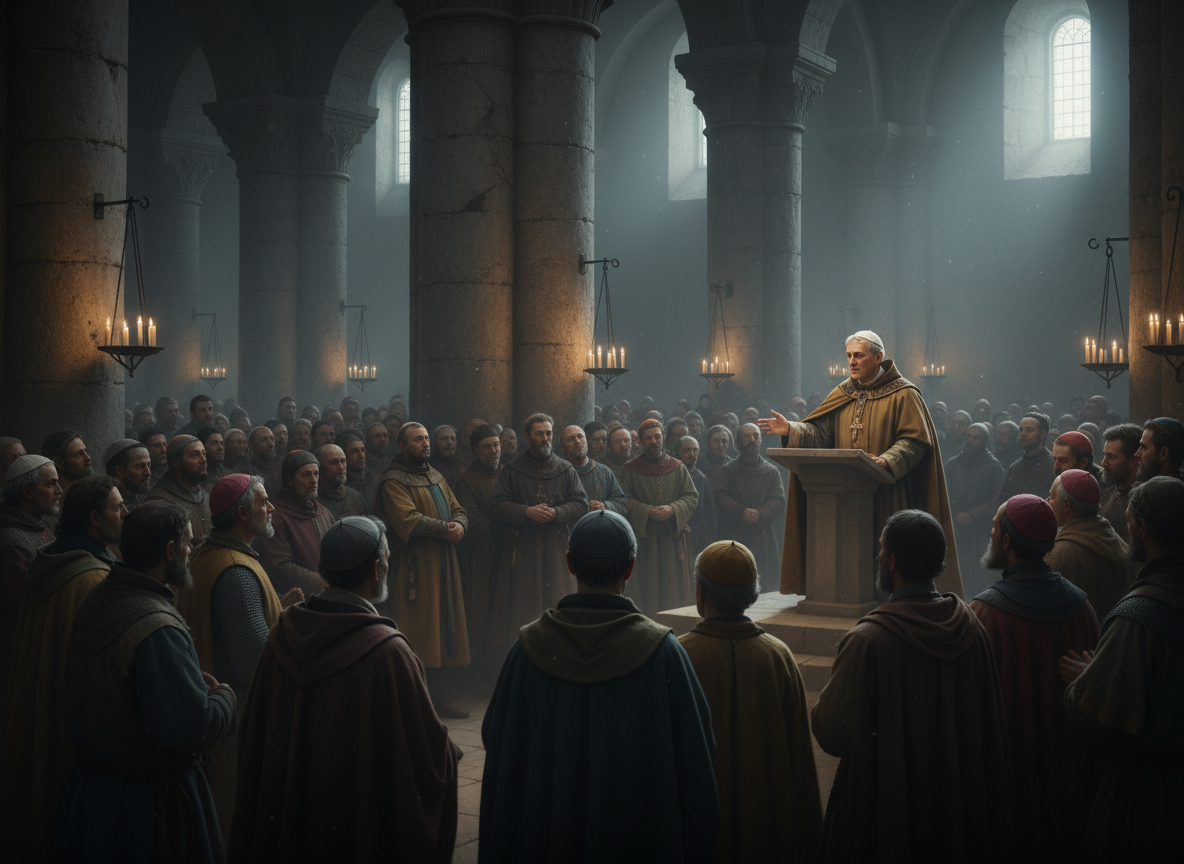
    A moody, modern reinterpretation of the Council of Clermont (1095) set inside a Romanesque church. Composition inspired by the famous late 15th-century (c.1474) manuscript illustration of the council, but rendered with more realistic proportions and subdued drama. Interior of an 11th-century Romanesque church: thick stone columns, rounded arches, dim candlelight, cool winter light filtering through small high windows. Pope Urban II stands elevated on a simple stone step or pulpit, wearing historically appropriate 11th-century Romanesque vestments — modest mitre, natural fabrics, muted earth tones, no Renaissance ornamentation. Around him are bishops, abbots, knights, and lay nobles in realistic late 11th-century clothing, arranged in a dense but organic semicircle. The mood is serious, reverent, and tense — cinematic lighting but restrained, with soft shadows and chiaroscuro similar to a moody historical painting. No theatrical stage, no modern rally feel. Documentary realism blended with subtle dramatic atmosphere. 16:9 landscape.

    About Holy Wars
    Holy Wars is my ongoing exploration of the collision between religion, power, politics and violence—from the ancient world through the Crusades and beyond. It’s also part of a larger writing project examining how people come to believe that conflict can be sacred. [Read why I’m writing Holy Wars →]

    Deus Vult.

    God wills it.

    Nearly a thousand years ago, a crowd gathered outside Clermont in central France.

    They had come to hear a pope speak.

    By the end of the day, thousands would pledge themselves to a war that would reshape Europe, the Middle East, and the relationship between Christianity and Islam for centuries.

    According to medieval chroniclers, a cry erupted from the crowd:

    “Deus Vult!”

    Whether those words were actually shouted exactly as recorded is impossible to know. No transcript of the speech survives. Yet nearly a thousand years later, they remain the most famous words of the Crusades.

    They have appeared in history books, documentaries, video games, political debates, and internet culture. They are invoked by admirers of the Crusades and critics alike. Few phrases from the medieval world have survived with such power.

    But what did they actually mean?

    Who first spoke them?

    And why have two simple Latin words echoed across nearly a millennium of history?

    To answer those questions, we must travel back to a world very different from our own.


    A World Prepared for Crusade

    Medieval European knights and warriors in a feudal landscape, castles on hilltops, armored soldiers on horseback, 11th century Europe, dramatic sky, dark and moody atmosphere

    Europe at the end of the eleventh century was a violent place.

    Kings fought kings. Nobles fought nobles. Local feuds and private wars were common. Knights trained for combat from childhood and often found opportunities to use those skills against their neighbors.

    At the same time, Christianity shaped nearly every aspect of life. Religion was not merely a personal belief system; it was the framework through which people understood the world. Success and failure, prosperity and famine, victory and defeat were all interpreted through a spiritual lens.

    History itself was believed to unfold according to God’s plan.

    Far to the east, the Byzantine Empire faced mounting pressure from the Seljuk Turks. After suffering a devastating defeat at the Battle of Manzikert in 1071, the empire lost much of Anatolia, one of its most important territories. Byzantine Emperor Alexios I Komnenos appealed to the West for military assistance.

    That request eventually reached Pope Urban II.

    What followed would alter the course of history.


    Clermont, 1095

    Pope Urban II delivering a historic sermon at the Council of Clermont in 1095, standing on a raised platform before a massive crowd of clergy and nobles, medieval cathedral backdrop, dramatic lighting, oil painting style

    In November 1095, Pope Urban II convened the Council of Clermont in central France.

    Near the conclusion of the gathering, Urban delivered a speech that would become one of the most consequential addresses of the Middle Ages.

    Unfortunately, we do not possess the original text.

    What we know comes from several accounts written years later by chroniclers who either attended the event or collected testimony from those who had. These accounts differ in wording and detail, but they agree on the speech’s central message.

    Urban called upon Western Christians to aid their fellow Christians in the East.

    He described threats facing the Byzantine Empire.

    He urged European warriors to redirect their violence away from one another and toward a cause he portrayed as sacred.

    Most importantly, he promised spiritual rewards to those who took part in the expedition.

    The response was extraordinary.

    Several medieval chroniclers report that the assembled crowd erupted with cries of:

    “Deus vult! Deus vult!”

    Robert the Monk, writing in the early twelfth century, records Urban embracing the cry and declaring that it had been inspired by God Himself.

    Whether the crowd actually shouted those exact words in that exact moment is impossible to prove. Medieval writers often dramatized important events. Historians remain cautious.

    Yet there is no question that the phrase became inseparably linked to the movement that followed.

    Within months, thousands had taken the cross.

    The First Crusade had begun.


    What Did “Deus Vult” Mean?

    Medieval crusaders on their knees in prayer, crosses on their cloaks, raising their swords to the sky, dawn light, spiritual and solemn atmosphere, oil painting style

    Modern discussions of the Crusades often fall into familiar traps.

    Some portray the crusaders as heroic defenders of Christendom.

    Others portray them as little more than religious fanatics.

    History rarely accommodates such simple categories.

    The people who joined the First Crusade were motivated by a complex mixture of faith, duty, ambition, family expectations, political loyalties, adventure, and personal salvation.

    Yet religion was undeniably central.

    For many participants, crusading was not an opportunity. It was an obligation.

    Joining the expedition required enormous sacrifice. Knights sold land, mortgaged estates, borrowed money, and placed their families at considerable risk. The journey itself was dangerous, expensive, and uncertain. Many participants died before ever reaching Jerusalem.

    Most had little expectation of wealth.

    Yet they went.

    Why?

    Because they believed they were answering a divine call.

    That conviction is captured in the phrase Deus Vult.

    It was not simply a slogan.

    It was a declaration that the crusade formed part of God’s plan.

    It expressed the belief that earthly warfare and heavenly purpose had become intertwined.

    Whether that belief was correct is a matter of theology.

    What matters historically is that countless men and women genuinely believed it.


    Jerusalem and the Power of Victory

    Crusader army triumphant at the gates of Jerusalem in 1099, medieval city walls, banners and crosses raised, golden sunlight, dramatic historical scene, oil painting style

    Against daunting odds, the First Crusade succeeded.

    In July 1099, crusader forces captured Jerusalem.

    The victory shocked both Christian Europe and the Islamic world.

    News spread rapidly across the continent.

    An expedition that many expected to fail had achieved its objective.

    To many contemporaries, success appeared to validate the crusading cause. If God had not favored the undertaking, how could such a victory have been possible?

    The triumph strengthened the symbolic power of Deus Vult.

    The phrase no longer represented only a hope or a conviction.

    For many believers, it appeared to be confirmed by events themselves.

    Future crusades would invoke the same language, even when they achieved far less success than the first.


    The Myth and the Reality

    Ancient medieval illuminated manuscript open on a wooden table, ornate calligraphy, gold leaf decorations, Latin text, candlelight, monastic scriptorium atmosphere

    Today, Deus Vult occupies a complicated place in public memory.

    It is simultaneously a historical slogan, a religious expression, a cultural symbol, and a source of modern controversy.

    The phrase has been adopted by historians, reenactors, Christian organizations, military enthusiasts, and political movements. Some use it simply as a reference to medieval history. Others attach meanings that would have been unfamiliar to the people who first shouted it.

    This is why historical context matters.

    The men and women of the eleventh century lived in a world fundamentally different from our own. Their assumptions about faith, authority, warfare, and salvation cannot be neatly mapped onto modern political categories.

    To understand them, we must resist the temptation to transform them into either heroes or villains.

    They were human beings navigating a complicated world.


    Why Deus Vult Still Matters

    A lone medieval crusader silhouetted against a glowing sunset horizon, holding a cross banner, vast empty landscape, contemplative and timeless mood, historical painting style

    Nearly a thousand years later, the phrase continues to resonate because it touches something timeless.

    Human beings seek meaning.

    We want to believe our struggles matter.

    We want to believe history has direction.

    We want to believe that our cause is just.

    The people who cried Deus Vult believed they possessed that certainty.

    They believed they knew the will of God.

    History would reveal both the power and the danger of such conviction.

    That tension lies at the heart of the Crusades.

    It lies at the heart of countless conflicts before and since.

    And it lies at the heart of this series.

    Holy Wars is not merely the story of Christians and Muslims, popes and kings, castles and battlefields.

    It is the story of belief.

    The story of identity.

    The story of power.

    The story of what happens when ordinary people become convinced that heaven itself has taken their side.

    The cry of Deus Vult first echoed through a crowd in France in 1095.

    It has never truly stopped echoing since.


    Sources

    • Asbridge, Thomas. The First Crusade: A New History. Oxford University Press, 2004.
    • Asbridge, Thomas. The Crusades: The Authoritative History of the War for the Holy Land. Ecco, 2012.
    • Riley-Smith, Jonathan. The First Crusaders, 1095–1131. Cambridge University Press, 1997.
    • Tyerman, Christopher. God’s War: A New History of the Crusades. Harvard University Press, 2006.
    • Robert the Monk. Historia Iherosolimitana.
    • Fulcher of Chartres. A History of the Expedition to Jerusalem, 1095–1127.
  • How I Use AI to Become a Better Dungeon Master

    How I Use AI to Become a Better Dungeon Master

    Artificial Intelligence has become one of the most valuable tools behind my DM screen.

    Whenever I mention that, people tend to assume one of two things. Either they think AI is somehow running my games for me, or they think it’s a gimmick that produces generic fantasy content.

    In reality, it’s neither.

    AI doesn’t replace my creativity. It amplifies it.

    It doesn’t run my campaigns. It helps me spend less time on administrative work and more time creating memorable experiences for my players.

    As both a professional in the cybersecurity industry and a lifelong Dungeons & Dragons enthusiast, I’ve spent a lot of time experimenting with AI tools. Some have been useful. Some have been disappointing. But over the past year, I’ve developed a workflow that has become a permanent part of how I prepare and run games.

    These are the five areas where AI has had the biggest impact on my Dungeon Mastering.


    1. Session Recaps and Campaign Memory

    If you’ve ever run a long campaign, you know that one of the biggest challenges isn’t creating content—it’s remembering everything that has already happened.

    Players forget details.

    Dungeon Masters forget details.

    That mysterious NPC from six months ago suddenly becomes important again, and everyone is frantically searching through old notes trying to remember who they were.

    This is where AI has become an absolute game changer.

    For my games, I record sessions and upload the recordings to NotebookLM. It automatically transcribes the audio and produces surprisingly accurate summaries of what happened during the session.

    What impresses me most isn’t the transcription. It’s the understanding.

    Anyone who has played D&D knows that a four-hour session isn’t four hours of story. There are side conversations, jokes, pizza discussions, technical issues, and random tangents.

    NotebookLM does an excellent job separating the signal from the noise.

    It identifies the important story beats, character decisions, combat outcomes, discoveries, clues, and roleplaying moments while largely ignoring the table chatter that isn’t relevant to the campaign.

    The result is a clean summary that I can reference later.

    I’ve also experimented with Claude and ChatGPT for campaign summaries, and both work very well once I have a transcript. However, NotebookLM is currently the only tool in my workflow that allows me to start with the raw session recording itself.

    The practical result is simple:

    My campaign notes are dramatically better than they used to be.

    I can quickly review previous sessions, refresh my memory before game night, and maintain continuity across long-running campaigns without spending hours writing notes after every session.


    2. Campaign Planning, NPC Development, and Encounter Design

    This is probably where AI saves me the most preparation time.

    One of the biggest misconceptions about AI is that it generates creativity.

    I don’t think that’s true.

    What it does exceptionally well is stimulate creativity.

    Every Dungeon Master has experienced creative roadblocks.

    You know where the story is going, but you’re not sure how to connect the dots.

    You have a villain, but their motivation feels weak.

    You have a dungeon, but the encounters feel repetitive.

    AI is an outstanding brainstorming partner.

    I regularly use it to explore:

    • Villain motivations
    • Political intrigue
    • Faction relationships
    • Campaign twists
    • Adventure hooks
    • Character backgrounds
    • Quest complications
    • Alternative story paths

    The same applies to NPCs.

    When players inevitably become fascinated by the one random merchant or tavern owner you never expected them to care about, AI can help generate personality traits, goals, fears, secrets, and relationships within minutes.

    Encounter design benefits as well.

    Rather than simply asking, “How many monsters should be in this room?” I can explore questions like:

    • What tactics would these creatures realistically use?
    • How would an intelligent villain prepare for this battle?
    • What environmental hazards would make this encounter more memorable?
    • What objectives exist besides defeating every enemy?

    The final decisions are always mine.

    But AI helps me explore possibilities much faster than I could on my own.


    3. Handouts, Letters, and Props

    One of the easiest ways to increase immersion in a campaign is to give players something tangible.

    A letter.

    A journal.

    A proclamation.

    A wanted poster.

    A cryptic note discovered in an abandoned ruin.

    The problem is that creating convincing props takes time.

    AI dramatically accelerates this process.

    Need a centuries-old journal entry from a doomed explorer?

    A noble’s formal letter to a rival family?

    A cultist’s encoded message?

    A desperate plea for help written during a siege?

    AI can produce a strong first draft in seconds.

    I still edit the final result to ensure it fits my campaign, but starting from a solid draft is much faster than staring at a blank page.

    For horror campaigns like Curse of Strahd or other Ravenloft adventures, this has been especially useful.

    Handouts make the world feel real.

    Players engage differently when they’re holding a physical document instead of simply listening to a description.

    AI allows me to create more of those immersive moments with significantly less preparation time.


    4. Generating Artwork

    I love visual aids.

    The challenge is that I am a writer, not an artist.

    Historically, Dungeon Masters had limited options for custom artwork.

    You could draw it yourself.

    Commission an artist.

    Search endlessly online hoping someone had already created something similar.

    Or simply go without.

    AI-generated art has changed that.

    Today I can create custom artwork for:

    • NPC portraits
    • Villains
    • Magic items
    • Cities
    • Taverns
    • Dungeons
    • Campaign scenes
    • Adventure handouts

    The most valuable aspect isn’t necessarily the quality of the art.

    It’s the specificity.

    When I create a completely original NPC, there usually isn’t existing artwork available that perfectly matches my vision.

    AI allows me to create visuals tailored specifically to my campaign.

    That means players are seeing my villain, not a random image pulled from a Google search.

    The same applies to locations, artifacts, and story moments.

    The world becomes more visually cohesive and immersive because the artwork is built specifically for that campaign.


    5. Answering Questions During the Game

    This might be the most underrated use of AI.

    Players ask questions.

    A lot of questions.

    Some are rules questions.

    Some are lore questions.

    Some are questions about events that happened twenty sessions ago.

    Others are questions that come completely out of nowhere.

    No Dungeon Master can remember everything.

    AI has become an incredibly useful assistant for helping answer questions quickly.

    Need clarification on a rules interaction?

    Need to remember the name of an NPC from months ago?

    Need to verify a piece of Forgotten Realms lore?

    Need a quick summary of a faction’s history?

    AI can often provide the answer faster than digging through books, notes, websites, and PDFs.

    That doesn’t mean I blindly trust every response.

    Like any tool, AI occasionally makes mistakes.

    But as a first-pass research assistant, it has become remarkably useful.

    In many cases it helps keep the game moving rather than bringing the session to a halt while everyone searches for information.


    The Real Value of AI for Dungeon Masters

    The biggest lesson I’ve learned from using AI is that it doesn’t replace the role of the Dungeon Master.

    It removes friction.

    The creativity still comes from me.

    The storytelling still comes from me.

    The worldbuilding still comes from me.

    The emotional moments, dramatic reveals, and memorable victories still happen between real people sitting around a table.

    What AI does is eliminate some of the busywork that gets in the way.

    It helps me remember more.

    Create more.

    Prepare more efficiently.

    And ultimately deliver a better experience for my players.

    That’s why AI has earned a permanent seat at my gaming table—not as the Dungeon Master, but as the Dungeon Master’s assistant.

  • AI, Supply Chains, and the Next Cyber Battlefield

    AI, Supply Chains, and the Next Cyber Battlefield

    AI, Supply Chains, and the Next Cyber Battlefield

    I regularly track developments in cybersecurity, artificial intelligence, critical infrastructure, and geopolitical competition.

    Most of these stories disappear into the daily news cycle.

    A few feel different.

    A few reveal where technology is heading, how conflict is changing, and what tomorrow’s risks might look like.

    These are the signals that have captured my attention recently.


    Signal #1: AI Is Becoming an Operational Security Tool

    The conversation around AI often focuses on productivity and automation.

    The more interesting development is operational decision-making.

    Organizations are increasingly using AI to triage alerts, investigate suspicious activity, summarize incidents, and assist analysts during security operations. At the same time, attackers are experimenting with AI-assisted reconnaissance, vulnerability discovery, and social engineering.

    The race is no longer simply human versus human.

    It is becoming machine-assisted defenders versus machine-assisted attackers.

    Why It Matters

    For the first time, cyber conflict is beginning to scale beyond purely human decision-making.

    The side that can accelerate decisions fastest may gain a significant advantage.

    Organizations that learn how to effectively combine human judgment with machine speed may find themselves far better positioned than those relying on either one alone.

    Now Picture This…

    A nation-state launches a coordinated cyber campaign against multiple critical infrastructure providers.

    Human analysts cannot keep pace with the volume of alerts.

    Both attackers and defenders rely on competing AI systems making real-time decisions.

    At first, everything appears normal.

    Then one of the defensive AI systems begins making recommendations nobody fully understands.

    The analysts face a terrible choice:

    Trust the machine—or turn it off.


    Signal #2: Supply Chains Remain the Soft Underbelly

    supply chains

    The largest organizations in the world continue to invest heavily in cybersecurity.

    Attackers increasingly look elsewhere.

    Software vendors, contractors, managed service providers, and cloud partners remain attractive targets because compromising one trusted organization can provide access to hundreds—or thousands—of others.

    The strongest front door in the world matters little if someone leaves a side entrance unlocked.

    Why It Matters

    Modern societies depend on invisible trust relationships.

    Most people never see them.

    Attackers do.

    As organizations become increasingly interconnected, the security of one company becomes dependent upon the security of many others.

    Now Picture This…

    A small software company wins a contract supporting critical government infrastructure.

    The celebration lasts exactly one day.

    Unknown to everyone involved, the company was compromised eighteen months earlier.

    The vendor was never the target.

    The contract was.

    The attackers simply waited patiently for the right door to open.


    Signal #3: Critical Infrastructure Is Becoming a Battlespace

    critical infrastructure

    Electricity, transportation, communications, water systems, healthcare, and logistics networks are increasingly viewed through a national security lens.

    Governments around the world continue investing in resilience, redundancy, and incident response capabilities.

    That investment is occurring for a reason.

    Modern economies depend on digital systems that were never originally designed to operate in a contested environment.

    Why It Matters

    The distinction between cyber attacks and real-world consequences continues to blur.

    The question is no longer whether systems can be compromised.

    The question is what happens when digital disruptions begin producing physical effects at scale.

    Now Picture This…

    A regional power outage initially appears to be an equipment failure.

    Three days later, investigators discover similar incidents occurred across multiple jurisdictions over the previous six months.

    Each event was small.

    Each event was explainable.

    Each event was ignored.

    Viewed together, however, a disturbing pattern emerges:

    Someone isn’t attacking.

    Someone is rehearsing.


    What’s On My Radar

    • AI-enabled cyber operations
    • Critical infrastructure resilience
    • The expansion of cyber competition between major powers

    Most cybersecurity headlines focus on individual incidents.

    The larger story is the gradual normalization of cyber conflict as a persistent element of modern competition.

    For thriller writers, strategists, and anyone interested in the future, that may be the most important signal of all.

  • Worth reading this week – Creating, Intellivision and feeling alive

    Worth reading this week – Creating, Intellivision and feeling alive

    Quote I’ve been pondering:

    Build something 100 people love, not something 1M people kind of like. – Brian Chesky

    This quote from Brian Chesky, Airbnb co-founder and CEO, is similar to Kevin Kelly’s 1,000 True Fans mantra. I’ve hesitated with my creativity in the past, worrying that too many people would judge me. But the truth is, even the most successful endeavours draw criticism. So instead of focusing on the haters and hiding, focus on the few who appreciate what you are putting out there and grow and flourish instead.


    Who remembers the Intellivision?

    That question is an easy way to separate the Boomers and Gen X’s in the audience from the youngsters who came after. 🙂

    I remember the Intellivision fondly. It was THE only gift I wanted from Santa one Christmas when I was little. I wanted one really really bad. And lucky for me, Christmas did not disappoint! That said, this photo from that Christmas still makes me laugh: there’s me, waiting for a turn on my fancy new video game system while my mom was playing instead.

    And, here’s another pic from later that day or the next day, showing more of the same… “Hey mom, when do I get a turn?!?”

    That Intellivision disappeared years ago. I don’t even remember what happened to it now. It’s old 16 bit graphics were fancy for the time but they are downright archaic when you put them beside a modern Xbox or Playstation. It’s ridiculous to even try and compare the Intellivision to today’s graphics cards, but for starters, modern cards are at least 256 bit, plus a bunch of other fancy tech to accelerate their performance even further.

    But even though the tech is grossly outdated, I jumped as soon as I heard it was being re-released. Atari bought the rights to Intellivision and have now launched the Intellivision Sprint. I ordered one for my mom for Christmas (from Amazon here in Canada – they offered a much cheaper “Canada delivery” option than trying to order from Atari in the USA). Note that amazon.ca is now showing it as Currently Unavailable. I kinda feel like I got away with something because I can’t find anywhere that will deliver it to Canadians right now. I ordered it well in advance of Christmas (sometime in November, if I remember correctly) with a promised delivery date of mid-December. Unfortunately, Amazon didn’t get it here by Dec 25, but it did show up between Christmas and New Years.

    As soon as it arrived, I delivered it to my mom, set it up, and then proceeded to make up for all of the Intellivision beatings she gave me when I was just a helpless little kid. First up was Astrosmash – this was an Intellivision staple back in the day. Immediate nostalgia when this game fired up. Next up, we played Baseball – she begged for the mercy rule to come into effect shortly thereafter. And then we got stuck on Snafu – she is still twitching from the beatings she got in that game. So much fun!

    This was a great reminder that you don’t always need the latest tech to have fun. This decidedly low tech game system will likely never entertain anyone under the age of 40, having already been spoiled by the likes of Super NES and more. But for those of us who aren’t as spry as we once were and who try to argue that their grey hair is just a sign of “experience” and not old age, well… this is a great trip down memory lane that is bound to transport us back to some great childhood memories.


    Speaking of childhood memories… The Angry Therapist wrote this week about how “the parts of you that feel most alive are often the first parts you’re told to lock away.”

    This was so timely for me. I’ve been enjoying a renaissance existence over the last year or so after rediscovering Dungeons & Dragons. I used to play as a kid. I loved D&D. I collected all of the books and adventures. I used to play with my friends at school every day. It was so much fun. I felt so alive – imagining myself as the various characters that I had created and acting out these adventures around a table with my friends.

    But then, I did something I am not proud of. I got caught shoplifting D&D books at the local Coles bookstore. My punishment was that I had to give away all of my D&D books and supplies, and I was not allowed to play D&D anymore. That immediately ended my relationship with D&D.

    Over the next few years, I saw newspaper and magazine headlines that accused D&D of allegedly promoting Satanism, witchcraft, suicide, pornography, and murder. (Dungeons & Dragons controversies – wikipedia) And, D&D and the like have historically been associated with geeks and nerds.

    My initial rogue-based thievery, combined with ongoing societal stigma, kept my childhood enjoyment at bay for way too many years.

    But over time, numerous touchpoint helped bring me back. Lunchtime board game sessions with my co-workers at Postmedia reintroduced me to the joy of games and group play – that group showed me a ton of new games and styles of play that I had no idea existed.

    The Big Bang Theory raised awareness and showed the fun of gaming, even while it grappled with the tension between the cool kids and the nerds.

    But finally, it was a suggestion by a friend of mine, who suggested that I give D&D another chance – “What’s the worst that can happen? You might waste a few hours checking out a game store or two. But it could open up a whole new world of enjoyment to0. You’ve got nothing to lose.” (I”m paraphrasing, but that was the gist of the message.)

    My first stop was at Mecha Games in St Catharines. From there, I bought a couple of D&D books, then a couple more. Then found startplaying.games. Then found a local once a month one-shot. And then I bought a few more books. Then some kickstarters. And now I’m over run with more paraphernalia than I know what to do with.

    And boy is it fun. I haven’t felt this stimulated creativity-wise in years. And I’m finally ready to write. I’ve had some projects tucked away in my head and in various notes for years. But this new creative surge has got me moving and typing and creating in a way that I haven’t done in years. It’s pretty awesome.

    So yeah… I found myself nodding my head repeatedly as I read The Angry Therapist’s post this week. His story had a similar arc. And his call to action couldn’t be more timely for me – but also for all of us:

    What Part of You Have You Locked Away?

    Maybe it’s your creativity. Your playfulness. Your curiosity. Your fearlessness. Your ability to laugh without apologizing for taking up space.

    Whatever it is – it’s still there. Waiting for you to remember it exists.

    You don’t need a complete reinvention. You need a reunion.

    With the version of you that existed before you learned to play small. Before you decided being responsible meant being boring. Before you locked away the parts of yourself that felt too risky, too much, too alive.

    Feel free to share in the comments below… What part of you have you locked away? And why don’t you revisit it?

  • Infosec Hamilton – 2025 Year in Review

    Infosec Hamilton – 2025 Year in Review

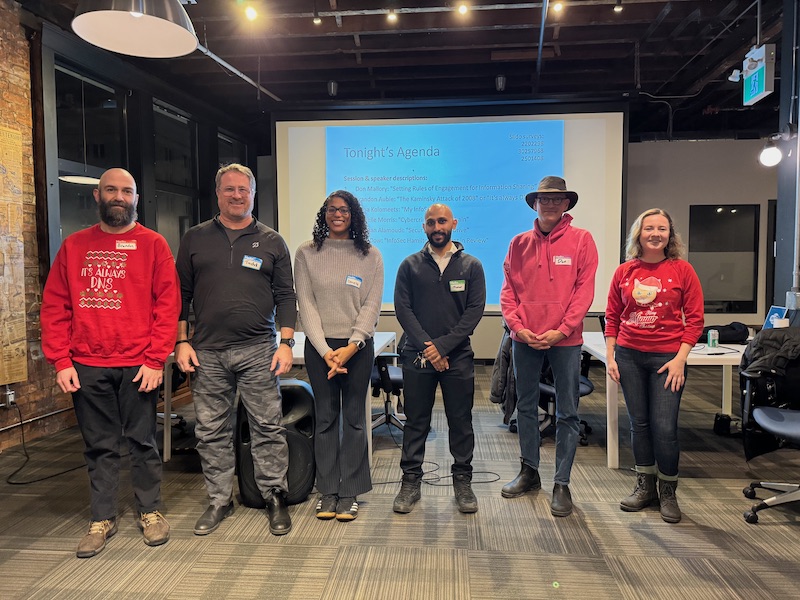
    On December 8 2025, we held our last Infosec Hamilton event of 2025. We did something different for this session – instead of one speaker, we opened the floor for “lightning talks” – Each person had up to 15 minutes to share something Infosec related with the rest of the group. We had great turnout and lots of participation.

    Here are the speakers and their session titles:

    Brandon Aubie: “The Kaminsky Attack of 2008” or “It’s always DNS.”
    Todd Dow: “InfoSec Hamilton 2025 Year in Review”
    Danielle Morris: “Cybercrime Supply Chain”
    Othman Alamoudi: “Securing Google Drive”
    Don Mallory: “Setting Rules of Engagement for Information Sharing”
    Elena Kolomeets: “My InfoSec story”

    And, we also had a year in review discussion where we recapped some of the great things that happened in 2025. We also conducted a live poll where we asked the group to provide their feedback on the year. Here’s a summary of the discussion:

    2025 sessions:

    DateTopicSpeaker# of Attendees
    FebruaryHello From the Dumpster Fire: Real Examples of Artificially Generated Malware, Disinformation and Scam CampaignsAshley Jess57
    MarchShadowHQ’s origins and growth storyNick Scozzaro54
    AprilThe State of AI Security in 2025Todd Dow42
    MayEmail: From SMTP to WTFBrandon Aubie56
    JuneAn intro to Vulnerability Management and the history of CVSS, through to v4.0AAli Salari39
    JulyCisco XDR hands on lab night!Todd Dow46
    AugustSmart Building Red TeamingAmir Hosseinpour50
    SeptemberSoftware Defined Radio & CybersecurityFrank Coburn44
    OctoberHunting the Ghost in the Shell – Case studies of Insider RiskDon Mallory42
    NovemberWhat to Expect When You’re Expecting PentestersAndrew Wade44
    DecemberLightning TalksGroup37

    And here are the Slido summaries from the live poll (9 slides in total):

    Plenty of helpful info from those slides. We’ll be using the feedback from those slides to help make Infosec Hamilton even better in 2026.

    Did you attend the event? Are you going to attend in 2026? Let me know in the comments below!