Author: Todd Dow

  • Building a Creative Ecosystem

    Building a Creative Ecosystem

    How I’m building a sustainable creative system for writing books, blogging, and sharing ideas through ToddHDow Studios.

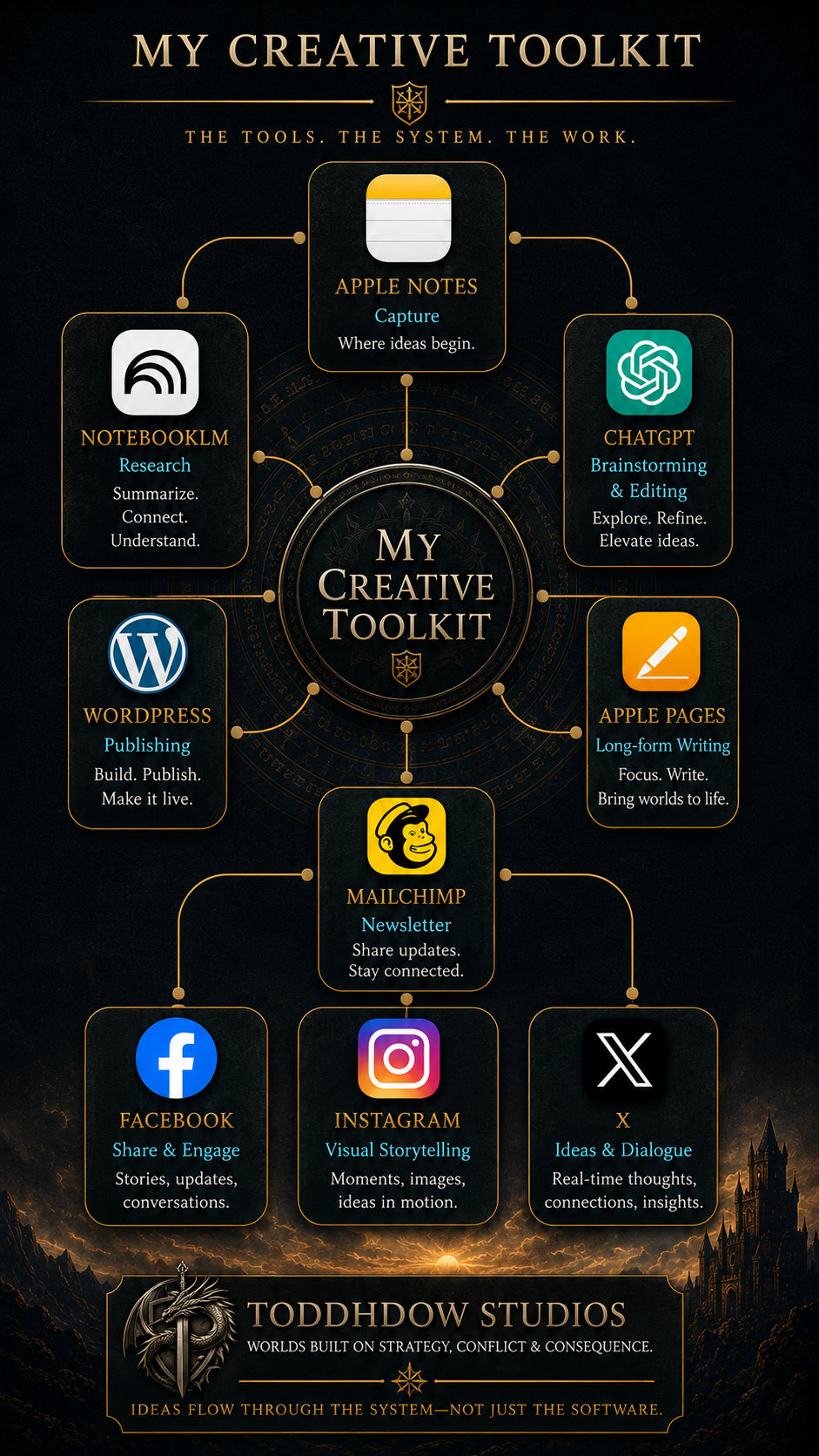
    The ToddHDow Studios Creative Toolkit.
    The ToddHDow Studios Creative Toolkit.

    People often imagine writing as the moment someone sits down in front of a blank page.

    The truth is, that’s only the visible part of the process.

    Writing begins long before the first sentence is typed.

    It begins with a conversation. A book. A question. A walk. A podcast. A news article. A half-formed idea scribbled into a notes app while standing in line for coffee.

    I’ve spent a surprising amount of time over the past year thinking not just about what I want to write, but how I want to write. As ToddHDow Studios has grown, I’ve realized that building a sustainable creative life has much less to do with finding the perfect software and much more to do with building a system that keeps ideas moving.

    I’m still refining that system, but I thought it might be interesting to pull back the curtain and share how it works today.

    Building Worlds

    A wide cinematic collage blending Cryptogeddon, Holy Wars, Book of Dow, TTRPGs and my writing.

    ToddHDow Studios is home to everything I create.

    Some of those ideas become weekly blog posts. Others are slowly evolving into books. Some may never become either, and that’s okay too. Not every idea needs to become a finished project.

    The four worlds I’ve chosen to focus on – CryptogeddonHoly WarsThe Book of Dow, and TTRPGs – give my curiosity somewhere to live. The Writer’s Notebook is where I step back from those worlds and talk about the creative process itself.

    At first glance, cybersecurity, medieval and colonial history, writing, and tabletop gaming don’t seem to have much in common.

    To me, they’re connected by the same thread.

    They’re all worlds built on strategy, conflict & consequence.

    Some ideas are ready to share almost immediately. Others need years to mature before they’re ready to become books. The destination changes, but the creative process is surprisingly similar.

    Removing the Daily Decision

    One lesson I’ve learned is that creative energy is limited.

    If every Saturday morning begins with the question, “What should I write today?”, I’ve already wasted energy making a decision that didn’t need to exist.

    Instead, I created a simple publishing rhythm.

    • Week One: The Cryptogeddon Briefing
    • Week Two: Holy Wars Journal
    • Week Three: Book of Dow: The Archive
    • Week Four: Campaign Chronicles
    • Week Five: The Writer’s Notebook

    Every week, I also publish The ToddHDow Dispatch, my newsletter that ties everything together.

    Over time, I’ve settled into a publishing rhythm that works well for both me and my readers. New blog posts are published on Saturdays. The following Monday, I send The ToddHDow Dispatch, introducing that week’s post, sharing what I’m reading, highlighting anything new across ToddHDow Studios, and offering a preview of what’s coming next.

    But that’s not where the process ends. Throughout the week, I continue the conversation on FacebookInstagramX and LinkedIn, sharing quotes, images, behind-the-scenes thoughts, and stories inspired by the article. Rather than treating social media as advertising, I see it as another way to explore ideas, connect with readers, and invite people into the worlds I’m building.

    Every idea follows a similar lifecycle: capture, research, write, publish, share, then move on to the next one. Having that predictable rhythm means I spend less time wondering what to do next and more time actually creating.

    Like everything else in my workflow, the schedule isn’t about rigid rules. It’s about creating a sustainable rhythm that lets me keep showing up, week after week.

    That schedule keeps my blog moving forward while giving my longer writing projects room to develop in the background. Blog posts may be measured in days, while books are measured in months—or more likely, years—but both benefit from showing up consistently.

    Sometimes the best creative decision is removing decisions altogether.

    Following an Idea

    The ToddHDow Studios Creative Ecosystem.
    The ToddHDow Studios Creative Ecosystem.

    People sometimes ask how I go from an idea to something I publish.

    The answer is… slowly.

    Almost everything begins in Apple Notes.

    Ideas arrive at strange times, and I’ve learned not to trust my memory. Whether it’s a thought for a Holy Wars article, a scene for a future novel, or a question I want to explore, it gets captured before it disappears.

    From there, I research.

    I read.

    I ask questions.

    I sketch outlines.

    Sometimes I brainstorm with ChatGPT – not because I want it to write for me, but because it’s an excellent thinking partner. I’ll ask it to challenge an argument, suggest different ways to organize an article, or point out places where my reasoning isn’t as clear as I thought it was.

    Eventually, the path splits.

    If the idea is timely, it usually becomes a blog post. I’ll draft it, revise it, prepare images, format everything in WordPress, build the newsletter in Mailchimp, and publish it.

    If the idea has deeper roots, it usually moves into Apple Pages, where it becomes part of a much longer project. Books don’t care about weekly publishing schedules. They ask for patience instead.

    Different destinations.

    The same creative engine.

    Sharing the Conversation

    Publishing a post isn’t actually the end of the process.

    It’s the beginning of another one.

    Every article gets its own newsletter, but it also becomes the foundation for posts and stories across Facebook, Instagram, X and LinkedIn over the following days. Sometimes that’s a quote that stands on its own. Sometimes it’s a single image. Sometimes it’s a behind-the-scenes thought that didn’t make the final article.

    I don’t think of social media as marketing.

    I think of it as continuing the conversation with readers who may never visit my website otherwise.

    In many ways, a finished blog post isn’t the final product.

    It’s the source material for everything that follows.

    Chasing the Perfect Tool

    The ToddHDow Studios Creative Toolkit.
    The ToddHDow Studios Creative Toolkit.

    If there’s one rabbit hole I’ve fallen into more times than I’d like to admit, it’s searching for the perfect writing software.

    Should I use Word?

    Pages?

    Scrivener?

    Ulysses?

    Obsidian?

    Google Docs?

    Something else entirely?

    The answer, I’ve discovered, is that none of them actually solve the problem.

    Software doesn’t create discipline.

    It simply supports it.

    Today my workflow uses a collection of tools because each one does something well.

    Apple Notes captures ideas before they’re forgotten.

    Pages is where my longer writing currently lives.

    Gemini Notebook (formerly NotebookLM) helps me organize and understand research.

    ChatGPT helps me brainstorm, edit, and think through problems.

    WordPress and Mailchimp help me share finished work with readers.

    Together, these tools form a pipeline rather than a collection of disconnected apps. Ideas flow naturally from one stage of the creative process to the next.

    One thing that surprised me while writing this article was realizing just how long some of these tools have been part of my life.

    ToddHDow.com has been running on WordPress for more than twenty years. If you browse my archive, you’ll find posts dating all the way back to December 2005. Mailchimp has been part of my workflow for well over a decade too. My very first subscriber – appropriately enough – was me, back on October 15, 2012.

    Looking back, I’m grateful that “past Todd” chose tools that proved reliable enough to grow alongside me.

    Those tools may or may not change someday.

    The habit of creating is the part I hope never does.

    Reading Is Part of Writing

    My bookshelf
    My bookshelf

    People often ask about my writing habits.

    Far fewer ask about my reading habits.

    The truth is they’re impossible to separate.

    Every book I read becomes part of my creative toolbox.

    History feeds Holy Wars.

    Cybersecurity and emerging technology shape Cryptogeddon.

    Stephen King constantly reminds me how powerful voice can be.

    Brandon Sanderson demonstrates the importance of structure, planning, and worldbuilding.

    Neal Stephenson encourages me to think bigger, research deeper, and ask more ambitious questions.

    Even books that seem completely unrelated to whatever I’m working on have a way of influencing what comes next.

    I’ve stopped thinking of reading as something that competes with writing.

    Reading is writing preparation.

    Still Learning

    One thing I’ve become comfortable admitting is that I don’t have this all figured out.

    My workflow changes.

    My software changes.

    My routines evolve.

    Every project teaches me something new.

    That’s part of the reason I wanted to create The Writer’s Notebook in the first place.

    Not because I have all the answers.

    Because I enjoy exploring the questions.

    Final Thoughts

    When I first imagined becoming a writer, I thought success depended on inspiration.

    Today, I think it depends on something much quieter: building an environment where inspiration has somewhere to go.

    For me, that environment is made up of habits as much as technology. Reading sparks new ideas. Apple Notes captures them before they’re forgotten. ChatGPT and NotebookLM help me explore and challenge them. Pages gives my books room to grow. WordPress, Mailchimp and my socials help me share finished work with readers. My publishing cadence keeps everything moving forward, one project at a time.

    None of those tools writes for me.

    None of them can replace curiosity, discipline, or creativity.

    But together they remove friction, helping me spend less time wondering how to create and more time actually creating.

    Perhaps that’s the systems engineer in me. After decades working in technology and cybersecurity, I’ve developed an instinct for choosing tools that are stablereliablesecurescalable, and well-supported – tools I can trust to grow with me instead of forcing me to start over every few years. The best technology quietly fades into the background, allowing the work itself to take centre stage.

    Looking back, I’m grateful that “past Todd” made some good decisions. WordPress has been home to ToddHDow.com for more than twenty years. Mailchimp has been part of my workflow for well over a decade. Those choices gave me continuity, allowing me to focus on creating instead of constantly rebuilding.

    That’s ultimately what this ecosystem is designed to do. Every tool, every habit, every book I read, every note I capture, every conversation I have with ChatGPT, every newsletter I send, and every social post I publish serves the same purpose: reducing friction so I can spend more time thinking, writing, and building worlds.

    Because in the end, writing isn’t about finding the perfect tool.

    It’s about building a life that keeps you curious enough to have something worth writing about.
  • Preparing for Game Night: Inside My DM Prep Process

    Preparing for Game Night: Inside My DM Prep Process

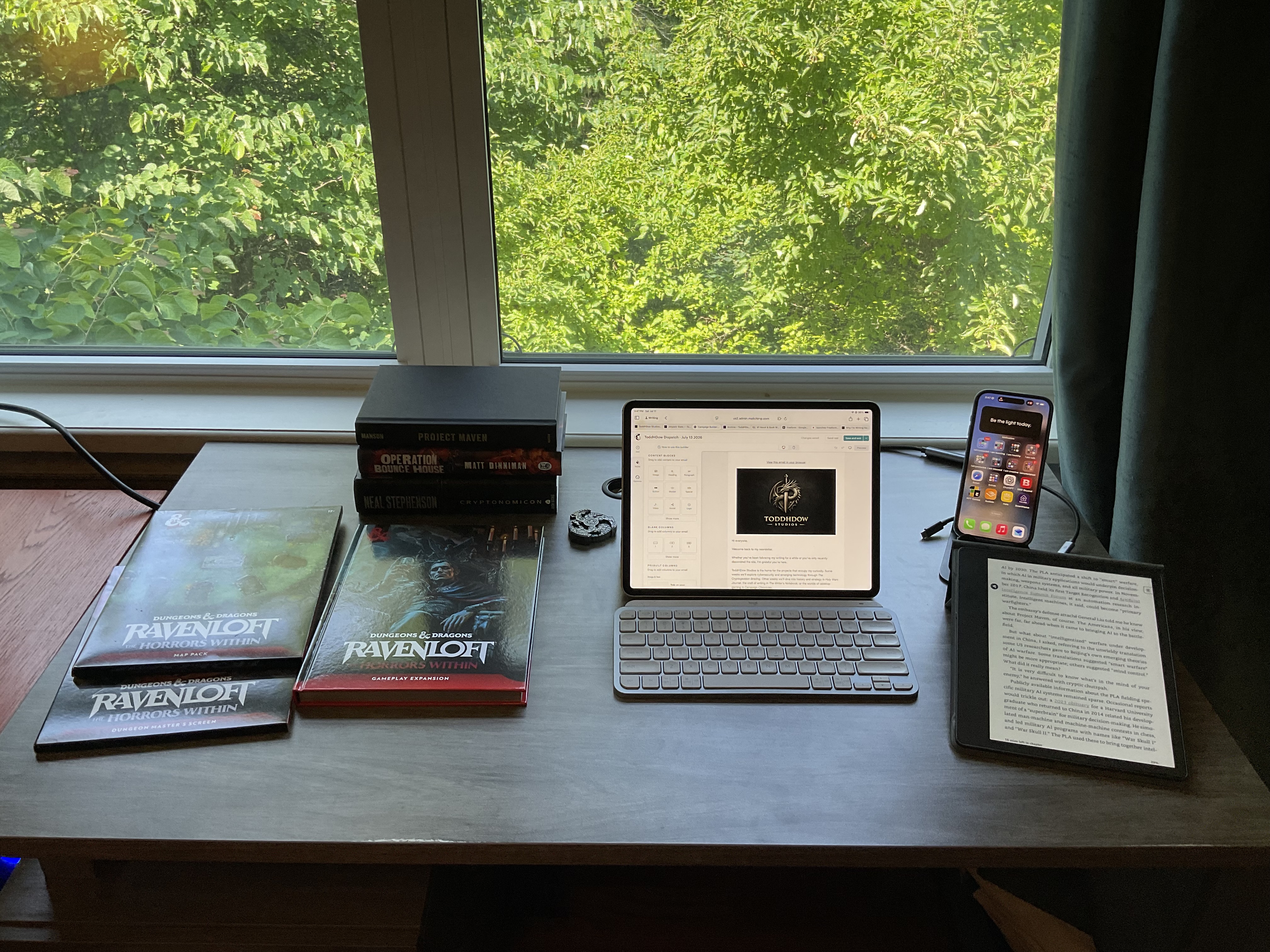
    My writing setup. This is where I do the bulk of my writing. My desk overlooks our beautiful backyard. In the summer, it is a forest of trees and greenery. In the winter, the leaves all disappear and I get a great view of our large backyard. I like the winter view better because without the tree cover, I am often able to catch glimpses of rabbits and deer wandering through our backyard.
    My writing setup. This is where I do the bulk of my writing. My desk overlooks our beautiful backyard. In the summer, it is a forest of trees and greenery. In the winter, the leaves all disappear and I get a great view of our large backyard. I like the winter view better because without the tree cover, I am often able to catch glimpses of rabbits and deer wandering through our backyard.

    One of the questions I get asked most often is surprisingly simple:

    “How much prep do you actually do before a session?”

    The honest answer?

    Less than I used to.

    That probably sounds strange coming from someone who loves worldbuilding, campaign design, and collecting maps, books, miniatures, and terrain. But over the last year or so I’ve realized that good prep isn’t about creating more material – it’s about creating the right material.

    The players are going to surprise me anyway.

    My job isn’t to predict everything they’ll do. My job is to know the world well enough that I can respond naturally when they inevitably wander off the path I expected.

    Here’s what my preparation process looks like before most game nights.

    NotebookLM summary of a recent D&D adventure session
    NotebookLM summary of a recent D&D adventure session.

    Step 1: Review the Last Session (if there was one)

    I never begin by opening my adventure book.

    Instead, I revisit what happened last session.

    One of the biggest improvements to my workflow has been recording my games and uploading them into NotebookLM. It transcribes the session, removes most of the table chatter, and gives me a surprisingly accurate summary of everything that happened. (I will definitely write more about this whole process in a future blog post!)

    Sometimes I’ll ask questions like:

    • What NPC promises are still unresolved?
    • Which plot hooks did the players ignore?
    • What clues did they discover?
    • Which character moments seemed important?

    It’s remarkable how often players accidentally create future story threads that I hadn’t planned.

    Those become some of the best parts of the campaign.

    Shadows of Sithicus D&D Encounter
    Shadows of Sithicus D&D Encounter

    Step 2: Decide What Matters

    I don’t prepare five different adventures.

    I prepare the one that’s most likely.

    If the party is halfway through Death House, that’s where my attention goes.

    If they’re travelling toward the Misty Forest, I prepare the Misty Forest.

    If there’s a reasonable chance they’ll completely derail the session…

    … I spend a little time preparing that possibility too.

    Experience has taught me that trying to prepare every possible outcome is impossible.

    Preparing the most probable outcome – and understanding the world around it – is far more effective.

    Step 3: Brainstorm with AI

    This is probably where my process has changed the most of the last year.

    I use AI extensively—not to replace my creativity, but to challenge it.

    I’ll ask questions like:

    • What motivations would this NPC realistically have?
    • Give me five encounter ideas that fit this location.
    • What clues would make this mystery more satisfying?

    Most of the suggestions never make it into the game.

    But one good idea out of twenty is worth the conversation.

    It’s like having another experienced Dungeon Master sitting beside me while I prep.

    Canvas maps and a Devil's playground.
    Canvas maps and a Devil’s playground.

    Step 4: Build the Table Experience

    This is the fun part.

    I’ll gather whatever I need for the session:

    • Maps
    • Miniatures
    • Terrain
    • Handouts
    • Letters
    • Props
    • Music
    • Ambient sound

    I’m a big believer that immersion comes from lots of small details rather than one expensive centerpiece.

    A weathered letter with a wax seal.

    A faded map.

    The right soundtrack.

    A miniature that perfectly represents the villain.

    None of these things are essential.

    Together, they make the world feel real.

    Step 5: Review the Rules

    Every session has one or two mechanics that deserve a refresher.

    Maybe a monster with unusual legendary actions.

    Maybe a spell interaction I haven’t seen in months.

    Maybe grappling.

    I don’t try to memorize every rule in D&D.

    Instead, I identify the handful of rules that are likely to matter in my next game.

    That dramatically reduces the number of pauses during play.

    The prep ends here. From this moment on, the players decide where the story goes, and I simply follow their lead—one decision, one surprise, and one dice roll at a time.
    The prep ends here. From this moment on, the players decide where the story goes, and I simply follow their lead—one decision, one surprise, and one dice roll at a time.

    Step 6: Prepare to Improvise

    This might sound contradictory after everything I’ve just described.

    But the goal of preparation isn’t to avoid improvisation.

    It’s to improvise with confidence.

    Once I know:

    • the NPCs,
    • the locations,
    • the motivations,
    • the likely encounters,
    • and the important rules,

    I’m comfortable throwing my notes aside if the players decide to do something unexpected.

    And they always do.

    Some of our most memorable sessions have come from moments I never could have prepared for.

    My Actual Prep Time

    People often imagine Dungeon Masters spending twenty hours every week preparing.

    Sometimes that’s true.

    Usually it isn’t.

    A typical weekly prep session for me looks something like this:

    • 20 minutes reviewing last session
    • 30 minutes brainstorming ideas
    • 30 minutes preparing encounters
    • 20 minutes gathering maps and assets
    • 20 minutes reviewing rules

    Roughly two hours.

    Some weeks it’s less.

    Some weeks—especially before major story arcs—it can be considerably more.

    But consistency beats marathon prep sessions every time.

    Dice. Maps. Miniatures. Character sheets. A laptop full of plans. Every session starts with the same tools - but no two adventures ever unfold the same way.
    Dice. Maps. Miniatures. Character sheets. A laptop full of plans. Every session starts with the same tools – but no two adventures ever unfold the same way.

    The Real Secret

    The biggest lesson I’ve learned isn’t about AI.

    It isn’t about terrain.

    It isn’t about miniatures.

    It isn’t even about preparation.

    It’s about trusting your players.

    Players don’t remember perfectly balanced encounters.

    They don’t remember every stat block.

    They remember impossible choices.

    Unexpected victories.

    Hilarious failures.

    The NPC who somehow became their favourite character despite only appearing for five minutes.

    That’s the magic we’re trying to create.

    Everything else is just preparation for those moments.

    What’s Next?

    Over the next few months I’ll be sharing more behind-the-scenes looks at how I run games, the tools I’m experimenting with, AI workflows that have genuinely improved my prep, and lessons I’ve learned from both successful sessions and spectacular failures.

    If you’re a Dungeon Master – or you’re thinking about becoming one – I hope some of these ideas help make your own game nights just a little easier to run.

    And if your players completely derail your carefully prepared session next week…

    Welcome to the club.

    And lastly, what did I miss? If I’ve overlooked anything, please do share in the comments below!

  • Why I’m Writing Holy Wars

    Why I’m Writing Holy Wars

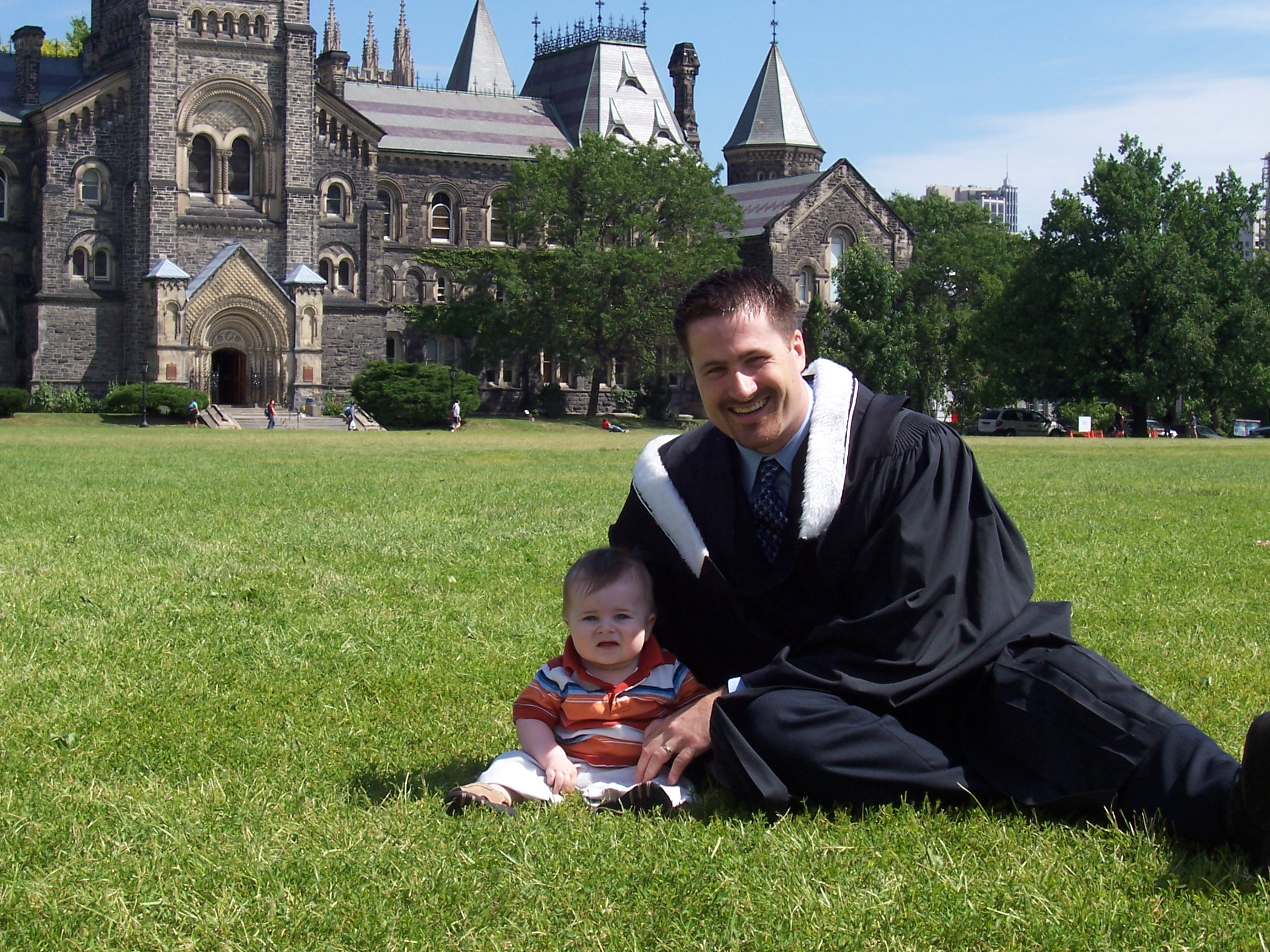
    Graduation Day, June 21 2006 at the University of Toronto. Noah and I sitting outside Convocation Hall with University College in the background.
    Graduation Day, June 21 2006 at the University of Toronto. Noah and I sitting outside Convocation Hall with University College in the background. At the time, I thought I was finishing a chapter of my life. Looking back now, I realize I was only writing the first page.

    Every writer eventually gets asked the same question:

    “Why are you writing this?”

    Over the last few weeks, a few people have asked me why I’m so interested in the Crusades, religious conflict, and Christian history. On the surface, it probably seems like an odd direction for someone who spends his days working in cybersecurity and his evenings writing about technology, AI, Dungeons & Dragons, and speculative fiction.

    It’s a fair question.

    The short answer is that Holy Wars has been quietly taking shape in my mind for more than twenty years.

    The longer answer is much more interesting.

    This isn’t simply a story about medieval Europe, knights, or the Crusades. It isn’t an attempt to defend Christianity, nor is it an attempt to attack it. It’s the culmination of a lifelong fascination with one question:

    Why do people believe what they believe?

    That question has shaped nearly every major decision in my adult life. It led me back to university. It influenced my career, my reading, and my writing. It challenged assumptions I had held since childhood. And ultimately, it became the foundation for Holy Wars.

    “Holy Wars isn’t the story of what I believe. It’s the story of why I’ve spent more than twenty years asking why people believe what they do.”

    It Started With Questions

    I grew up attending an Alliance church.

    Like many kids, Sunday mornings meant church services, Sunday school, and Bible stories. Faith was simply part of life.

    Then I became a teenager.

    Sports, friends, work, and life gradually replaced church attendance. I didn’t reject Christianity; I simply drifted away from it. By the time I entered my twenties, I wasn’t spending much time thinking about religion at all.

    That changed when I became engaged.

    I was marrying into a deeply Christian family, and for the first time I realized that inherited beliefs weren’t enough anymore. If I was going to build a life with someone whose faith was central to who they were, I owed it to myself—and to her—to understand what I actually believed.

    Not what my parents believed.

    Not what my church believed.

    Not what my friends believed.

    What I believed.

    And perhaps more importantly…

    Why?

    Choosing Questions Over Certainty

    Around that same time, I decided to return to school.

    I already had a college diploma and had spent several years working full-time in information technology, but I wanted to earn a university degree. After looking through the programs offered by the University of Toronto, one combination immediately captured my attention: Philosophy and Religious Studies.

    When I mentioned the idea to my pastor, he offered some well-intentioned advice.

    He told me not to do it.

    His concern was that studying philosophy and religion academically would destroy my faith.

    I understood where he was coming from. Universities have a reputation—fairly or unfairly—for encouraging students to question everything. From his perspective, that represented a spiritual risk.

    I appreciated his concern.

    Then I enrolled anyway.

    Looking back, I’m glad I did.

    Did university ruin my faith? No. It challenged it. It refined it. And perhaps most importantly, it taught me that beliefs worth holding should be strong enough to withstand honest questions.

    One of the things I’ve realized about myself over the years is that I can’t simply accept ideas because someone tells me they’re true. I need to understand them. I need to know where they came from. I need to see the historical evidence, hear competing viewpoints, and wrestle with difficult questions before I’m comfortable reaching a conclusion.

    That curiosity has served me well throughout my career in cybersecurity, and it served me equally well in the classroom.

    I left university with far more questions than answers.

    I also left with something much more valuable: the tools to ask better questions.

    Four Years That Changed Everything

    My undergraduate years at the University of Toronto remain some of the most intellectually rewarding years of my life.

    They were also among the busiest.

    Throughout my degree I continued working full-time.

    During my final year, life became almost absurdly busy. I was two years into my marriage. My son Noah had just been born. I was working a full-time job while carrying a full-time course load.

    Todd studying in 4th year university with a newborn in the house.
    Todd studying in 4th year university with a newborn in the house.

    Looking back now, I’m honestly not sure how I managed it.

    There wasn’t much free time.

    There were a lot of late nights.

    There was a constant balancing act between work, family, and school.

    But somehow, one assignment at a time, I made it through.

    When things became overwhelming, I found myself drawing on lessons I had learned years earlier through martial arts. In my early twenties, I earned black belts in karate, taekwondo, and jiu-jitsu. Beyond the physical training, martial arts taught me discipline, perseverance, and how to dig deep when every part of me wanted to quit. More importantly, it taught me to finish what I started.

    That mindset carried me through university just as much as any study habit ever did.

    More importantly, those years reinforced that learning wasn’t simply something I enjoyed—it was part of who I was.


    The Course That Started Holy Wars

    One opportunity during my fourth year changed the trajectory of my thinking forever.

    I was fortunate enough to complete a full-year independent study under the supervision of one of my professors. Rather than following a standard curriculum, I was able to design an entire year’s worth of research around a single topic of my choosing.

    I chose Christianity, Pacifism, and Just War Theory.

    Together, my professor and I built a curriculum that traced Christian thought on violence from the ministry of Jesus through the Roman Empire, Constantine, Augustine, the Crusades, the Reformation, and into the modern world.

    For an entire academic year, I immersed myself in one question:

    How did a religion founded by a man who taught his followers to love their enemies become intertwined with armies, kingdoms, crusades, revolutions, and wars?

    The deeper I dug, the more fascinating the story became.

    Nothing was as simple as I expected.

    History rarely is.

    The people involved weren’t cartoon heroes or villains. They were complex individuals making decisions inside political systems, cultural pressures, and historical moments very different from our own.

    That realization has stayed with me ever since.

    In many ways, Holy Wars began there—not as a novel, but as a question that refused to let go.

    I Thought I Was Going to Become a Pastor

    After graduating from the University of Toronto, I wasn’t ready to stop learning.

    In fact, I felt called to continue.

    I enrolled at McMaster Divinity College and began working toward a Master of Divinity degree.

    At the time, I seriously believed pastoral ministry might become my future.

    I loved studying theology.

    I loved church history.

    I loved wrestling with difficult biblical and philosophical questions.

    For a while, becoming a pastor felt like a very real possibility.

    Life, however, had other plans.

    My daughter Katie was diagnosed with Cystic Fibrosis.

    Around the same time, my father was battling leukemia.

    Family responsibilities naturally became my priority.

    Eventually I made the difficult decision to put graduate school on hold.

    I completed roughly half of the degree before stepping away.

    I’ve often thought about going back.

    Whether it’s to finish an M.Div. or pursue something more focused on Christian history or historical research, I still feel that pull.

    I suspect I always will.

    What I Learned About Myself

    Ironically, the more I studied Christianity, the more I realized I probably wasn’t meant for pastoral ministry.

    Not because I lost interest.

    Quite the opposite.

    I discovered that what excited me most wasn’t preaching.

    It wasn’t leading a congregation.

    It wasn’t pastoral care.

    It was history.

    Research.

    Ideas.

    Questions.

    I love understanding how ideas evolve over centuries.

    I love seeing how theology intersects with politics, economics, philosophy, warfare, and culture.

    I enjoy following evidence wherever it leads—even when the answers are uncomfortable or incomplete.

    That’s simply how my mind works.


    So…What Do I Believe?

    People occasionally ask me where all of that studying ultimately left my own faith.

    The honest answer is…

    I’m still figuring it out.

    If you asked me today, I’d probably describe myself as agnostic. Some days that leans a little closer to faith. Other days it leans a little closer to skepticism. The older I get, the more comfortable I’ve become admitting that I don’t have every answer.

    Beliefs aren’t static.

    Mine certainly haven’t been.

    Different seasons of life have caused me to revisit old questions with new perspectives.

    Ironically, studying religion taught me humility more than certainty.

    And I’m okay with that.

    What Holy Wars Really Is

    Some readers may assume Holy Wars is intended to make an argument about Christianity.

    It isn’t.

    Others may assume it’s an attempt to criticize religion.

    It isn’t that, either.

    At its heart, Holy Wars is about something much bigger.

    It’s about what happens when human beings become absolutely convinced they’re right.

    Holy Wars isn’t about proving anyone right or wrong. It’s about understanding how beliefs shape individuals, civilizations and history itself.

    It’s about conviction.

    Identity.

    Power.

    Tribalism.

    Politics.

    Fear.

    Hope.

    Love.

    Violence.

    Forgiveness.

    These aren’t medieval questions.

    They’re human questions.

    They’re just as relevant in today’s polarized world as they were a thousand years ago.

    History simply gives us enough distance to examine them honestly.

    Why Historical Fiction?

    The story I’m writing isn’t a history textbook.

    Nor is it fantasy.

    It’s historical fiction because history already provides an extraordinary foundation.

    The facts are remarkable.

    The people are fascinating.

    The events are almost unbelievable.

    Historical fiction simply allows me to weave those threads together into a narrative that, I hope, helps readers experience history rather than merely observe it.

    I’ve spent years reading, researching, outlining, and quietly connecting ideas that first emerged during that independent study course at the University of Toronto.

    Little by little, those ideas have grown into something much larger than I ever imagined.

    The Story Has Been Waiting

    For years, the final paper from that fourth-year independent study has remained alive in the back of my mind.

    Not literally.

    But intellectually.

    Every book I’ve read.

    Every documentary I’ve watched.

    Every historical rabbit hole I’ve wandered into has added another piece to the puzzle.

    Eventually those pieces began fitting together into something unexpected.

    A saga.

    One that spans centuries.

    One that blends carefully researched history with compelling fiction.

    One filled with twists, unexpected connections, and the reminder that history is often stranger than anything we could invent.

    That story became Holy Wars.

    Whether you share my beliefs, reject them entirely, or are still asking your own questions, my hope is that you’ll find something worthwhile in the journey.

    Because Holy Wars isn’t ultimately about proving anyone right or wrong.

    It’s about understanding how beliefs shape individuals, civilizations, and history itself.

    And perhaps, along the way, understanding a little more about ourselves.


    I’d love to hear from you.

    Have you ever had a book, a class, or a conversation that fundamentally changed how you think about the world?

    Leave a comment below. I’d genuinely be interested to hear your story.


  • The Quiet Miracles of AI

    The Quiet Miracles of AI

    The Quiet Miracles of AI

    “Technology is a useful servant but a dangerous master.”
    — Christian Lous Lange

    This week’s Cryptogeddon Briefing is a little different.

    Normally, this space is where I explore the technologies, cyber threats, geopolitical shifts, and emerging ideas that inspire my writing—and, ultimately, the world of Cryptogeddon. Most weeks, that means discussing artificial intelligence in the context of cybersecurity, autonomous systems, espionage, or the changing balance of power between nations.

    This week, though, I found myself thinking about AI from a very different perspective.

    The idea came after a conversation over dinner.

    The topic of artificial intelligence came up, and as it so often does these days, opinions around the table were mixed. Some people were optimistic. Others were skeptical. The concerns were familiar: AI-generated artwork replacing artists, copyright, deepfakes, misinformation, job displacement, and the growing uncertainty surrounding where this technology is taking us.

    They’re fair concerns.

    In fact, they’re concerns I share.

    Like every transformative technology before it, artificial intelligence will undoubtedly be used for both good and bad. It will create incredible opportunities while introducing entirely new risks. Pretending otherwise would be naïve.

    But as I listened to the discussion, I couldn’t help thinking about another side of AI—one that rarely dominates headlines or social media debates.

    It reminded me that while we spend enormous amounts of time asking what AI might take away from us, we spend surprisingly little time asking what it might give us.


    That thought brought me to my daughter.

    “The good physician treats the disease; the great physician treats the patient who has the disease.”
    — Sir William Osler

    She has cystic fibrosis.

    If you’ve never known someone with CF, it’s a genetic disease caused by mutations in the CFTR gene. Those mutations disrupt how salt and water move through cells, producing the thick mucus that damages the lungs and digestive system. For decades, treatment focused primarily on managing symptoms: daily physiotherapy, inhaled medications, repeated courses of antibiotics, and frequent hospital stays whenever infections became severe.

    When my daughter was born, there was hope—but there were also countless unanswered questions.

    Researchers had identified the genetic cause of the disease, but understanding exactly how hundreds—and eventually thousands—of different mutations affected the CFTR protein required years of painstaking laboratory research. Every discovery was earned through thousands of experiments, each one consuming time, funding, and the efforts of countless scientists.

    A realistic, documentary-style close-up photograph inside a biomedical research laboratory. Shallow depth of field. Gloved hands holding a pipette carefully dispensing liquid into petri dishes on a stainless steel lab bench. The background is softly blurred laboratory equipment and shelving. Natural, soft white lighting. No dramatic lighting, no glowing screens, no futuristic elements. Clean, subtle, professional, editorial medical photography. Landscape orientation.

    Drug development was no different.

    Researchers would identify promising compounds, synthesize them, test them in the laboratory, modify them, and begin the process again. Most candidates failed. The few that succeeded often required more than a decade of research and billions of dollars before they ever reached patients.

    Thankfully, that work paid off.

    Today, my daughter is nineteen years old. She lives what is, for all practical purposes, a normal life. She still has cystic fibrosis. She still follows a treatment regimen every day. But she’s healthy, active, independent, and planning her future just like any other young adult.

    That’s nothing short of extraordinary.

    And while AI didn’t create those first breakthrough therapies, it’s beginning to change how the next generation of discoveries will happen.


    Artificial intelligence doesn’t replace scientific curiosity—it amplifies it.

    This is where artificial intelligence becomes genuinely exciting—not because it’s generating artwork or writing marketing copy, but because it’s helping scientists ask better questions.

    Modern AI systems can analyze enormous biological datasets in hours rather than months. They can compare thousands of genetic mutations, identify patterns that would be nearly impossible for humans to detect unaided, and predict how specific mutations alter the shape and function of proteins. Instead of relying entirely on trial and error, researchers can now use AI to prioritize the most promising hypotheses before stepping into the laboratory.

    That doesn’t replace science.

    It makes science more efficient.

    One of the most exciting developments has been AI-assisted protein modelling. Understanding exactly how a mutation changes the three-dimensional shape of a protein—and how a potential drug might restore its function—once required years of painstaking structural biology. Today, AI systems such as AlphaFold can generate remarkably accurate structural predictions in hours, allowing researchers to focus precious laboratory time where it’s most likely to produce meaningful results.

    AI is also transforming medical imaging. Researchers are using machine learning to identify subtle changes in CT scans that may indicate disease progression earlier than conventional methods. They’re studying how bacterial populations evolve inside the lungs of people with cystic fibrosis, helping predict antibiotic resistance and personalize treatments. AI is helping researchers identify better candidates for clinical trials, reducing the time required to evaluate promising therapies.

    None of these breakthroughs eliminate the need for scientists.

    They eliminate wasted effort.

    Every experiment that doesn’t need to be performed because AI helped identify a dead end means researchers can spend more time pursuing ideas with genuine potential. Every month saved in research is another month that a promising therapy could reach the people waiting for it.

    And while cystic fibrosis is one example, the same technologies are now accelerating research into cancer, Alzheimer’s disease, rare genetic disorders, antibiotic discovery, and countless other medical challenges.

    That’s a much bigger story than AI-generated artwork.

    And yet, both conversations are about the same technology.


    Technology itself is remarkably neutral.

    Electricity powers hospitals.

    It also powers electric chairs.

    The Internet connects families across continents.

    It also spreads misinformation across them.

    Encryption protects political dissidents.

    It also protects organized crime.

    Artificial intelligence belongs in exactly the same category.

    The same machine learning algorithms helping researchers discover life-saving medicines can also help militaries identify targets faster, guide autonomous drones, improve missile accuracy, or analyze satellite imagery to track troop movements. Those very same technologies can also detect incoming missile attacks, improve battlefield medicine, assist humanitarian rescue operations, strengthen cyber defenses, and protect civilian infrastructure.

    The technology hasn’t changed.

    Only the objective has.

    That’s why I don’t think AI is inherently good or inherently bad.

    I think it’s something much simpler.

    It’s a multiplier.

    Put AI in the hands of a scammer and they’ll scam more people.

    Put it in the hands of a military and they’ll build more capable weapons—or more capable defenses.

    Put it in the hands of an artist and they’ll create in entirely new ways.

    Put it in the hands of a physician or researcher, and they’ll ask bigger questions, analyze more data, and discover answers faster than they could alone.

    AI doesn’t determine the outcome.

    People do.

    The tool simply multiplies whatever intentions we bring to it.


    “The future is already here—it’s just not evenly distributed.”
    — William Gibson

    "The future is already here—it's just not evenly distributed."
— William Gibson

    If you had told me twenty years ago that one day my daughter would wake up, take a handful of pills, complete her treatments, and then go about living what is—for all practical purposes—a normal life, I would have struggled to believe you.

    That future wasn’t built by artificial intelligence alone.

    It was built by thousands of researchers, physicians, engineers, patients, and families who spent decades advancing science one careful step at a time.

    Now, for the first time, many of those same researchers have a tool that allows them to move faster than ever before.

    Artificial intelligence won’t replace human ingenuity.

    It will amplify it.

    And perhaps that’s the conversation we should be having.

    Not whether AI can generate a beautiful painting.

    Not whether it can replace a writer or an illustrator.

    Those are important discussions, and they’re worth having.

    But they aren’t the whole story.

    The quiet miracles of AI won’t be measured by the pictures it generates.

    They’ll be measured by the discoveries it accelerates, the diseases it helps us understand, and ultimately, the lives it helps us save.


    Further Reading

    1. Jumper, J. et al. (2021). Highly accurate protein structure prediction with AlphaFold. Nature, 596, 583–589.
    2. Paul, D. et al. (2021). Artificial Intelligence in Drug Discovery and Development. Drug Discovery Today.
    3. De Marchis, M. et al. (2023). Machine Learning Applications in Cystic Fibrosis: A Narrative Review.
    4. Cystic Fibrosis Foundation. Research and Clinical Trials Pipeline.
    5. Nature Reviews Drug Discovery (2024). Artificial Intelligence and the Future of Biomedical Research.

  • Welcome to ToddHDow Studios

    Welcome to ToddHDow Studios

    Adjust the existing cinematic workspace image to a wider, landscape orientation suitable for full-width display. Keep all current visual elements exactly the same: 12.9-inch iPad Pro with Logitech keyboard (no number pad), Apple Pencil and mug on the left side, and the WordPress writer’s workflow visible on the screen. Maintain the same dark, moody lighting, dramatic atmosphere, and realistic reflections. Expand the horizontal composition naturally, adding subtle desk and background detail on the sides so it feels intentionally framed for widescreen rather than cropped.

    ToddHDow.com has been part of my life for more than twenty years.

    Over that time it’s been a personal website, a résumé, a place to share projects, and occasionally a home for whatever happened to capture my attention at the time.

    If you’ve visited before, you might notice that things look a little different.

    Not because I’ve started over.

    Because I’ve finally decided to become intentional about where I’m headed.

    For years I’ve talked about writing novels, building worlds, running memorable tabletop RPG campaigns, and exploring the ideas that have fascinated me throughout my life. Those dreams always existed somewhere in the background, squeezed into evenings, weekends, and the occasional burst of inspiration between the demands of career and family.

    Eventually I realized something.

    If I was ever going to take writing seriously, I had to stop treating it like something I fit into the margins of life.

    It deserved the same commitment I’d given my career.

    ToddHDow Studios is that commitment.

    It isn’t a new beginning.

    It’s the next chapter.

    Following the Thread

    I’ve never been particularly good at having just one hobby.

    What I’ve always enjoyed is understanding how things work.

    Sometimes that’s a cyber attack.

    Sometimes it’s a medieval battle.

    Sometimes it’s a fantasy world.

    Sometimes it’s a beautifully crafted collector’s edition sitting on a bookshelf.

    Once something captures my imagination, I tend to dive in completely.

    I’m a lifelong reader and, admittedly, a bit of a book collector. Stephen King’s early novels, the Fighting Fantasy books by Steve Jackson that first taught me how stories could branch based on my decisions, epic fantasy like Brandon Sanderson’s Stormlight Archive and Robert Jordan’s Wheel of Time, modern favourites like Dungeon Crawler Carl—my shelves are filled with stories that reward curiosity and immerse you in carefully built worlds.

    That same curiosity spills into technology. I spend time experimenting with artificial intelligence, software-defined radios, emerging cybersecurity tools, and whatever new technology catches my attention. Not because I need another hobby, but because I genuinely enjoy learning how complex systems fit together.

    For a long time I thought these were separate interests.

    Now I realize they’ve always been connected.

    They’re all about understanding systems, exploring decisions, and seeing how consequences ripple outward.

    From Security Analyst to Storyteller

    I’ve spent more than twenty-five years working in cybersecurity, beginning as a security analyst and eventually serving as Chief Information Security Officer before moving into my current role as a Security Solutions Engineer.

    One of the biggest lessons that career has taught me is that systems rarely fail because of technology alone.

    They fail because people make decisions.

    Good decisions.

    Bad decisions.

    Sometimes impossible decisions.

    Every incident tells a story.

    Every attack begins with a choice.

    Every defense depends on someone seeing the bigger picture before it’s too late.

    Once I recognized that, I started seeing the same patterns everywhere.

    History.

    Politics.

    Business.

    Tabletop games.

    The best novels.

    Different settings.

    The same human questions.

    The Worlds I’m Building

    A wide cinematic collage blending four scenes seamlessly: a futuristic city skyline glowing with digital threat overlays and cascading code; a dramatic medieval battlefield with armored knights and billowing banners in smoky dusk light; a warm candlelit tabletop RPG scene with dice, miniatures, maps and rulebooks; and a close-up of an open writer's notebook with scribbled ideas, ink, and a fountain pen. All four scenes merge together in a moody, atmospheric composite — dramatic shadows, rich colors, cinematic widescreen composition, highly detailed, sophisticated and evocative.

    That’s why ToddHDow Studios is organized around four long-term creative worlds.

    Each one represents something that has shaped my life for decades.

    Cryptogeddon

    A moody cinematic wide illustration of a near-future city at night under subtle digital attack. Glass skyscrapers reflect cascading green and blue code. Faint glowing network lines arc across the sky like constellations. Tension in the atmosphere but not chaos. Dark, high-tech, realistic, dramatic lighting, sophisticated color grading, highly detailed, widescreen composition.

    This project is rooted in the career I’ve spent decades building.

    I’ve watched cybersecurity evolve from antivirus software and firewalls into artificial intelligence, ransomware, nation-state operations, and increasingly fragile digital ecosystems that underpin nearly everything we do.

    Somewhere along the way I stopped asking, “How do we defend against this?”

    I started asking, “What happens if we don’t?”

    Cryptogeddon is where those questions become fiction.

    It’s grounded in the technology I’ve spent my career working with, but ultimately it’s a story about people trying to navigate a world that’s changing faster than they can understand it.

    Holy Wars

    A moody cinematic wide illustration of a medieval battlefield at dawn. Thick mist hangs low over the ground. Armored knights and soldiers stand in silhouette holding banners that ripple in the wind. The sky is dramatic with dark storm clouds breaking to reveal faint early light. Realistic historical tone (not fantasy-heavy). Rich textures, dramatic shadows, sophisticated cinematic color grading, widescreen composition.

    Long before cybersecurity became my profession, I studied Philosophy and Religious Studies at the University of Toronto.

    My honours thesis—The Just War Theory and the Argument for Peace—traced Christian thinking about warfare from the time of Christ to the modern era.

    That research never really left me.

    History isn’t simply a collection of dates and battles.

    It’s a study of ideas.

    Leadership.

    Faith.

    Power.

    Ethics.

    And the stories civilizations tell themselves to justify conflict.

    Holy Wars is where I’ll continue exploring those questions.

    Book of Dow

    Book of Dow

    Every family carries stories.

    Some are preserved in journals and photographs. Others survive only through fragments—old letters, fading gravestones, whispered family legends, and unanswered questions.

    Book of Dow is my attempt to explore those stories.

    Part genealogy, part historical research, and part storytelling, it’s a long-term project inspired by my family’s roots in early New England. Whether that journey ultimately becomes a work of family history, historical fiction, or something that ventures into the supernatural shadows of Salem remains to be seen.

    What matters most is the search itself.

    Because every family has a past.

    Every place has its legends.

    And sometimes the line between history and myth isn’t as clear as we’d like to believe.

    Campaign Chronicles

    A moody cinematic wide illustration of a candlelit tabletop roleplaying game scene. Dice mid-roll across a detailed battle map. Painted miniatures stand in dramatic shadow. A Dungeon Master's screen partially visible. Warm candlelight contrasts with deep shadows. Rich textures, realistic style, sophisticated cinematic color grading. IMPORTANT: true full-bleed composition, no white borders, no letterboxing, no blank canvas space at top or bottom, edge-to-edge artwork filling entire frame.

    I first rolled dice as a kid.

    Like many people, life eventually pulled me away from Dungeons & Dragons.

    Years later I found my way back, and today I enjoy the hobby even more than I did growing up.

    I play around my own table, at friends’ homes, in local game stores, and online with players from around the world.

    As a Dungeon Master I’m drawn to horror, suspense, impossible choices, and campaigns where actions have lasting consequences. Ravenloft, gothic horror, and stories where the world remembers what the players have done.

    I’m also fascinated by how AI and modern technology are transforming tabletop gaming. From worldbuilding and encounter design to handouts, artwork, and campaign management, we’re living through one of the most exciting periods the hobby has ever seen.

    Campaign Chronicles is where I’ll share that journey as both a Dungeon Master and someone building a business around helping others experience unforgettable games.

    The Writer’s Notebook

    A moody cinematic wide illustration of a writer's notebook open on a wooden desk at night. Pages filled with handwritten notes, crossed-out lines, sketches, and margin ideas. A fountain pen rests across the page. A half-empty coffee cup nearby. Warm desk lamp light illuminating the notebook while the rest of the room fades into deep shadow. Atmospheric, reflective, sophisticated tone. Highly detailed, realistic textures, dramatic lighting, widescreen composition.

    Everything eventually comes back to writing.

    This is where I’ll document the journey itself.

    The victories.

    The frustrations.

    The lessons learned.

    The books I’m reading.

    The publishing decisions.

    The creative breakthroughs.

    The moments when everything seems impossible.

    And, hopefully, the moments when it all comes together.

    Because I suspect building these worlds will be every bit as interesting as eventually finishing them.

    Looking Ahead

    ToddHDow.com isn’t becoming something entirely different.

    In many ways, it’s becoming what it was always meant to be.

    A place where my professional experience, academic background, lifelong hobbies, and creative ambitions all come together under one roof.

    Whether you’re here because of cybersecurity, speculative fiction, history, tabletop gaming, writing, or simply because you’re curious about how creative projects grow over time, I’m glad you stopped by.

    My hope is that years from now someone can visit ToddHDow.com and discover something that sparks their own curiosity.

    Maybe it’s a novel.

    Maybe it’s a D&D campaign.

    Maybe it’s a historical essay.

    Maybe it’s an article about cybersecurity or artificial intelligence.

    Different projects.

    Different audiences.

    One philosophy.

    Worlds built on strategy, conflict & consequence.

    Welcome to ToddHDow Studios.